
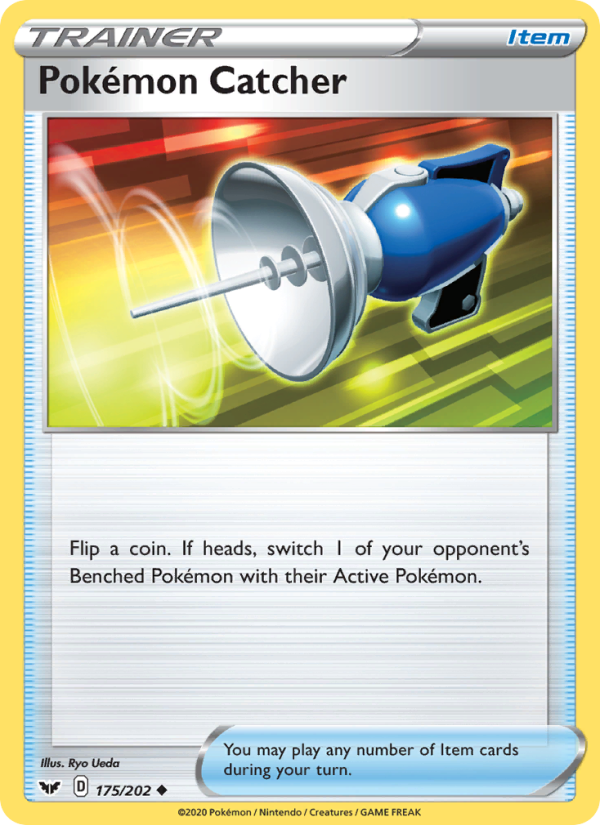
Image courtesy of TCGdex.net
In the fast-paced world of the Pokémon TCG, a single Trainer card can swing momentum as decisively as a well-timed attack. Pokémon Catcher, a Sword & Shield era Item Trainer illustrated by Ryo Ueda, embodies that idea with a simple but spicy coin flip: if heads, you switch one of your opponent’s Benched Pokémon with their Active Pokémon. That moment, a flip of fate, is exactly the kind of disruption that stadium cards are designed to amplify. When you’re pairing Catcher with a stadium, you’re not just playing cards—you’re drafting tempo, control, and psychological pressure into your entire match. ⚡🔥
Understanding the Catcher-stadium dynamic
Pokémon Catcher is a mid-range disruption tool. It doesn’t generate extra damage or draw cards, but it creates a situation your opponent must respond to immediately: which bench Pokémon will you reintroduce into the active slot, and how will you recalibrate your setup on the next turn? Stadium cards—which stay in play on both sides of the field and can alter the rules of engagement—let you shape that response. Think of Catcher as a catalyst; stadiums provide the environment that magnifies its impact. When you listen to the pace of the game and plan around that coin flip, you can force opponents into awkward bench choices just as you pivot to your win condition. 🎴🎨
In Expanded format, Catcher remains a versatile piece because it thrives on decks that want to push for precise bench exchanges rather than brute-force pressure. Data notes show that Catcher sits in the Sword & Shield swsh1 catalog, with the set officially featuring 202 official cards and 216 total in its block. The card itself is Uncommon, illustrated by Ryo Ueda, and its legal status is Expanded-only (standard format currently does not include it). That means players who enjoy rotating through a broader trainer ecosystem can craft longer tempo games that hinge on pivotal bench moves. The card’s market presence, as recorded in CardMarket pricing, sits modestly around €0.02–€0.05 for non-holo copies, with holo versions often carrying a small premium (~€0.42 on average). Small price, big impact if you read the moment correctly. 💎
Stadium archetypes that pair well with Catcher
When selecting stadiums to pair with Pokémon Catcher, look for effects that either restrict the opponent’s bench options, hasten your own setup, or disrupt their ability to rebound after a bench swap. Here are five archetypes to consider, described in practical terms and with how they synergize with a Catcher-driven plan:
- Bench-control stadiums: Stadiums that tamp down the opponent’s bench growth or complicate their bench transitions make Catcher flips more punishing. If your opponent is trying to rapidly redeploy Bench Pokémon or fill their Active slot with a favorable type matchup, a stadium that curtails those moves lets your Catcher coin flip land with greater certainty. The result? You force suboptimal active choices and pave the way for your attacker to shine on the following turns. ⚡
- Ability-suppressing stadiums: Some stadiums dampen or temporarily shut off Abilities that could power up the opponent’s Bench or Re-Entrant attackers. Against decks that rely on Ability-driven lines, a stadium that reduces those options makes each Catcher swing more consequential, since your opponent can’t lean on a flexible ability to recover after a bench swap. This creates a choked tempo where your Catcher becomes the control lever. 🎨
- Speed-boosting or draw-friendly stadiums: Stadiums that accelerate draw or search for your own Trainer lineup help you chain Catcher plays more consistently. With an additional way to fetch needed Trainers or support cards, you can set up a multi-turn Catcher plan that keeps swapping and reshaping the board—keeping your opponent guessing and your engine humming. 🎮
- Prizes and tempo shifters: Some stadiums subtly manipulate prize pressure or the timing of when you can access key resources. When Catcher trades force your opponent to exchange a bench Pokémon, a stadium that superficially nudges the prize race or the tempo of exchanges can tilt late-game decisions in your favor, turning a coin-flip risk into a predictable sequence. 💎
- Resource-recycling stadiums: Look for stadiums that help you recycle or protect crucial trainer lines, so you can keep feeding Catcher into the game with minimal draw or search friction. The extra stability lets you press the initiative rather than chasing cards, letting you press the advantage after a successful bench swap. 🎴
Practical build tips for Catcher + stadiums
- Timing is everything. Use Catcher to swap an inconvenient Benched Pokémon into the Active slot when you’re ready to pivot your attacker—ideally right after you’ve established a bench buffer or two that makes the swap predictable for you, not your opponent. The stadium’s effect can then reinforce that timing, either by restricting opponent benching or by accelerating your own engine. ⚡
- Balance your bench. Since Catcher targets the opponent’s Benched Pokémon, ensure your own bench stays healthy and diversified. A stadium that aids your bench development without giving your opponent an easy reset keeps the pressure on and reduces risky late-game coin-flips. 🔥
- Format-aware choices. In Expanded play, where Catcher is legal, align your stadium strategy with the broader trainer and energy support you’re using. The synergy isn’t about a single card—it’s about crafting a tempo that makes your opponent think twice before benching a critical threat. 🎴
- Illustration and flavor matter. Pokémon Catcher bears the signature art of Ryo Ueda, adding that unmistakable Sword & Shield era charm to your deck. If you’re a collector as well as a player, the Uncommon status and the market data point to a neat, budget-friendly pick with room to grow in your binder. 🖼️
Market and collector notes
For players watching value, Catcher’s extended format viability and its Uncommon rarity make it a smart add for Expanded-focused decks. The card’s price trajectory on CardMarket and similar trackers suggests a small but stable demand, with holo variants commanding a modest premium. As a card that frequently makes or breaks bench dynamics, Catcher remains a tactical staple rather than a flashy at-a-glance pick. Collectors may appreciate the Ryo Ueda illustration and the card’s place in the Sword & Shield era, while competitive players will value its ability to shift momentum in a single turn. 💎
Pairing Catcher with the right stadiums is less about chasing a single “best” card and more about building a cohesive tempo plan. If you enjoy decks that want to apply pressure in the midgame, don’t shy away from stadium choices that empower maintains of bench control and allow you to press your coin-flip advantage with confidence. The result is a smarter, tighter game—where a single flip can redefine the board state and tilt the game in your favor. 🎮
Ready to add a bit of flair to your setup? Check out the product link below and consider how a new stadium might fit into your Catcher-driven strategy. And as always, keep an eye on your local format rules, because the best synergy is the one that sticks in your next match. ⚡
Custom Gaming Neoprene Mouse Pad 9x7 stitched edges
More from our network
- https://blog.zero-static.xyz/blog/post/how-gossips-talent-art-fits-its-sets-visual-identity/
- https://blog.crypto-articles.xyz/blog/post/nft-data-nuddies-1814-from-nuddies-collection-on-magiceden/
- https://blog.digital-vault.xyz/blog/post/blue-giant-shines-from-80000-light-years-away/
- https://blog.crypto-articles.xyz/blog/post/nft-data-klout-genesis-hashtag-2052-from-klout-genesis-hashtags-collection-on-magiceden/
- https://cryptoacolytes.zero-static.xyz/edced741.html
Pokémon Catcher
Set: Sword & Shield | Card ID: swsh1-175
Card Overview
- Category: Trainer
- HP:
- Type:
- Stage:
- Dex ID:
- Rarity: Uncommon
- Regulation Mark: D
- Retreat Cost:
- Legal (Standard): No
- Legal (Expanded): Yes
Description
Pricing (Cardmarket)
- Average: €0.05
- Low: €0.02
- Trend: €0.05
- 7-Day Avg: €0.06
- 30-Day Avg: €0.06
Support Our Decentralized Network
Donate 💠More from our network
- https://blog.zero-static.xyz/blog/post/how-gossips-talent-art-fits-its-sets-visual-identity/
- https://blog.crypto-articles.xyz/blog/post/nft-data-nuddies-1814-from-nuddies-collection-on-magiceden/
- https://blog.digital-vault.xyz/blog/post/blue-giant-shines-from-80000-light-years-away/
- https://blog.crypto-articles.xyz/blog/post/nft-data-klout-genesis-hashtag-2052-from-klout-genesis-hashtags-collection-on-magiceden/
- https://cryptoacolytes.zero-static.xyz/edced741.html