
Image courtesy of TCGdex.net
Bewear Card Art: How game references appear in Pokémon TCG visuals
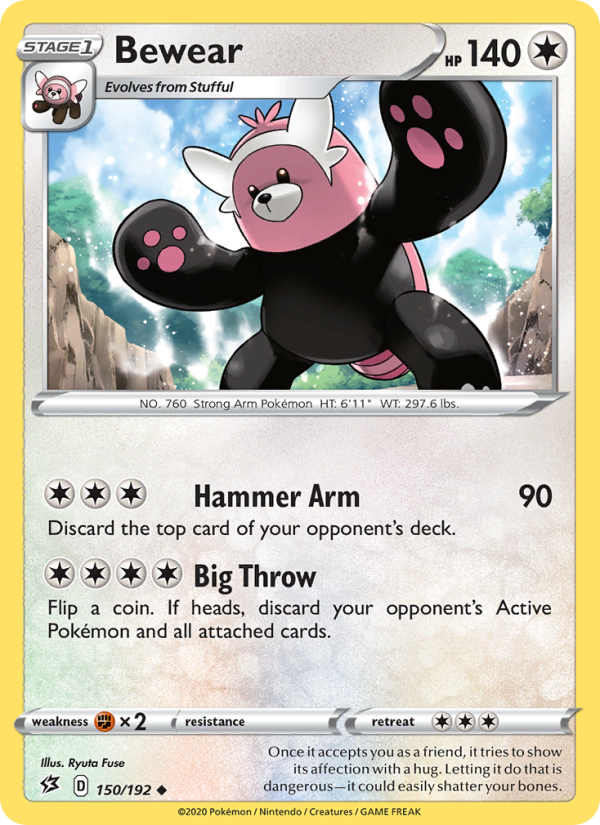
In the Rebel Clash era, the Pokémon TCG explored not just battles on the table, but the stories those battles tell. The swsh2-150 Bewear, illustrated by Ryuta Fuse, is a standout case where the artwork and card data collide to echo gameplay mechanics in a single, memorable image. As an Uncommon Colorless Stage1 Pokémon with a sturdy 140 HP, Bewear is more than a bruiser in the deck—it’s a narrative cue about how risk, timing, and board state shape the game. The image captures a moment of raw momentum, with the cautionary undertone baked into Bewear’s lore: “Once it accepts you as a friend, it tries to show its affection with a hug. Letting it do that is dangerous—it could easily shatter your bones.” That tension mirrors the TCG’s own tension between offense and control. ⚡🔥
From a collector’s perspective, the art’s composition leans into the evolution arc: Bewear evolves from Stufful, and the artwork highlights the moment where the cute, lumbering bear becomes a strategic threat on the battlefield. Fuse’s portrayal blends warmth with power, a duality that reflects the card’s role in gameplay—friendly in concept, formidable in action. The color palette and line work evoke a sense of impending impact, which perfectly aligns with the two potent attacks in its moveset. The card’s narrative voice is clear: growth comes with complexity, and with complexity comes the potential to swing a game in a single decisive moment. 🎨🎮
What the card’s data tells us about its in-game identity
- Set and rarity: Rebel Clash, Uncommon. This placement inside the set signals a balance of power and accessibility—especially for players who want a solid midgame attacker without breaking the bank on pricier staples.
- Type and evolution: Colorless, Stage1, evolving from Stufful. The evolutionary line underscores a typical midgame tempo: Stufful can set up, but Bewear brings more punch and resilience as a bigger threat on a single target.
- Hit points and resilience: 140 HP provides staying power, allowing Bewear to weather trades and pressure opponents into suboptimal plays as the game unfolds.
- Attacks and how they reference the meta:
- Hammer Arm — Cost: Colorless x3; Damage: 90; Effect: Discard the top card of your opponent’s deck. This is a classic deck-disruption tool in the TCG, nudging opponents toward fatigue and forcing them to adjust their draw strategy mid-match.
- Big Throw — Cost: Colorless x4; Effect: Flip a coin. If heads, discard your opponent’s Active Pokémon and all attached cards. This high-variance swing captures the high-risk, high-reward mentality players chase in the broader game: buy a tempo swing now, risk losing a key resource later.
- Weakness and retreat: Fighting ×2 weakness makes Bewear a natural counter to many fighting-themed decks in the era, while a retreat cost of 3 invites a thoughtful approach to tempo and resource management mid‑game.
- Regulation and legality: Regulation Mark D; legal in Expanded. For collectors and competitive players, this anchors Bewear within a broader, ongoing dynamic of format balance and reprints—an important factor when evaluating long-term value and playability.
In the artwork’s spirit, the document’s flavor text and the card’s mechanical identity align to create a unified feel: a hug that can shift the game’s momentum, a reminder that every action has a consequence, and a celebration of the deck-building discipline that keeps players coming back for more. This synthesis—art that reflects play—has long been a hallmark of Ryuta Fuse’s work, and Bewear is a textbook example of how a single card can echo multiple layers of the Pokémon TCG universe. 💎🎴
“A friend who hugs too hard can change the board.” It’s a concise line that captures the dual nature of Bewear’s presence: comforting at first, crushing in practice.
Strategy and deck-building vibes: turning art into play
For players, Bewear’s two attacks are a study in tempo and resource management. Hammer Arm’s three-colourless cost is a clear call to a multi-attack rhythm—invest three energy to set up a disruptive effect, then push for advantage as your opponent’s deck thins. Because you discard from the top of your foe’s deck, you’re not just dealing damage; you’re shaping the opponent’s draws, which can slow their plan and open windows for coordinated hits. That makes Bewear an intriguing choice in decks that want a reliable, midrange behemoth with a proactive ability to impact the opponent’s resources.
Big Throw, with its four-energy cost, demands careful planning and likelihood assessment. The coin flip introduces a dramatic edge—if you flip heads, you turn the game’s momentum in a single moment by removing the opponent’s Active Pokémon and attached tools. It’s the kind of move that makes opponents weigh risk-reward in real-time and teaches newer players the importance of board state management and probabilistic thinking. Used with proper support—draw engines, disruption tools, and a methodical retreat plan—Bewear can pressure opponents into suboptimal plays, setting up finishers for a later turn or turn two of a two-turn combo. ⚡🔥
From a collector’s perspective, Bewear’s Stage1 lineage and its Rebel Clash era place it in an interesting slot for price and availability. The card’s pricing data in the secondary market show a broad spectrum: non-holo copies tend to be affordable, with low prices near a few cents to a few tenths of a dollar and mid prices often around a few tenths to a dollar; holo variants, where applicable, run higher but still remain accessible for curious collectors. This makes Bewear a nice entry point for players who want a bigger, more impactful card without the premium of the most sought-after staples. For those cataloging sets, its unassuming charm and the art’s narrative ties give it a memorable presence on a binder page. In market terms, the normal print sits around a low to mid price in the single-digit cents to around a dollar range, while the holo counterparts tend to track a touch higher. The data points reflect a card that’s both playable in the Expanded format and approachable for collectors chasing Rebel Clash relics. 💎🎮
Of course, the artist’s touch matters as well. Ryuta Fuse’s approach to Bewear captures the warmth of a guardian figure while hinting at the power that lies just beneath the surface. The composition respects the dynamics of Pokémon battles—how a single hug can become a turning point when the field is set just right. It’s a reminder that in the TCG, the most memorable moments often come from the blend of theme, artwork, and strategy working in harmony. 🎨
Collector’s notes: pricing, rarity, and expansion value
Bewear’s Uncommon rarity places it in that sweet spot for players who want a sturdy card without paying premium collector-tier prices. In the secondary market, non-holo copies typically sit at low price points (often under a dollar in many listings), with mid prices hovering around modest amounts and outliers pushing toward the higher end of the spectrum when supply is thin or demand spikes. For holo counterparts, if you’re chasing them specifically, expect the price tier to be higher, but still accessible for a single-utility card from a beloved set. The Rebel Clash era also carried a broader ecosystem of cards that players mix and match with Bewear, making it a practical addition to Expanded-focused decks and a nostalgic pick for fans who remember the set’s bold aesthetic. ⚡💎
If you’re curating a Bewear-focused sub-theme—perhaps alongside Stufful or other Bear-related Pokémon—the card’s story, art, and gameplay implications create a strong through-line that resonates with fans who love the lore of evolving friends and the consequences of a heavy-handed embrace in battle. The synergy between the artwork’s narrative and the card’s mechanics makes it a fine candidate for a themed binder page or a playful display in a sleeve collection that celebrates the intersection of art and play. 🎴🎨
Neon Phone Case with Card Holder (MagSafe-compatible) – Glossy MatteMore from our network
- https://blog.crypto-articles.xyz/blog/post/nft-data-bmb-community-season-5-4778-from-bmb-community-airdrop-season-5-collection-on-magiceden/
- https://blog.crypto-articles.xyz/blog/post/garbodor-timing-your-plays-for-maximum-damage-in-the-meta/
- https://wiki.digital-vault.xyz/wiki/wiki/post/pokemon-tcg-stats-espathra-card-id-sv07-069/
- https://articles.zero-static.xyz/blog/post/doduo-across-games-and-cards-a-pokemon-tcg-comparison/
- https://crypto-acolytes.xyz/blog/post/nft-stats-geek-2146-from-geeks-collection/
Bewear
Set: Rebel Clash | Card ID: swsh2-150
Card Overview
- Category: Pokemon
- HP: 140
- Type: Colorless
- Stage: Stage1
- Evolves From: Stufful
- Dex ID: 760
- Rarity: Uncommon
- Regulation Mark: D
- Retreat Cost: 3
- Legal (Standard): No
- Legal (Expanded): Yes
Description
Once it accepts you as a friend, it tries to show its affection with a hug. Letting it do that is dangerous—it could easily shatter your bones.
Attacks
| Name | Cost | Damage |
|---|---|---|
| Hammer Arm | Colorless, Colorless, Colorless | 90 |
| Big Throw | Colorless, Colorless, Colorless, Colorless |
Pricing (Cardmarket)
- Average: €0.06
- Low: €0.02
- Trend: €0.06
- 7-Day Avg: €0.06
- 30-Day Avg: €0.05
Support Our Decentralized Network
Donate 💠More from our network
- https://blog.crypto-articles.xyz/blog/post/nft-data-bmb-community-season-5-4778-from-bmb-community-airdrop-season-5-collection-on-magiceden/
- https://blog.crypto-articles.xyz/blog/post/garbodor-timing-your-plays-for-maximum-damage-in-the-meta/
- https://wiki.digital-vault.xyz/wiki/post/pokemon-tcg-stats-espathra-card-id-sv07-069/
- https://articles.zero-static.xyz/blog/post/doduo-across-games-and-cards-a-pokemon-tcg-comparison/
- https://crypto-acolytes.xyz/blog/post/nft-stats-geek-2146-from-geeks-collection/