
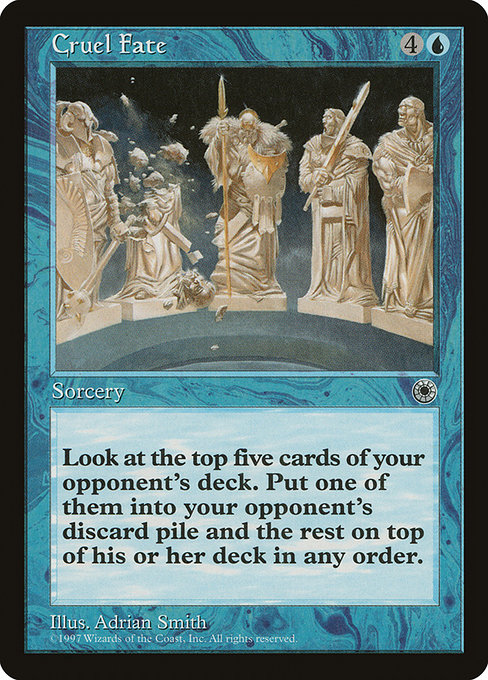
Image courtesy of Scryfall.com
Graveyard Recursion in Portal-era Blue: A Strategic Look at Cruel Fate
Blue has always loved to bend the flow of information, timing, and chance. When you combine a precise library manipulation like Cruel Fate with graveyard recursion, you’re playing a long game of chess where every move reshapes the opponent’s next draw and buys you valuable tempo. This rare Portal-era sorcery, with the cost of {4}{U} and its clean blue aura, asks you to peek at the top five of your opponent’s library, pick one to send to their graveyard, and place the rest back on top in any order. It’s an elegant, cerebral tool that shines in decks built around controlling access to resources and capitalizing on that control with repeatable recursion. 🧙♂️🔥💎
What Cruel Fate actually does for you
Look at the top five cards of target opponent's library. Put one of those cards into that player's graveyard and the rest on top of their library in any order.
That single sentence hides a surprisingly versatile engine. You’re not just discarding a card; you’re orchestrating a disruption plan. By selecting which card to push into their graveyard, you can accelerate threats they hoped to draw later or plant a blocker they’ll need to rely on. By arranging the rest on top in any order, you shepherd their next draws—setting up win conditions on your terms or, at the very least, slowing their momentum. And because the effect is purely library-based, you’re not burning creatures or resources you might need later in the game. It’s quiet, precise control with blue’s signature cool confidence. 🧊🎯
Graveyard recursion: turning a one-off into a repeatable rhythm
The real magic happens when you weave Cruel Fate into a deck built for graveyard recursion. In blue-dominant strategies, you’ll look for engines—whether modern or retro—that let you replay key spells from your own graveyard. Think of cards that return instant or sorcery cards to your hand or directly to the stack, or effects that recycle cards from the graveyard back into play. The appeal is simple: Cruel Fate invites you to reuse your own library manipulation, bounce, and draw-disruption tools over and over, turning a single strong play into a recurring tempo threat. 🧙♂️🎲
- Recursion engines pick your preferred blue staples—things that fetch back an instant or sorcery from your graveyard to your hand or to the top of your library. In modern formats, this might be Mnemonic Wall or Archaeomancer-type recursion; in a Portal-leaning context, you can imagine analogous effects that return casting-ready spells for another run.
- Counter-magic and protection keep Cruel Fate safe as you assemble your loop. If you’re steering into a control shell, you’ll want built-in draw and card selection, plus a way to counter or disrupt opposing answers to your strategy.
- Deck-thinning and card selection want you to hit Cruel Fate reliably. Blue’s depth of card draw and filtering helps you find it when you need it, so that every cast becomes a repeatable setup for the next turn’s chess move.
- Deck architecture should emphasize ordering and manipulation. Because Cruel Fate only affects your opponent’s top decks, your own graveyard can be a rich resource for recasting the recursion engine itself or for fueling draw spells that keep your hand full while you assemble the plan.
There’s also a storytelling element to this approach. Cruel Fate is a window into the era’s design philosophy: a single spell that teases “what if” scenarios—what if you could choose which card your opponent will draw next, or which card slides into their graveyard to linger there? It’s a design that invites both strategic depth and a touch of nostalgia for the days when a portal-themed starter set could still punch above its weight in a casual or commander table. And let’s be honest: blue’s calm, calculating vibe is perfect for a moment when you glimpse an opponent’s next lines and calmly decide the best place to set them up. 🧩⚔️
Practical tips for building around Cruel Fate
When you’re sketching a deck that leans into this approach, you want three pillars: library control (to maximize what you see each turn), graveyard recursion (to reuse your best spells), and protection (to keep Cruel Fate and your engines alive). Here are a few practical angles to consider:
- Cast Cruel Fate at a moment when your opponent’s draws are most threatening—before a big answer, or when they’re about to topdeck a crucial threat. The moment you glimpse their top five, you can steer their fate with precision. 🧙♂️
- Pair with draw-disruption tools that also enable you to dig for Cruel Fate or the recursion pieces you need. Blue’s draw suite can help you find the exact sequence you want, turning a risky gambit into a reliable setup.
- Include a few “recovery” spells that let you reuse Cruel Fate or its supporting engines from your graveyard. In a modern context, you might turn to classic blue recursion or reuse tricks; in Portal’s relative simplicity, you’d lean on any card that returns sorceries to your hand or grants another casting opportunity.
- Mind the timing: Cruel Fate’s value grows as the game evolves. Early, it’s a diagnostic tool; mid- to late-game, it can lock in a strategic edge by shaping draws and trimming the edges of the opponent’s deck.
Finally, there’s the art and the era to savor. Adrian Smith’s illustration for Cruel Fate captures that cool, arcane blue glow that feels almost like an invitation to a quiet duel of wates and wiles. The Portal set, a starter-era release, is a reminder that some of the most enduring MTG concepts can emerge from the most accessible palettes. The rarity—rare—also hints at the card’s potential to surprise and reward patient players who read the play lines as they unfold. 🎨🧊
If you’re looking for a tangible way to weave this into a broader strategy, the art and the text invite you to treat Cruel Fate as a keystone in a blue grimoire—a spell that doesn’t just disrupt but enables a recurring, cerebral rhythm of control and recursion. It’s not the flashiest spell in the book, but it’s exactly the kind of careful, elegant play that makes MTG so rewarding for fans who love the slow-build of strategy and the thrill of turning the page on an opponent’s plan. 🔥💎
More from our network
- https://crypto-acolytes.xyz/blog/post/nft-stats-xp-3-from-xp-collection/
- https://crypto-acolytes.xyz/blog/post/nft-stats-lebanon-momint-2-from-momints-collection/
- https://blog.crypto-articles.xyz/blog/post/nft-data-gamba-dog-9785-from-gamba-dogs-collection-on-magiceden/
- https://wiki.digital-vault.xyz/wiki/post/pokemon-tcg-stats-relic-hunter-card-id-ecard3-120/
- https://crypto-acolytes.xyz/blog/post/nft-stats-boom_1-139-from-branches-of-our-mind_1-collection/
Cruel Fate
Look at the top five cards of target opponent's library. Put one of those cards into that player's graveyard and the rest on top of their library in any order.
ID: 44bea0d4-946e-4cb8-b6f1-50231d52bfbe
Oracle ID: e199e183-e857-4dc7-87f4-36b32c4dac96
Multiverse IDs: 4257
TCGPlayer ID: 645
Cardmarket ID: 10036
Colors: U
Color Identity: U
Keywords:
Rarity: Rare
Released: 1997-05-01
Artist: Adrian Smith
Frame: 1997
Border: black
EDHRec Rank: 28646
Set: Portal (por)
Collector #: 50
Legalities
- Standard — not_legal
- Future — not_legal
- Historic — not_legal
- Timeless — not_legal
- Gladiator — not_legal
- Pioneer — not_legal
- Modern — not_legal
- Legacy — legal
- Pauper — not_legal
- Vintage — legal
- Penny — not_legal
- Commander — legal
- Oathbreaker — legal
- Standardbrawl — not_legal
- Brawl — not_legal
- Alchemy — not_legal
- Paupercommander — not_legal
- Duel — legal
- Oldschool — not_legal
- Premodern — not_legal
- Predh — legal
Prices
- USD: 0.82
- EUR: 1.79
More from our network
- https://crypto-acolytes.xyz/blog/post/nft-stats-whale-4258-from-entropy-acolytes-collection/
- https://blog.crypto-articles.xyz/blog/post/solana-meme-coin-gains-momentum-against-peers/
- https://blog.crypto-articles.xyz/blog/post/nft-data-slyfella-1326-from-slyfella-collection-on-magiceden/
- https://crypto-acolytes.xyz/blog/post/nft-stats-planet-kaiju-3905-from-planet-kaiju-collection/
- https://blog.crypto-articles.xyz/blog/post/nft-data-bbc-1517-from-battle-bros-club-collection-on-magiceden/