
Image courtesy of TCGdex.net
Dialga and the Rotation Question: What Set Cycles Mean for Investment Potential
Pokémon TCG collectors and players alike know that set rotation isn’t just about which cards can show up in a deck this season. It’s a fundamental force that reshapes demand, price trajectories, and the long-term value of old favorites. When a card is tied to a legacy expansion, its fate often follows a two-step dance: a dramatic shift in playability as formats update, followed by a steadier climb in the eyes of collectors who prize rarity, nostalgia, and exquisite art. Dialga from the Great Encounters era—DP4-16, illustrated by Daisuke Ito—offers a nuanced case study in how rotation shapes investment potential, even when a card isn’t legal in Standard or Expanded play today.
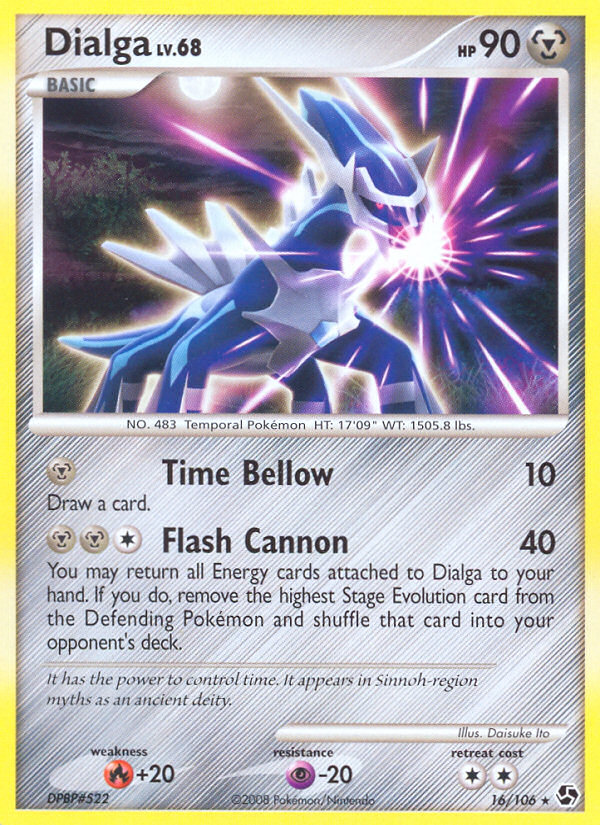
First, a quick snapshot of the card itself. Dialga is a Basic Metal-type Pokémon with 90 HP, a Rare rarity in the Great Encounters set. Its attacks tell a story of tempo and control: Time Bellow costs a Metal energy and simply draws a card, offering a modest early-game edge in resource flow. Flash Cannon costs Metal, Metal, and Colorless and delivers 40 damage, but with a dramatic secondary effect: you may return all Energy attached to Dialga to your hand, and, if you do, remove the highest Stage Evolution card from the Defending Pokémon and shuffle that card into your opponent’s deck. That line reads like a relic of early DP-era design—strong tempo, with a big strategic swing that could punish overzealous evolutions. The card’s weakness to Fire (+20) and a Psychic resistance (-20) round out a balanced but purposeful package. Dialga’s holo cosmos variant, plus platinum-stamped variants, add layers of collectibility that aren’t just about on-table power.
From a rotation perspective, this is where the conversation gets interesting. Great Encounters sits deep in the pre-Sun & Moon era, and its cards are not legal in Standard or Expanded formats today. In the current official environment, DP4-16 sits firmly in the “not playable” bucket for tournament players. That fact alone would typically depress near-term demand from deck builders. However, rotation also creates a kind of scarcity premium that many investors chase: the older a card is, the more it often serves as a tangible slice of Pokémon history. Dialga’s rarity, combined with its distinctive holo and platinum variants, makes it a magnet for collectors who want emblematic pieces from the Diamond & Pearl era. The result is a multi-layered investment profile where playability is sidelined in favor of long-tail value, condition sensitivity, and relative scarcity.
Price data from contemporary markets provides a useful compass. Non-holo Dialga dp4-16 copies hover in a relatively affordable range, with CardMarket showing average prices around a few euros and TCGPlayer indicating a broader spread—roughly in the low-dollar to mid-dollar range for common print runs, with higher values for holo or reverse-holo variants. In practical terms, a typical, well-preserved copy might settle around the $1–$3 mark in modern markets, while holo versions—especially those with the cosmos foil treatment—can trend higher, and reverse-holo copies often fetch a premium compared to their standard counterparts. This price dynamic aligns with rotation-driven demand: the card remains accessible for collectors who admire the era’s art and design, while scarcity and variant desirability can lift the ceiling for pristine copies. It’s a gentle arc rather than a rocket, but it’s real—and it’s precisely what many investors chase when they diversify beyond current-rotation staples. ⚡
Another crucial axis is variant availability and condition. The dp4 set yielded multiple evolutions in its print history, including normal, reverse, holo, and even a platinum-stamped version in some print runs. The holo cosmos variant, in particular, is a visual standout with shimmering foil that captures the imagination of fans who love the era’s distinctive aesthetics. For investors, this means focusing on the right tiers of rarity can yield more meaningful upside than chasing the most common print run. It also means that grading becomes a meaningful factor: a high-grade holo cosmos or platinum-stamped copy can outperform a mid-grade regular print in resale value. In practice, collectors often reward careful preservation, accurate grading, and provenance when a set’s rotation has cooled active play but heated collector interest. 🎴💎
Strategy for Navigating Rotation as an Investment Tool
- Distinguish between playability and collectibility. Dialga’s dp4-16 is not a standard-legal powerhouse today, but its place in Pokémon history is secure. Investors should separate the deck-building utility from the card’s long-term desirability as a collectible piece.
- Prioritize holo and variant rarity. The cosmos holo and platinum-stamped prints offer stronger upside in non-rotating formats where scarcity and aesthetics drive demand. Keep an eye on mint-condition copies and graded examples to maximize potential appreciation.
- Track market signals across platforms. CardMarket and TCGPlayer data show how sentiment shifts over time. A stagnant price on a common print may still hide value in a limited-availability holo variant. Diversification across variants can mitigate risk in a rotation-heavy market.
- Consider the art and lore. Dialga’s distinctive design by Daisuke Ito and its place in Great Encounters evoke nostalgia that transcends gameplay. When rotation cools demand for power in decks, it often amplifies the collector’s appetite for iconic art and beloved characters.
- Watch for reprint shadows and anniversary releases. While not guaranteed, reprints or special editions can compress or enhance value depending on how they reframe a card’s rarity and accessibility. Rotation timing matters—buying near a new set release can present leverage for longer-term growth, or it can compress margins if new prints flood the market.
For the patient investor, Dialga dp4-16 exemplifies a thoughtful balance: a rare older card with strong art, meaningful variance, and a price floor that remains accessible for newcomers to the hobby, while offering potential upside for seasoned collectors who chase pristine holo copies. The card’s built-in weaknesses and energy-centric attack design also remind us that not every collectible gains value from playability; some gain value from mood, memory, and mastery of a generation’s aesthetic. The Great Encounters era, after all, is a doorway to a time when the TCG universe was expanding in bold, experimental ways—and Dialga stands as a proud beacon of that era. 🔥🎨
As you consider adding Dialga dp4-16 to an investment portfolio, keep the rotation timeline in mind. Cards from eras that no longer revolve through Standard are less about current tournament viability and more about the story you want to tell with your collection—how it captures a moment in the game’s evolving tapestry and how it ages as a collectible artifact. The engines of rotation may move on, but the glow of Dialga’s art, the memory of its clever attacks, and the charm of its variants continue to resonate with fans and collectors alike. ⚡🎴
Interested in a practical buy? Check out the product linked below to see a sleek, modern accessory that fits any desk or play space while you plan your next collection move:
Rectangular Gaming Neon Mouse Pad (1.58mm Thick)More from our network
- https://transparent-paper.shop/blog/post/stable-diffusion-xl-prompt-sci-fi-pulp-jade-and-navy-cybernetic-lotus-neon-glow-vintage-magazine-cover-ornate-engravings/
- https://crypto-acolytes.xyz/blog/post/nft-stats-tardio-1947-from-tardio-collection/
- https://crypto-acolytes.xyz/blog/post/lnl-1666-long-neck-legends-nft-stats/
- https://wiki.digital-vault.xyz/wiki/post/pokemon-tcg-stats-vulpix-card-id-a4-025/
- https://blog.crypto-articles.xyz/blog/post/explores-seasonal-pricing-fluctuations-for-bouffalant-pokemon-tcg-cards/
Dialga
Set: Great Encounters | Card ID: dp4-16
Card Overview
- Category: Pokemon
- HP: 90
- Type: Metal
- Stage: Basic
- Dex ID: 483
- Rarity: Rare
- Regulation Mark: —
- Retreat Cost: 2
- Legal (Standard): No
- Legal (Expanded): No
Description
Attacks
| Name | Cost | Damage |
|---|---|---|
| Time Bellow | Metal | 10 |
| Flash Cannon | Metal, Metal, Colorless | 40 |
Pricing (Cardmarket)
- Average: €2.07
- Low: €0.15
- Trend: €2.23
- 7-Day Avg: €2.37
- 30-Day Avg: €1.7
Support Our Decentralized Network
Donate 💠More from our network
- https://transparent-paper.shop/blog/post/stable-diffusion-xl-prompt-sci-fi-pulp-jade-and-navy-cybernetic-lotus-neon-glow-vintage-magazine-cover-ornate-engravings/
- https://crypto-acolytes.xyz/blog/post/nft-stats-tardio-1947-from-tardio-collection/
- https://crypto-acolytes.xyz/blog/post/lnl-1666-long-neck-legends-nft-stats/
- https://wiki.digital-vault.xyz/wiki/post/pokemon-tcg-stats-vulpix-card-id-a4-025/
- https://blog.crypto-articles.xyz/blog/post/explores-seasonal-pricing-fluctuations-for-bouffalant-pokemon-tcg-cards/