
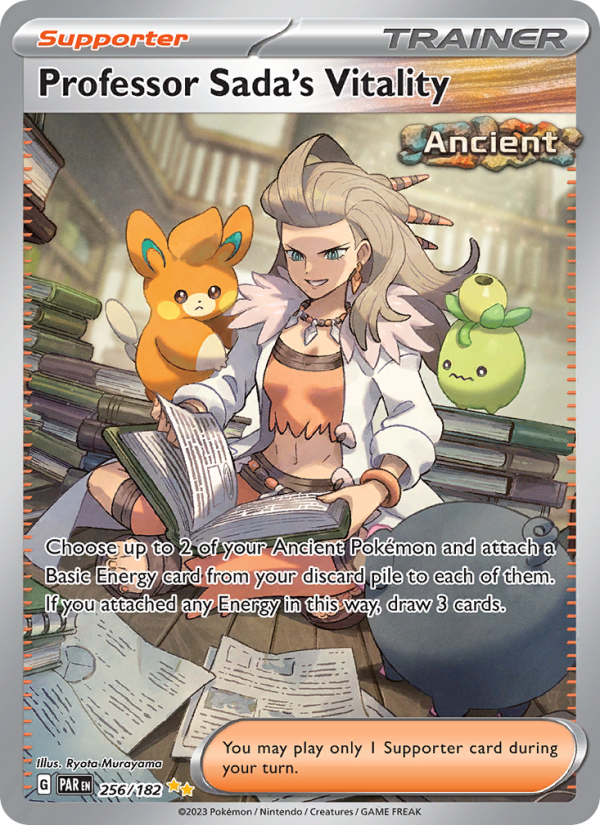
Image courtesy of TCGdex.net
Evolution of Pokémon Card Design Through Sada's Vitality
In the ever-expanding tapestry of the Pokémon TCG, card design often travels hand in hand with how players approach the game. Professor Sada's Vitality, a Special Illustration Rare Trainer card illustrated by Ryota Murayama, sits at a crossroads of aesthetics and functionality within the Paradox Rift set (SV04). Its presence signals a shift toward more purposeful, art-forward trainer cards that reward not just what you play, but how you visualize your strategy unfolding on the table. ⚡🔥
Design milestones in Trainer cards
Trainer cards have long guided the tempo of a match, evolving from plain text boxes to showcases of narrative and arc. Early trainer cards prioritized clarity—energy costs, effects, and conditions were laid out in a way that any player could parse quickly. As sets grew, art teams experimented with full-art layouts, alternating frame treatments, and, in rarer cases, illustrated cards that doubled as collectible artworks. Special Illustration Rare (SIR) cards, like Sada's Vitality, push this evolution further by centering a single, distinctive piece of art that becomes a talking point for collectors and a beacon for deck builders alike. The Paradox Rift era embraces this trend, pairing Murayama’s evocative artwork with a gameplay mechanic that feels modern and forgiving enough for new players while still offering depth to veterans. 🎴🎨
What helps Sada’s Vitality stand out is not just its rarity, but how the card’s design communicates its function. The holo treatment, the crisp white text box, and the set symbol for Paradox Rift all work in harmony to ensure the card remains legible at a glance, even when the match is heating up. In contemporary design language, this balance—art that captivates without sacrificing readability—has become a guiding principle for trainer cards across formats. The G regulation mark places it squarely in both Standard and Expanded play, underscoring its broad relevance in a dynamic meta. 💎
Key design elements on this card
- Rarity and illustration: Special Illustration Rare denotes unique artwork and typically a holo finish. The credit goes to Ryota Murayama, whose dynamic lines bring a sense of motion and intellect to Professor Sada’s Vitality.
- Set identity: SV04, Paradox Rift, carries its own symbol and color language that fans instantly recognize. The holo treatment and the vivid palette reinforce the sense that this card belongs to a distinct era of the game’s narrative. 🔮
- Card type and function: Classified as a Trainer – Supporter, the card’s effect centers on Ancient Pokémon. The design clearly separates function from flavor: the ability text is concise, but the implications for tempo and hand refresh are substantial.
- Flavor and lore alignment: The character of Professor Sada—whose research themes mirror energy, vitality, and discovery—pairs thematically with a card that accelerates energy from the discard pile and rewards card draw. The art and name tie into a broader story arc, making the card feel like a chapter in the Paradox Rift saga. 🔬
- Typography and layout: The effect text uses clean typography and line breaks that maintain readability even when the card is in the middle of a crowded play area. This is crucial when players scan for interactions like “attach a Basic Energy from discard to each of them” and “draw 3 cards.”
Gameplay strategy: how design supports playability
Design decisions on Sada's Vitality directly support a tempo-forward strategy that rewards careful planning. The ability to attach Basic Energy from the discard pile to up to two Ancient Pokémon is a potent way to jump-start energy acceleration, especially in decks built around Ancient Pokémon that require specific energy types. The conditional draw—“If you attached any Energy in this way, draw 3 cards”—provides a measured but meaningful reward for committing to the engine that the card enables. This embodies a core principle of modern TCG design: the reward for resourceful play should feel tangible without creating oppressive power spikes.
From a deck-building perspective, Sada's Vitality invites multi-target energy distribution. You can sequence plays that set up two Ancient Pokémon to accelerate two different lines of attack, or you can pivot mid-game if one line stalls. The trainer’s Remind-Mechanic feel—rewarding a well-timed energy attachment with card draw—also helps balance risk: you’re invested in your discard pile and your board state, but the payoff comes in the form of more options on the next turn. For players, this translates into a more dynamic, less linear decision tree. 🧭
Collectors and players alike can appreciate how the artful presentation mirrors the strategic flexibility. The card communicates, at a glance, that you’re playing into a layered strategy: identify your Ancient Pokémon targets, manage your energy resources, and time the draw to fuel your next sequence. The result is a design that feels both elegant and practical—an emblem of how Pokémon TCG design has evolved to reward thoughtful plays while elevating the visual storytelling of the game. ⚡🎯
Collector insights and market perspective
While Sada's Vitality sits firmly in the Special Illustration Rare category, its market presence is modest but telling. CardMarket shows a broad spread for non-holo copies (averaging around 0.06 EUR with low prices around 0.02 EUR), while holo variants carry a premium—average around 0.32 EUR with recent holo-trend values nudging higher, around 0.42 EUR. This pattern aligns with collector interest in artist-driven, holo-foil trainer cards that celebrate lore and design as much as gameplay. It’s a card that seems approachable for newer collectors while still offering appeal to those chasing the distinctive Murayama artwork in a modern set. 🔎💎
As Paradox Rift expands the timeline of the Pokémon world, cards like Sada's Vitality become touchstones for how the game’s design language communicates both story and strategy. The combination of a strong, actionable effect with an iconic, illustrated treatment makes it a desirable piece for collectors who value both playability and artistry. The card’s position within the SV04 lineup—and its ongoing availability in Standard and Expanded—ensures it remains a relevant reference point for discussions about how trainer design has evolved over time. 🎴
For fans of Ryota Murayama’s work, this card is a standout example of how an illustrator’s signature style can harmonize with game mechanics to create something that resonates beyond a single match. The vitality of the artwork, the clarity of the text, and the strategic potential all come together to tell a story about evolution—one that mirrors the path of the Pokémon TCG from its humble roots to its modern, art-forward era. 🔥
Clear Silicone Phone Case Slim Durable Open Port Design 2More from our network
- https://blog.digital-vault.xyz/blog/post/tower-of-coireall-mana-fixing-for-two-color-decks/
- https://blog.digital-vault.xyz/blog/post/mtg-cut-propulsion-color-palette-and-symbolism-explored/
- https://crypto-acolytes.xyz/blog/post/haxz-1059-haxz-nft-stats/
- https://crypto-acolytes.xyz/blog/post/mifgen3810-mifella-genesis-nft-stats/
- https://blog.rusty-articles.xyz/blog/post/japanese-vs-english-absol-g-card-layouts-a-tcg-comparison/
Professor Sada's Vitality
Set: Paradox Rift | Card ID: sv04-256
Card Overview
- Category: Trainer
- HP:
- Type:
- Stage:
- Dex ID:
- Rarity: Special illustration rare
- Regulation Mark: G
- Retreat Cost:
- Legal (Standard): Yes
- Legal (Expanded): Yes
Description
Pricing (Cardmarket)
- Average: €0.06
- Low: €0.02
- Trend: €0.05
- 7-Day Avg: €0.05
- 30-Day Avg: €0.06
Support Our Decentralized Network
Donate 💠More from our network
- https://blog.digital-vault.xyz/blog/post/tower-of-coireall-mana-fixing-for-two-color-decks/
- https://blog.digital-vault.xyz/blog/post/mtg-cut-propulsion-color-palette-and-symbolism-explored/
- https://crypto-acolytes.xyz/blog/post/haxz-1059-haxz-nft-stats/
- https://crypto-acolytes.xyz/blog/post/mifgen3810-mifella-genesis-nft-stats/
- https://blog.rusty-articles.xyz/blog/post/japanese-vs-english-absol-g-card-layouts-a-tcg-comparison/