
Image courtesy of TCGdex.net
Darkrai and the balance calculus of attack costs
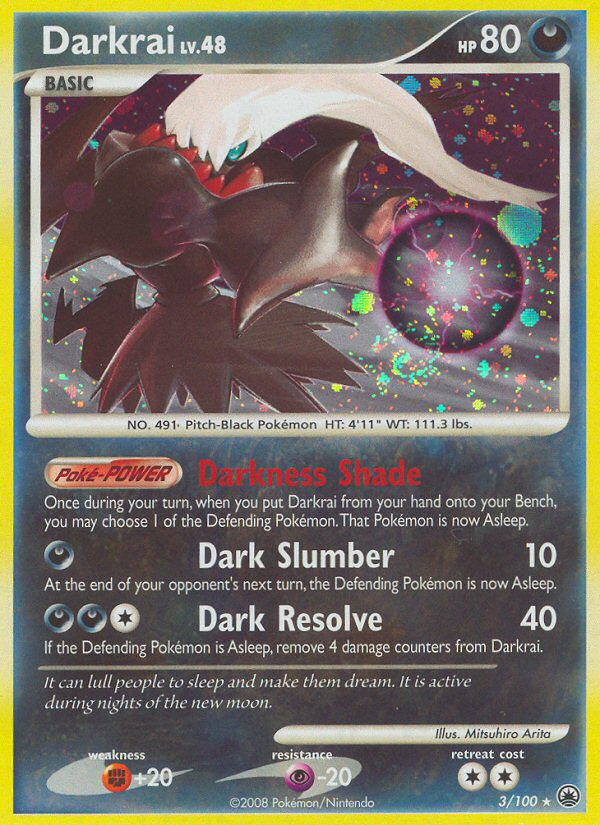
In the Majestic Dawn era, Darkrai dp5-3 stands as a compact lesson in how a Pokémon’s energy costs can shape the tempo of a match. This basic Dark-type with 80 HP appears as a Rare Holo—an aesthetic highlight that underscores a deliberate design choice: give players two paths to pressure their opponent, then tether those paths to a disruptive on-entry ability. Created by the meticulous illustrator Mitsuhiro Arita, this card embodies a snapshot of the era where players weighed risk, timing, and board state as heavy levers of balance. ⚡🔥
To understand the balance, we first look at the card’s raw stats. Darkrai sits at 80 HP, modest by most standards, with a relatively lightweight retreat cost of 2. That means it’s not a brick wall to retreat early but doesn’t telegraph invincibility either. Its typing—Darkness—pairs with a weakness to Fighting (+20) and a resistance to Psychic (-20), a common setup to keep it from running away with too-high a punch in the early game. The real balance engine, though, sits in its two attacks and its signature Poke-Power, Darkness Shade, which can tilt the momentum as soon as Darkrai hits the bench.
Two paths, two costs: understanding the attack ladder ⚡
The first move, Dark Slumber, costs a single Darkness Energy and delivers a modest 10 damage. The real value here isn’t raw numbers; it’s the timing. At the end of your opponent’s next turn, the Defending Pokémon falls asleep. That sleep effect can force your foe to stall, shift resources, or miss a crucial attack, creating space for Darkrai to set up its follow-up. The low cost makes this a tempting entry play—especially in a deck that’s stacking Darkness Energy or leveraging bench-friendly tactics. The balance risk is clear: a 10-damage poke with sleep is not a hard-kill, but it accrues strategic pressure and can pave the way for the bigger payoff on the second attack.
The second option, Dark Resolve, asks for Darkness, Darkness, and Colorless (three energy) to deal 40 damage. The kicker is its interaction with Sleep: if the Defending Pokémon is Asleep, you remove 4 damage counters from Darkrai as part of the effect. In practical terms, that means a strong, tempo-friendly payoff that also provides a tiny bit of survivability as your opponent’s status condition lingers. This dual-cost structure—one quick, low-damage option and a heavier, more costly strike with a healing twist—embodies a core balance idea: make the high-impact move require a commitment, while preserving a safe, cheaper route that can still tilt the game through status control. 🎴
When you pair these attacks with Darkness Shade, the balance becomes more nuanced. This Poke-Power, usable when you put Darkrai from your hand onto your Bench, lets you choose one of the Defending Pokémon to fall Asleep. It’s a powerful setup tool because it lets you orchestrate the timing of Sleep for the opponent’s attacker, potentially aligning it with Dark Slumber’s end-of-turn effect or creating a window for Dark Resolve to land on a sleeping target. The synergy between benching Darkrai to apply Sleep and then leveraging your two-attack ladder creates a tempo engine that rewards careful planning and memory—two hallmarks of well-balanced card design. The design intentionally layers risk and reward: you can stall with Sleep, but you must invest in dark energies and manage your bench to actually land the big hit. 🗝️
Tempo, risk, and the decision tree
From a gameplay perspective, the attack costs force an early commitment to Darkness energies if you want both options available soon. Dark Slumber can pressure the opponent into defensive plays, while Dark Resolve can punish a stalled or damaged foe who is already sleeping. The combination also invites players to calculate when a slow burn becomes a strategic advantage versus when it’s better to push through with the larger 40-damage swing. The balance is further shaped by the card’s vulnerability to Fighting types and its modest HP; those factors keep Darkrai honest on the table, preventing a trivial climb to victory from a single, uncountered sequence.
Collectors will note the foil flair and Mitsuhiro Arita’s artistry, which helps this card remain a beloved relic of Majestic Dawn. The card’s rarity—Rare Holo—adds collectible value, while the dual-attack framework provides a satisfying mechanical narrative: you can creep toward a closing swing via Dark Slumber’s sleep setup, then finish with a calculated Dark Resolve when the moment is right. The creature’s lore, anchored in darkness and dreams, mirrors the in-game theme of balancing aggressive tempo with strategic restraint. 💎
Market vibes and collectible insights
Market data from recent years shows a robust but nuanced interest in Darkrai dp5-3. CardMarket data points to holo versions with a historical average around €6.17, with volatility depending on supply and condition, and holo values sometimes dipping to a few euros in lower grades. The TCGPlayer snapshot reveals holofoil values commonly landing in the $35–$46 range for mint, with reverse-holo copies hovering around the mid-single digits to the mid-teens in market trade environments. For collectors chasing pristine Majestic Dawn holos, the appeal isn’t just the power of the card; it’s the nostalgia and the aesthetic—Arita’s artwork remains a standout, bridging the darker, dreamlike vibe with a classic trainer-era silhouette. These price ranges reflect a balance between era-accurate nostalgia and the ongoing unpredictability of TCG markets. 🔮
“Two costs, two outcomes: you chase tempo with a cheap sleep, or you commit to a bigger swing and live with the risk.”
Practical takeaways for builders and battlers
- Tap into the Sleep tempo: use Darkness Shade to put the Defending Pokémon to sleep, aligning with Dark Slumber’s delayed effect for assured control turns.
- Manage energy economy: the second attack demands two Darkness energies plus a Colorless; plan for energy acceleration or multi-card setups to ensure you can access both attacks without stalling your board.
- Anticipate counterplay: the Fighting weakness and Psychic resistance create a predictable but fair match curve; expect opponents to hedge around speed and healing counters.
- Value beyond battles: for collectors, the holo and reverse-holo Majestic Dawn Darkrai dp5-3 remain iconic—an anchor for Dream-themed decks and 2007–2008 nostalgia alike.
Whether you’re building a strategy-focused Darkrai deck or chasing the storybook feel of Majestic Dawn, the attack costs on this card are a masterclass in balance through resource management and timing. The dual-path design invites careful planning and rewarding payoffs, while its bold art and historic status keep it a standout in any collection. 🎨🎮
Want to add a touch of rugged practicality to your everyday gear while you plan your next deck? Check out the Rugged Phone Case — Impact Resistant Glossy Finish for a durable companion that travels with your TCG adventures.
Rugged Phone Case — Impact Resistant Glossy Finish
More from our network
- https://crypto-acolytes.xyz/blog/post/geek-1562-geeks-nft-stats/
- https://crypto-acolytes.xyz/blog/post/nft-stats-catwifmask-nft-358-from-catwifmask-nft-collection/
- https://wiki.digital-vault.xyz/wiki/post/pokemon-tcg-stats-forretress-card-id-ecard3-56/
- https://articles.zero-static.xyz/blog/post/discover-control-underrated-mechanics-telekinesis-and-levitation/
- https://transparent-paper.shop/blog/post/proper-motion-traces-galactic-rotation-through-a-hot-giant-8000-light-years/
Darkrai
Set: Majestic Dawn | Card ID: dp5-3
Card Overview
- Category: Pokemon
- HP: 80
- Type: Darkness
- Stage: Basic
- Dex ID: 491
- Rarity: Rare Holo
- Regulation Mark: —
- Retreat Cost: 2
- Legal (Standard): No
- Legal (Expanded): No
Description
Abilities
-
Darkness Shade — Poke-POWER
Once during your turn, when you put Darkrai from your hand onto your Bench, you may choose 1 of the Defending Pokémon. That Pokémon is now Asleep.
Attacks
| Name | Cost | Damage |
|---|---|---|
| Dark Slumber | Darkness | 10 |
| Dark Resolve | Darkness, Darkness, Colorless | 40 |
Pricing (Cardmarket)
- Average: €6.17
- Low: €1
- Trend: €5.13
- 7-Day Avg: €6.26
- 30-Day Avg: €8.6
Support Our Decentralized Network
Donate 💠More from our network
- https://crypto-acolytes.xyz/blog/post/geek-1562-geeks-nft-stats/
- https://crypto-acolytes.xyz/blog/post/nft-stats-catwifmask-nft-358-from-catwifmask-nft-collection/
- https://wiki.digital-vault.xyz/wiki/post/pokemon-tcg-stats-forretress-card-id-ecard3-56/
- https://articles.zero-static.xyz/blog/post/discover-control-underrated-mechanics-telekinesis-and-levitation/
- https://transparent-paper.shop/blog/post/proper-motion-traces-galactic-rotation-through-a-hot-giant-8000-light-years/