
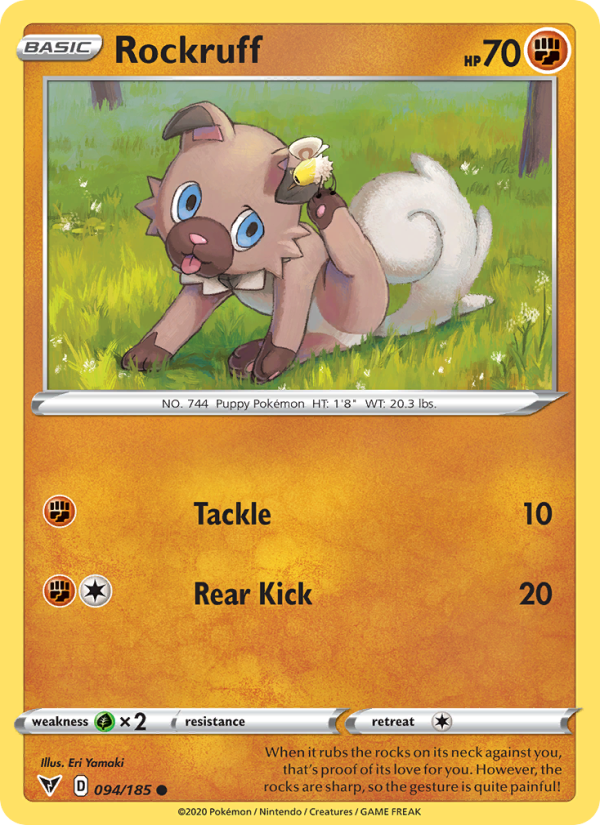
Image courtesy of TCGdex.net
Rockruff and the Craft of Balance: How Attack Costs Shape Early TCG Decisions
In the Pokémon TCG, every number on a card is a thread in a larger tapestry of balance, pacing, and player choice. Rockruff, a basic Fighting-type from the Vivid Voltage era (SWSh4), embodies a design philosophy that champions accessibility without sacrificing strategic depth. With 70 HP, two distinct attacks, and a pair of energy costs that invite careful budgeting, this little pup reminds us why attack costs are not just about raw damage—they’re about how players learn to think about tempo, resource management, and the inevitability of evolving into something stronger.
Rockruff’s stat line sits firmly in the “entry-level challenger” camp. Its HP of 70 is typical for basic Pokémon at a similar power tier, which makes it forgiving for new players and reliable for casual games. The base form’s two attacks are a study in contrast: a cheap, low-risk option and a slightly more demanding follow-up that rewards planning. This is precisely where balance decisions reveal themselves. If tackle could punch out big damage on day one, the card would skew toward aggression, but Rockruff keeps the pressure contained, ensuring early turns are about tempo and position rather than a single knockout burst.
Dissecting the Attacks: Costs, Colors, and Consequences
- Tackle — Cost: Fighting (one Fighting energy). Damage: 10. This is Rockruff’ s bread-and-butter move: it trades for a single energy and offers predictable, low-stakes damage. The simplicity makes it approachable for beginners and teaches the rhythm of attaching energy each turn while developing a board presence.
- Rear Kick — Cost: Fighting plus Colorless. Damage: 20. The added Colorless cost introduces marginal higher tempo but requires a second energy attachment, nudging players to think about energy acceleration and deck pacing. The Colorless symbol means any energy type can satisfy that portion, which broadens deck-building options and underscores how Rockruff can slot into diverse Fighting-type strategies without demanding a rigid energy mix.
From a gameplay perspective, the attack costs encourage players to weigh “short-term board presence” against “long-term evolution.” On one hand, Rockruff can contribute early damage and pressure, while on the other, you’ll likely invest in setting up a more powerful threat later in the game by evolving into Lycanroc. This balance is intentional: it keeps Rockruff relevant in the opening turns without outsizing its early utility, a delicate calibration that helps new players learn energy management, attack timing, and target prioritization.
Electric Chalk Lines: HP, Weakness, and Retreat
Rockruff’s 70 HP frames a fragile but serviceable base, reinforcing the beginner-friendly narrative. Its Grass weakness (×2) nudges players toward meta awareness—if opponents lean heavily on Grass-type attackers, Rockruff-based boards can feel the sting, especially in Limited formats or when the bench is thin. The Retreat Cost of 1 further grounds decision-making: it’s cheap enough to run, yet meaningful enough to force you to consider when to retreat and reset the exchange, rather than simply spamming attacks. These little trade-offs are the heartbeat of balance design: a modest HP pool, a manageable retreat, and a weakness that invites players to think in terms of matchups and sequencing rather than pure power।
Art, Lore, and the Story Behind the Card
Illustrator Eri Yamaki lends Rockruff a youthful, spirited appearance that captures the creature’s earnest, cheeky charm. The flavor text—“When it rubs the rocks on its neck against you, that's proof of its love for you. However, the rocks are sharp, so the gesture is quite painful!”—boasts a playful contrast between affection and risk, mirroring the card’s mechanical tension. This artistry isn’t just decoration; it anchors the card within the broader world of Pokémon where nurturing and danger often coexist in a single moment. For collectors, Yamaki’s work adds a familiar, warm texture to a common card that might otherwise fade into the sea of small-fire numbers and evolutions.
In the context of the Vivid Voltage set, Rockruff stands as a reminder that balance isn’t solely about raw power; it’s about accessibility, teachability, and the way a card supports a player’s learning curve. The Rockruff you pull on turn one can become a cornerstone of a longer arc—Lycanroc’s evolution line offers a narrative progression that resonates with players who enjoy collecting, building, and sharpening strategy over time. The card’s normal print and reverse-holo variants provide further collector appeal, underscoring how even a common Pokémon can hold enduring value in a well-balanced ecosystem.
Market Pulse: What Rockruff Tells Us About Value Trends
As a Common rarity from a popular set, Rockruff (SWSh4-94) typically sits at a budget-friendly price point. Price data from Cardmarket shows a low average around a few euro cents for standard non-holo copies, with holo- and reverse-holo versions fetching higher prices due to rarity and visual appeal. On the TCGPlayer side, the non-holo normal version often lands in the low cents to single-digit cents range, while the market price hovers similarly modestly. The high price in some datasets (e.g., a speculative spike up to the mid-range tens of dollars in rare cases) usually reflects unusual circumstances—misprints, misattribution to a special promo, or market anomalies—not the typical value of a common runner in standard play. For collectors, Rockruff remains an affordable entry point into an evolving line, especially for players who want a quick, affordable board presence that scales into Lycanroc as their collection grows.
Seeing how attack costs influence price anchors can help buyers and sellers gauge the health of a card’s market. The combination of low damage, cheap energy costs, and a reasonable HP pool makes Rockruff a dependable budget pick for new players, while its place in an evolving evolution line keeps it relevant for longer-term collectors. In other words, the balance baked into its attacks is mirrored by the balance in its value: accessible now, with the potential to rise in value only as its lineage and art grow in cultural significance.
Strategy Takeaways for Players and Collectors
- Use Tackle to establish early presence and force your opponent to commit resources while you plan your next evolution.
- Rear Kick rewards thoughtful energy planning: you’ll want at least one additional energy attachment available to unlock the higher-damage option.
- Factor Rockruff’s Grass weakness into deck choices. If you anticipate facing Grass-heavy lines, consider a different testing ground early or cushion Rockruff with Grass-resistance support through your bench.
- Appreciate the art and lore—Eri Yamaki’s artwork adds depth to a humble common, turning it into a character you’ll remember as you build toward Lycanroc and beyond.
- For collectors, explore both the normal and reverse-holo versions. The value isn’t dramatic, but the aesthetics and condition can turn a common card into a personal favorite.
More from our network
- https://crypto-acolytes.xyz/blog/post/imperia-4939-imperia-rome-citizens-nft-stats/
- https://crypto-acolytes.xyz/blog/post/meta-muse-1108-meta-muses-nft-stats/
- https://crypto-acolytes.xyz/blog/post/nft-stats-sempire-sempire-2182-from-sempiredao-collection/
- https://wiki.digital-vault.xyz/wiki/post/pokemon-tcg-stats-pansear-card-id-b1-037/
- https://crypto-acolytes.xyz/blog/post/drug-chicken-90-drug-files-nft-stats/
Rockruff
Set: Vivid Voltage | Card ID: swsh4-94
Card Overview
- Category: Pokemon
- HP: 70
- Type: Fighting
- Stage: Basic
- Dex ID: 744
- Rarity: Common
- Regulation Mark: D
- Retreat Cost: 1
- Legal (Standard): No
- Legal (Expanded): Yes
Description
When it rubs the rocks on its neck against you, that's proof of its love for you. However, the rocks are sharp, so the gesture is quite painful!
Attacks
| Name | Cost | Damage |
|---|---|---|
| Tackle | Fighting | 10 |
| Rear Kick | Fighting, Colorless | 20 |
Pricing (Cardmarket)
- Average: €0.04
- Low: €0.02
- Trend: €0.02
- 7-Day Avg: €0.03
- 30-Day Avg: €0.05
Support Our Decentralized Network
Donate 💠More from our network
- https://crypto-acolytes.xyz/blog/post/imperia-4939-imperia-rome-citizens-nft-stats/
- https://crypto-acolytes.xyz/blog/post/meta-muse-1108-meta-muses-nft-stats/
- https://crypto-acolytes.xyz/blog/post/nft-stats-sempire-sempire-2182-from-sempiredao-collection/
- https://wiki.digital-vault.xyz/wiki/post/pokemon-tcg-stats-pansear-card-id-b1-037/
- https://crypto-acolytes.xyz/blog/post/drug-chicken-90-drug-files-nft-stats/