
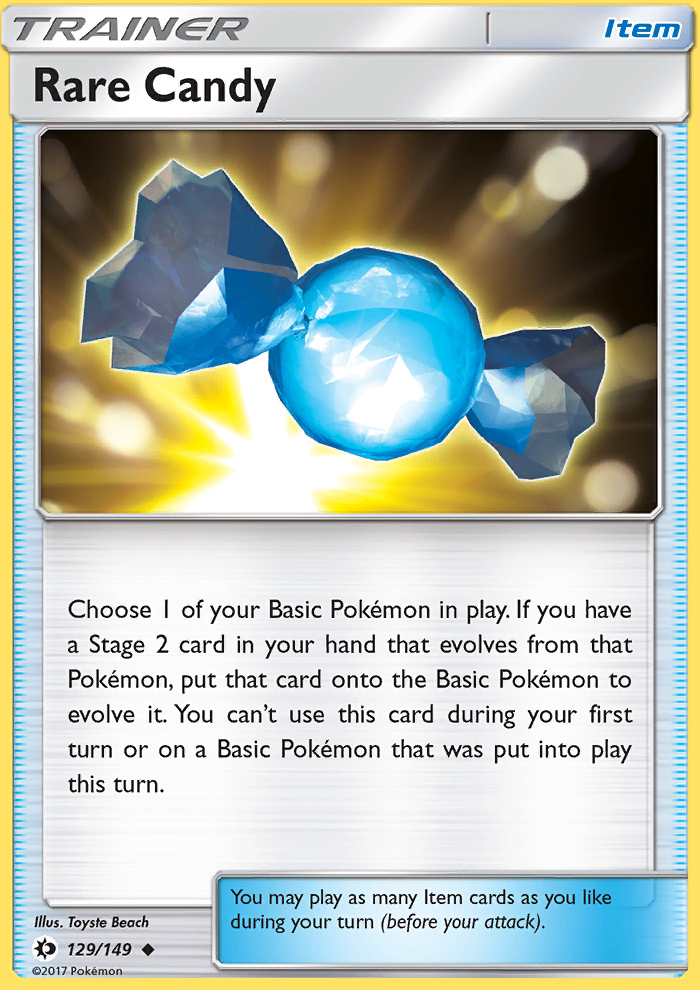
Image courtesy of TCGdex.net
How card design has changed to empower Rare Candy and the latest Pokémon
Since the dawn of the Sun & Moon era, the Pokémon TCG has evolved from a simple clash of numbers into a sophisticated dance of tempo, setup, and strategy. One card that embodies this shift is Rare Candy, a trainer item that quietly redefined how players approach evolution. Designed by the talented Toyste Beach and released as SM1, Rare Candy is an Uncommon card that players either loved for its value or debated for its conditional use. Its artistic presence in the set is matched by its impact on deck-building, forcing players to weigh timing, hand size, and the ever-present question: when is the best moment to accelerate to a Stage 2?
In its text, Rare Candy offers a powerful engine: you may choose 1 of your Basic Pokémon in play, and if you have a Stage 2 card in your hand that evolves from that Pokémon, you can put that Stage 2 card onto the Basic Pokémon to evolve it. The catch? you can’t use this card on your first turn, nor on a Basic Pokémon that was just put into play this turn. This constraint isn’t a roadblock so much as a design constraint that pushes players to plan ahead. The mechanic hinges on having a Stage 2 Evolution ready in hand, which naturally fosters smoother lines for mid-to-late-game plays and reduces the reliance on bulky Stage 2 cards arriving from the deck all at once. The idea is to create a dramatic, satisfying moment when you slam a Level 2 evolution onto a Pokémon that’s already on the board, rather than waiting for a drawn Evolution card each turn. ⚡
Artistically, Rare Candy sits at the intersection of practicality and flair. Toyste Beach gave the card a distinctive look within the Sun & Moon lineup, an era known for its bright, glossy visuals and a balance between approachable art and collector appeal. The card’s artwork mirrors a broader design philosophy of the time: make evolution feel impactful on the table while preserving clear readability of the card’s effects. In the context of modern Pokémon, this balance remains crucial as players juggle more complex combos and larger boards. 🎨
From baseline utility to strategic backbone
Design-wise, Rare Candy marked a pivot point. It acknowledged that evolving a Basic Pokémon into a formidable Stage 2 could be the difference between stalling and turning the tide of a match. This shift is echoed in the set’s structure: Sun & Moon brought a wave of trainer-focused tools that reward correct timing and synergy with evolving lines, while still preserving the game’s core tempo. The card’s status as an Item Trainer in the Expanded format (with Standard legality rolling in and out over time) also shows how card design must navigate format shifts. In practical terms, collectors and players alike remember Rare Candy as a card that created “evolution windows”—moments when the board state, your hand, and your opponent’s tempo align to deliver a powerful payoff. 🔄
For players building today’s decks, Rare Candy remains a reference point for thinking about how to accelerate into your big targets. It’s a reminder that evolution pacing matters as much as raw stats. While the effect is straightforward—pull a Stage 2 from your hand onto a Basic Pokémon in play—the timing and sequencing become an exercise in planning and risk management. In modern formats, where card pools are vast and the meta shifts quickly, this kind of planning is invaluable. The card’s “no first turn” restriction, in particular, still matters: it aligns with the broader principle that early-game setup should be measured and deliberate, not reckless. 🔎
Collectors will notice the card’s rarity and print variants. Rare Candy is Uncommon, with holo and reverse-holo versions in some print runs, reflecting a desire to keep its utility accessible while offering visual appeal for enthusiasts. The Sun & Moon SM1 set, with 149 official cards (172 total including some variations and promos), sits as a snapshot of an era where card design—riddled with evolving mechanics—began to balance accessibility with depth. The illustration by Toyste Beach adds a memorable touch to the card’s identity, making it a familiar feature in binders and display shelves alike. 💎
Design, balance, and market perspective
From a market perspective, Rare Candy’s value has ebbed and flowed with print runs, reprints, and format legality. Updated data as of late 2025 shows a nuanced picture: Cardmarket entries place the normal print around a modest range (avg around 0.15 EUR, with lows near 0.02 EUR and variations depending on holo status), while TCGPlayer data reveals a broader spectrum. Normal copies hover around a few pennies to a few tenths of a dollar/more, with holo versions commanding higher figures, evidenced by mid-range values around $0.50 and highs climbing into a couple of dollars in certain market windows. This dynamic highlights how a single trainer card can remain relevant—especially for players who value speed and consistency in evolution—without becoming a mere historical curiosity. 🔥
In terms of deck design, Rare Candy’s enduring lesson is simple: good design rewards thoughtful planning. It’s not merely about getting to a stronger Pokémon faster; it’s about sequencing evolutions to maximize attack pressure, board presence, and resource efficiency. For collectors, the card’s lightly embossed rarity and the prestige of holo variants provide a tangible connection to a pivotal era of card design. And for modern players, it’s a touchstone that reminds us how a single card can influence the pacing of a game long after it first appeared in the metagame. 🎴
Neon Desk Neoprene Mouse Pad 4mm Non-SlipMore from our network
- https://wiki.digital-vault.xyz/wiki/post/pokemon-tcg-stats-eevee-card-id-swshp-swsh190/
- https://transparent-paper.shop/blog/post/stable-diffusion-xl-prompt-neon-surrealism-astral-projection-mutating-fractals-regal-purple-mustard-crystal-obelisk-cosmic-glow/
- https://blog.crypto-articles.xyz/blog/post/on-chain-trend-fuels-solana-meme-coin-momentum/
- https://blog.crypto-articles.xyz/blog/post/nft-data-pumpixels-751-from-pumpixels-collection-on-magiceden/
- https://crypto-acolytes.xyz/blog/post/nft-stats-geek-2490-from-geeks-collection/
Rare Candy
Set: Sun & Moon | Card ID: sm1-129
Card Overview
- Category: Trainer
- HP:
- Type:
- Stage:
- Dex ID:
- Rarity: Uncommon
- Regulation Mark: —
- Retreat Cost:
- Legal (Standard): No
- Legal (Expanded): Yes
Description
Pricing (Cardmarket)
- Average: €0.15
- Low: €0.02
- Trend: €0.2
- 7-Day Avg: €0.36
- 30-Day Avg: €0.21
Support Our Decentralized Network
Donate 💠More from our network
- https://wiki.digital-vault.xyz/wiki/post/pokemon-tcg-stats-eevee-card-id-swshp-swsh190/
- https://transparent-paper.shop/blog/post/stable-diffusion-xl-prompt-neon-surrealism-astral-projection-mutating-fractals-regal-purple-mustard-crystal-obelisk-cosmic-glow/
- https://blog.crypto-articles.xyz/blog/post/on-chain-trend-fuels-solana-meme-coin-momentum/
- https://blog.crypto-articles.xyz/blog/post/nft-data-pumpixels-751-from-pumpixels-collection-on-magiceden/
- https://crypto-acolytes.xyz/blog/post/nft-stats-geek-2490-from-geeks-collection/