
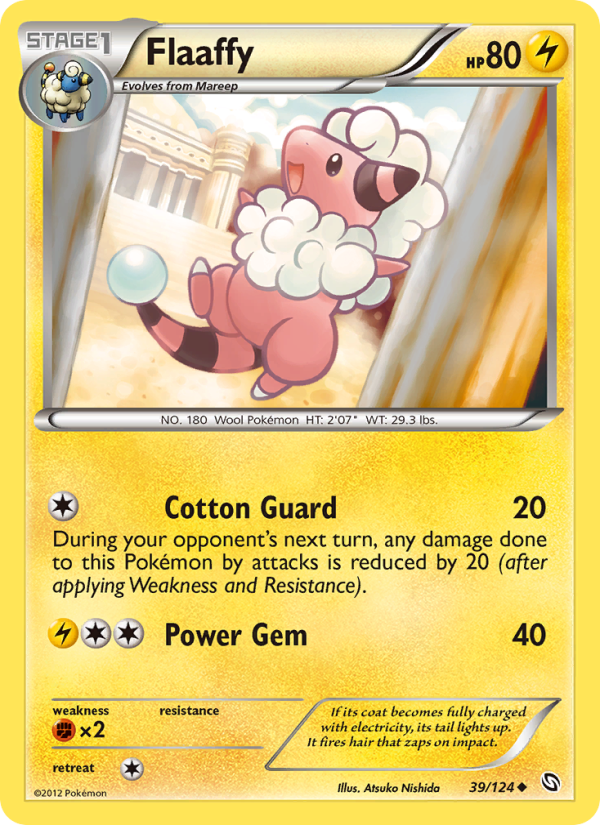
Image courtesy of TCGdex.net
Lightning Stall and Reprint Cycles in Dragons Exalted
In the ever-evolving world of the Pokémon TCG, reprint cycles act like tides that either flood or recede the market, while also reshaping how players approach deckbuilding. Flaaffy, a beloved stage-one Lightning-type from the Dragons Exalted expansion (BW6), provides a compact lens into how reprints influence competitiveness. With its 80 HP, a pair of practical attacks, and a stall-oriented defense, Flaaffy demonstrates how a single card can swing tempo in both casual and more serious Expanded-format play. ⚡🔥
Card snapshot and what it means for decks
- Set: Dragons Exalted (BW6)
- Rarity: Uncommon
- Stage: Stage 1 (evolves from Mareep)
- HP: 80
- Type: Lightning
- Attacks:
- Cotton Guard – Cost: Colorless. Effect: During your opponent's next turn, any damage done to this Pokémon by attacks is reduced by 20 (after applying Weakness and Resistance).
- Power Gem – Cost: Lightning, Colorless, Colorless. Damage: 40
- Weakness: Fighting ×2
- Retreat: 1
- Illustrator: Atsuko Nishida
- Legal in: Expanded (not standard at the time of its reprint window)
Flaaffy’s Cotton Guard is the kind of tempo tool that tilts games by turning early damage into a time-buying barrier. In a world where players chase rapid hits and big numbers, a reliable 20-point shield on each opponent’s turn can be the difference between stalling out a faster attacker or facing a risky, high-damage swing. Paired with Power Gem, Flaaffy can threaten steady chip damage while setting up for stronger pivots later in the match. The card’s Lightning typing also plays nicely with the era’s energy acceleration tools, which many players combine with Mareep’s evolving line to stabilize early turns. The 80 HP stat keeps it in the fragile-but-usable zone, so reprints in newer prints or alternate art runs can broaden access without upending balance too severely.
Collectors often watch how reprints shift the perceived value of staples. Flaaffy’s non-holo prints typically hover in the sub-dollar range, while holo and reverse-holo variants command higher attention in the market. As of late 2025 data, Cardmarket shows an average around 0.32 EUR for non-holo copies, with holo markets climbing into multi-euro territory depending on condition and demand. TCGPlayer data underscores this dynamic: normal copies average around 0.41 USD with a notable spike for reverse-holo copies, which have seen market prices as high as 6.99 USD in opportunistic sales. These numbers reflect a broad reality—reprints can flood the commons, but the holo-foil chase remains a collector’s allure.
“Reprint cycles don’t just add copies; they reset what players value and what shoppers expect to pay.”
From a gameplay perspective, the expanded environment accommodates Flaaffy más openly than standard, because the card’s timing and stall capability fit with older, more energy-sparse pacing. Reprints in later sets or within special promos keep this option alive, ensuring that new players can experiment with stall-based strategies even as the metagame evolves. In the competitive sense, that means a more diverse field of Builders can experiment with early-stage defense while steering toward electrifying late-game pressure—especially when paired with parallel Lightning archetypes that can accelerate energy without sacrificing tempo. ⚡🎯
Why reprints matter for competitiveness
Reprint cycles influence not just prices but also deck viability across formats. When a card like Flaaffy returns in a refreshed print run, several dynamics come into play:
- Accessibility: More copies means easier access for new players to build around a tried-and-true stall concept, lowering the barrier to entry for Expanded-only players.
- Market equilibrium: A flood of non-holo reprints tends to depress the price floor, allowing budget-conscious players to experiment without investing heavily. The data shows non-holo averages hovering in the few-tenths of a euro/dollar range, with holo copies commanding a premium—preserved by rarity and condition.
- Variant-driven interest: Holo, reverse-holo, and promo variants maintain collector interest, helping long-tail demand even as standard play leans toward newer tools.
- Meta resilience: Decks that rely on stall and gradual damage can persist beyond a single print run, because the concept of Cotton Guard isn’t tied to a single card’s identity. Reprints refresh the pool of options for builders who want to replicate or tweak that approach without buying a discontinued print.
The Dragons Exalted era itself sits in a nostalgic space for many players. Embora the set’s original print date is years behind us, the fact that Flaaffy is still referenced in modern market data highlights how reprints keep classic mechanics in circulation. The card art by Atsuko Nishida—one of the era’s enduring illustrators—helps preserve the tactile joy of the game, even as digital pricing data ebbs and flows. The visual identity of a holo Flaaffy can become iconic in display cases, while non-holo copies serve as practical, affordable options for casual playrooms and school leagues.
Practical takeaways for players and collectors
- For players: consider Flaaffy as a tempo anchor in Lightning-themed decks that lean into durability rather than outright power. The Cotton Guard shield buys time to set up Power Gem or energy acceleration strategies, especially in Expanded where older mechanics remain viable.
- For collectors: monitor holo versus non-holo variants, and watch the market’s pulse around reprint drops. A well-timed buy during a dip can pay off if a collector’s interest spikes later in the cycle.
- For casual builders: don’t overlook the synergy with Mareep’s evolution line and the broader Lightning toolbox. Reprints ensure you’re not stranded if you want to experiment with stall-based strategies in your next local meetup.
- For analysts: track card pricing trends alongside set release schedules. A spike in holo sales often coincides with a reprint reminder across social channels and collector forums.
As reprint cycles continue to shape accessibility and price, Flaaffy remains a small but mighty reminder of how a single stage-one Pokémon can influence deck theory and collecting culture alike. The blend of defensive utility, solid damage, and market dynamics makes this card a thoughtful case study in how reprints influence competitiveness across the entire Pokémon TCG ecosystem. 🎴💎
Phone Grip Click-On Adjustable Mobile HolderMore from our network
- https://crypto-acolytes.xyz/blog/post/upgrade-your-arcade-racing-rigs-with-real-steering-wheels/
- https://crypto-acolytes.xyz/blog/post/nft-stats-gorbage-chest-787-from-gorbage-chest-collection/
- https://crypto-acolytes.xyz/blog/post/nft-stats-pinheads-160-from-pinheads-collection/
- https://blog.crypto-articles.xyz/blog/post/nft-data-george-plays-clash- royale-693-from-gpcr-nft-collection-on-magiceden/
- https://crypto-acolytes.xyz/blog/post/area-51-on-ps2-and-the-2000s-fps-culture/
Flaaffy
Set: Dragons Exalted | Card ID: bw6-39
Card Overview
- Category: Pokemon
- HP: 80
- Type: Lightning
- Stage: Stage1
- Evolves From: Mareep
- Dex ID: 180
- Rarity: Uncommon
- Regulation Mark: —
- Retreat Cost: 1
- Legal (Standard): No
- Legal (Expanded): Yes
Description
Attacks
| Name | Cost | Damage |
|---|---|---|
| Cotton Guard | Colorless | 20 |
| Power Gem | Lightning, Colorless, Colorless | 40 |
Pricing (Cardmarket)
- Average: €0.32
- Low: €0.02
- Trend: €0.33
- 7-Day Avg: €0.28
- 30-Day Avg: €0.27
Support Our Decentralized Network
Donate 💠More from our network
- https://crypto-acolytes.xyz/blog/post/upgrade-your-arcade-racing-rigs-with-real-steering-wheels/
- https://crypto-acolytes.xyz/blog/post/nft-stats-gorbage-chest-787-from-gorbage-chest-collection/
- https://crypto-acolytes.xyz/blog/post/nft-stats-pinheads-160-from-pinheads-collection/
- https://blog.crypto-articles.xyz/blog/post/nft-data-george-plays-clash-royale-693-from-gpcr-nft-collection-collection-on-magiceden/
- https://crypto-acolytes.xyz/blog/post/area-51-on-ps2-and-the-2000s-fps-culture/