
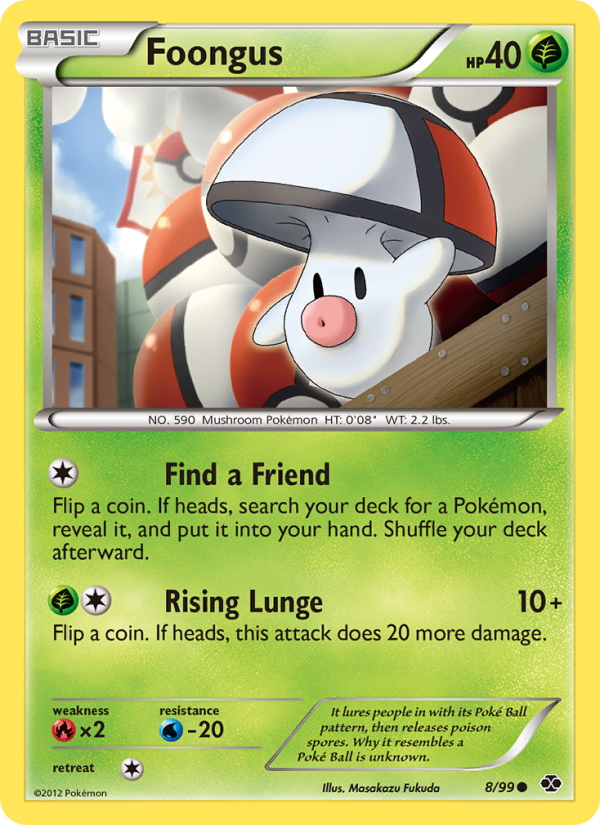
Image courtesy of TCGdex.net
Balancing Risk and Reward: What Foongus teaches us about attack costs in the Pokémon TCG
In the Pokémon Trading Card Game, every number is a decision—how many energy it costs, how much damage it can dish out, and how its special text nudges a match toward a particular strategic path. Foongus from Next Destinies (bw4) is a small, unassuming Grass type with a big lesson about balance. With only 40 hit points, two modest attacks, and a frail frame, Foongus looks like a wallflower in a world of powerhouse Beetle Bombs and Dragon assaults. Yet its very fragility, combined with a clever mix of card draw and potential damage, reveals how designers tune attack costs to shape deck-building and turn-by-turn decisions. ⚡🔥💎
Foongus is a Basic Pokémon with Grass typing that hinges on the concept of “finding a friend” while weaving in a gamble on the second strike. Its first attack, Find a Friend, costs a single Colorless energy and reads simply: search your deck for a Pokémon, reveal it, and put it into your hand. This is a rare utility for a Basic with such low HP, because it provides deck-thinning and consistency without advancing any threat on the opponent’s side. In practice, it’s not about raw damage; it’s about ensuring you can pressure the board state by fetching a key piece—an evolution, an attacker, or a trainer engine—when you need it most. Such an attack cost is a deliberate balance lever: you pay with one energy to accelerate your setup instead of relying on more fragile draw engines or costlier later plays. The one-energy price tag makes it accessible, but Foongus’s life total and attack output keep it from overextending early in the game.
Foongus’s second attack, Rising Lunge, costs Grass and Colorless energy and deals a baseline 10 damage. It also features a coin flip: if heads, you deal an additional 20 damage, bringing the total potential to 30. The combination of a relatively low base damage and the probabilistic boost is a brilliant study in balance. It creates a spectrum of outcomes: you can secure a modest, steady pressure with 10 damage, or you can spike up to 30 damage in a single swing—yet you gamble on the coin. The need to invest in Grass energy raises the bar for laddering into a bigger play, ensuring that Foongus remains a tempo-driven choice rather than a raw spoiler in the early game. This is not a card that wins fights by brute force; it wins by tempo, flexibility, and the strategic use of coin-flip risk in a way that keeps the opponent honest about their own board state. The 40 HP and Fire-type weakness to x2 ensure Foongus won’t steamroll the game, reinforcing that the two-attack model is a balance between risk and reward rather than a straightforward damage machine.
From a gameplay perspective, these costs help explain why Foongus exists at common rarity in Next Destinies. The set itself was known for its early-Black-and-White era experimentation—bringing back more Trainer and Supporter emphasis, combined with Pokémon that offered unique tempo plays. Foongus’s attribute spread matters: Grass type gives it access to a suite of support cards, while its poor bulk discourages it from becoming a solo frontline fighter. This is a deliberate design choice. It nudges players toward building strategies that leverage the Find a Friend effect to form a compact bench advantage and to set up for Rising Lunge in a controlled, not reckless, manner. In other words, Foongus embodies balance as a series of micro-decisions: you must decide when to lay one energy on a dependable search, when to push with the rising lunge, and how to protect your fragile line with retreat cost and resistances that make opposing lines weigh their options.
Balance mechanics in context: HP, costs, and the evolving metagame
Foongus’s 40 HP is a stark reminder that not every card aspires to tanks or one-hit KO potential. In the broader TCG ecosystem, HP values serve as a cap on how much punishment a card can absorb before being replaced by a more efficient reply. The heavy penalty of a Fire weakness (×2) complements the Grass typing by forcing players to consider type matchups and bench composition. The Resistance to Water at -20 further cushions Foongus against some of the trickier Water-based decks that became common in various Standard-legal rotations, though Foongus itself is not a front-line solution in most modern meta lines. The single Retreat Cost of 1 adds a practical mobility mechanic—Foongus is almost always a temporary asset, meant to retreat into a safer engine or to swap in a more robust attacker when the time is right. All of these numbers—HP, energy costs, strengths and weaknesses—are the balance dial that keeps Foongus from overshadowing other tools in the same format.
The two-attacks design simultaneously emphasizes risk management and clever sequencing. Find a Friend offers reliable access to a Pokémon, but it doesn’t guarantee a payoff beyond locating a card you might need to keep the pressure going. Rising Lunge, with its coin flip, becomes a test of pace: you can push a powerful swing on heads, or you maintain tempo with the humble 10-damage tick. This balance between certainty (searching for a card) and volatility (coin-flip damage) mirrors broader design philosophies across the Pokémon TCG: balance aggression with synchronization of energy costs and the ability to capitalize on favorable coin flips while minimizing the impact of unfavorable flips. The result is a card that rewards careful planning and resource management rather than sheer aggression. 🎴🎨
Collecting, pricing, and artful details
Beyond gameplay, Foongus carries collectible weight as a common rarity with holo options tallied in its variant lineup. Masakazu Fukuda, the illustrator credited for this artwork, adds a layer of visual charm—his design work is a familiar signature within the Next Destinies era. For price-conscious collectors, market data from CardMarket shows a typical average around 0.11 EUR for non-holo copies, with holo variants trending higher (avg holo around 0.40 EUR). TCGPlayer data paints a similar picture in USD terms, outlining a low around $0.07 and mid around $0.22 for standard foil or non-foil copies, with high-end market values for rare cases. Taken together, Foongus remains an approachable entry point for both new collectors chasing a complete Next Destinies set and veterans hunting for holo variants that catch the eye on display shelves. This accessible pricing, combined with a charming coin-flip mechanic and a search utility, makes Foongus a nostalgic favorite for players who love the early-Black & White era. 🟢💎
As a design study, Foongus demonstrates how a low-HP creature can still offer meaningful strategic depth. The card’s value isn’t only in raw power; it’s in the promise of reliable setup and a dynamic second attack that scales with chance. It’s a reminder that balance in Pokémon TCG design isn’t about forcing every card into a one-note role; it’s about weaving together costs, effects, and probabilities so that players are incentivized to think critically about tempo, resource management, and board presence. And when you’re a fan of the plant Pokémon who loves to surprise you with a coin-flipped crescendo, Foongus is the perfect small puzzle to solve on a summer night of casual play or a long-form deck-building session. ⚡🔥 Gaming Neon Mouse Pad 9x7 Custom-Stitched Edges
More from our network
- https://crypto-acolytes.xyz/blog/post/mifgen1032-mifella-genesis-nft-stats/
- https://crypto-acolytes.xyz/blog/post/steam-sale-myths-debunked-what-really-drives-deals/
- https://blog.crypto-articles.xyz/blog/post/nft-data-im-a-pancake-97-from-im-a-pancake-collection-on-magiceden/
- https://crypto-acolytes.xyz/blog/post/bitcreep-4-the-bitcreeps-nft-stats/
- https://blog.crypto-articles.xyz/blog/post/why-casual-players-love-the-wobbuffet-line-in-pokemon-tcg/
Foongus
Set: Next Destinies | Card ID: bw4-8
Card Overview
- Category: Pokemon
- HP: 40
- Type: Grass
- Stage: Basic
- Dex ID: 590
- Rarity: Common
- Regulation Mark: —
- Retreat Cost: 1
- Legal (Standard): No
- Legal (Expanded): Yes
Description
Attacks
| Name | Cost | Damage |
|---|---|---|
| Find a Friend | Colorless | |
| Rising Lunge | Grass, Colorless | 10 |
Pricing (Cardmarket)
- Average: €0.11
- Low: €0.02
- Trend: €0.1
- 7-Day Avg: €0.15
- 30-Day Avg: €0.12
Support Our Decentralized Network
Donate 💠More from our network
- https://crypto-acolytes.xyz/blog/post/mifgen1032-mifella-genesis-nft-stats/
- https://crypto-acolytes.xyz/blog/post/steam-sale-myths-debunked-what-really-drives-deals/
- https://blog.crypto-articles.xyz/blog/post/nft-data-im-a-pancake-97-from-im-a-pancake-collection-on-magiceden/
- https://crypto-acolytes.xyz/blog/post/bitcreep-4-the-bitcreeps-nft-stats/
- https://blog.crypto-articles.xyz/blog/post/why-casual-players-love-the-wobbuffet-line-in-pokemon-tcg/