
Image courtesy of TCGdex.net
How grading Dusknoir cards Impacts Their Market Value
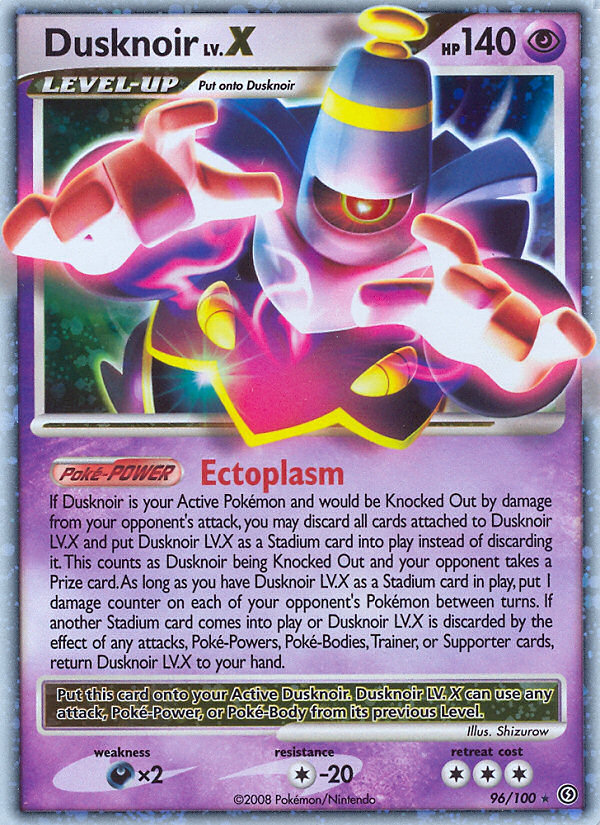
For collectors and players alike, grading isn’t just about pristine aesthetics—it’s a strategic move that can unlock liquidity, stabilize value, and tell a story about a card’s journey from booster packs to showcase shelves. Dusknoir, a Psychic-type LEVEL-UP favorite from the Stormfront set, is a prime example of how grading can impact worth. This DP7-96 holo LV.X version, illustrated by Shizurow, carries a distinctive aura with 140 HP, a potent Poke-POWER ability in Ectoplasm, and the glamour of a Rare Holo LV.X. When you factor in grading, you’re not just preserving a card—you’re potentially elevating its rarity tier, enhancing surface appeal, and signaling to buyers that this copy has been vetted for excellence.
Why the holo LV.X designation magnifies the value potential
Dusknoir’s LV.X form is a landmark in the diamond-and-pearl era, presenting a visually striking holo pattern that catches light and attention. The rarity tag—Rare Holo LV.X—already places it in a higher tier within the DP7 Stormfront lineup. Grading magnifies that premium by:
- Certainty of condition: A graded copy certifies the card’s exact condition to a broad audience, reducing ambiguity for buyers and traders who must rely on photos alone.
- Surface integrity: Holo surfaces are prone to micro-scratches and foil defects. A pristine 9 or 10 surface dramatically increases perceived value, especially for a card with dynamic holo indexing like Dusknoir LV.X.
- Centering and print consistency: Graders scrutinize centering, edge wear, and color consistency. A well-centered, uniformly sharp holo print tends to fetch a premium relative to a raw copy with subtle misalignment.
- Long-term liquidity: Graded cards travel more confidently across markets, from individual collectors to auction houses, thanks to standardized grading scales.
In markets tracked for holo cards, the price floor and ceiling can run in tandem with grade quality. The DP7 holo LV.X, for instance, shows a snapshot of modern market dynamics: current TCGPlayer data indicate a holo price range with a low around $40.01, a mid around $44.54, and a high near $55.11, with a market price hovering around $42.65. CardMarket data echoes the broader trend in euros, showing a holo average of roughly €2.40 but with higher activity on the more collectible end of the spectrum. When you add grading into the equation, many collectors are willing to pay a noticeable premium for copies certified as PSA 9 or PSA 10 (or CGC 9.5/10 equivalents), because guarantees accompany the grade and the card’s long-term investment narrative.
What grading adds in terms of market clarity
Grading provides a framework for risk analysis in a market that can otherwise feel subjective. For Dusknoir, the value uplift from a PSA 9–10 or CGC 9.5–10 copy rests on a few core factors:
- Consistency in the holo surface: Any polishing marks, scuffs, or misprints on the foil back or front can impact grade. A flawless holo finish signals premium quality and often translates into a steeper resale curve.
- Card text readability: The embossed, luminescent text should remain crisp. Clear labeling of the attack names and Ectoplasm’s effect is essential; blur or fading can complicate grading and reduce perceived value.
- Edge and corner integrity: Even the slightest whitening or chipping on corners can drop a grade significantly. Graders weigh these details heavily for LV.X-era cards, where edge wear is as telling as any misalignment in the holo pattern.
- Centering precision: Dusknoir’s DP7 print run often exhibits centering variance. A copy with near-perfect centering is more likely to achieve a higher grade and, by extension, a higher market price.
Of course, the game’s economics extend beyond a single copy. Graded examples of popular holo EVOLUTIONS-era staples can pull premium multiples, especially when the card is accompanied by a strong surface gloss and minimal print lines. For Dusknoir, the combination of Ectoplasm as a strategic ability and the dramatic holo presentation makes it a compelling candidate for graded submissions—provided the card is carefully preserved before sending it to the grading service.
Tips for collectors considering grading Dusknoir
- Don’t rush the submission: If you’ve found a near-mint copy with strong centering and a clean holo surface, weigh the cost of grading against potential uplift. PSA and CGC fees can influence the break-even point.
- Request a pre-grading assessment: Some services offer pre-screening to estimate likely grades. This can help you avoid submitting cards with obvious flaws that won’t reach your target grade.
- Document the card’s history: Keep provenance notes—where you found the card, its storage conditions, and any notable events in your collection. These details can help when negotiating trades or sales after grading.
- Compare grade-based value across marketplaces: Use the current holo price signals as a baseline; a graded copy may fetch a premium depending on the grade, market demand, and the platform you’re using.
Art, lore, and the collector’s journey
Beyond mechanics and market values, Dusknoir’s Stormfront art—brought to life by the talented Shizurow—contributes to its enduring appeal. The card’s pose, the faux-ephemeral mist around its silhouette, and the holo sheen all combine to make a standout piece for display and rotation in a deck-friendly environment. Grading doesn’t alter the artwork or the card’s lore; it validates the card’s physical condition while preserving its story for future generations of trainers to admire ⚡.
As you weigh whether to pursue grading for your Dusknoir DP7-96 holo LV.X, consider your collecting goals: Are you building a pristine Stormfront display, a playable set with high-grade cores, or a flexible collection that prioritizes liquidity and resale? Each path can benefit from a well-graded centerpiece that reflects both the card’s strategic depth and its artistic charm 🔥.
For readers who want a tangible link to a broader gear-up ecosystem, consider pairing your card journey with practical upgrades and accessories. Shop securely for related gear and cases that protect your investment, such as rugged organizers and display options that keep your collection pristine while you chase new milestones 🎴.
Rugged Phone Case Impact Resistant Dual Layer TPU PC GlossyMore from our network
- https://crypto-acolytes.xyz/blog/post/nft-stats-midevil-4639-from-midevils-collection/
- https://crypto-acolytes.xyz/blog/post/nft-stats-heavenware-72-from-heavenware-collection/
- https://crypto-acolytes.xyz/blog/post/unlocking-value-solana-nft-in-game-assets/
- https://crypto-acolytes.xyz/blog/post/nft-stats-solidskulls-131-from-solidskulls-collection/
- https://articles.zero-static.xyz/blog/post/new-world-timeline-breakdown-explores-patch-milestones/
Dusknoir
Set: Stormfront | Card ID: dp7-96
Card Overview
- Category: Pokemon
- HP: 140
- Type: Psychic
- Stage: LEVEL-UP
- Dex ID: 477
- Rarity: Rare Holo LV.X
- Regulation Mark: —
- Retreat Cost: 3
- Legal (Standard): No
- Legal (Expanded): No
Description
Abilities
-
Ectoplasm — Poke-POWER
If Dusknoir is your Active Pokémon and would be Knocked Out by damage from your opponent's attack, you may discard all cards attached to Dusknoir LV.X and put Dusknoir LV.X as a Stadium card into play instead of discarding it. This counts as Dusknoir being Knocked Out and your opponent takes a Prize card. As long as you have Dusknoir LV.X as a Stadium card in play, put 1 damage counter on each of your opponent's Pokémon between turns. If another Stadium card comes into play or Dusknoir LV.X is discarded by the effect of any attacks, Poké-Powers, Poké-Bodies, Trainer, or Supporter cards, return Dusknoir LV.X to your hand.
Pricing (Cardmarket)
- Average: €2.4
- Low: €0.4
- Trend: €2.35
- 7-Day Avg: €3.24
- 30-Day Avg: €2.08
Support Our Decentralized Network
Donate 💠More from our network
- https://crypto-acolytes.xyz/blog/post/nft-stats-midevil-4639-from-midevils-collection/
- https://crypto-acolytes.xyz/blog/post/nft-stats-heavenware-72-from-heavenware-collection/
- https://crypto-acolytes.xyz/blog/post/unlocking-value-solana-nft-in-game-assets/
- https://crypto-acolytes.xyz/blog/post/nft-stats-solidskulls-131-from-solidskulls-collection/
- https://articles.zero-static.xyz/blog/post/new-world-timeline-breakdown-explores-patch-milestones/