
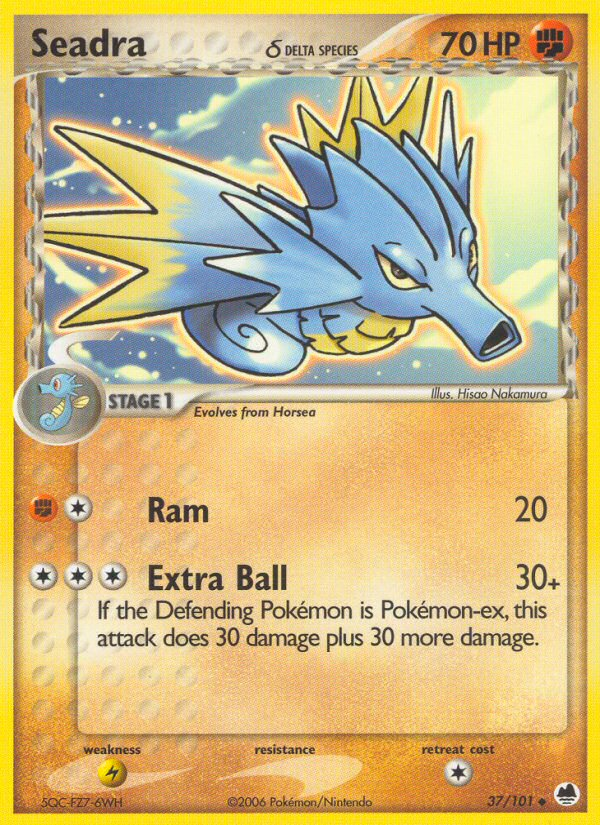
Image courtesy of TCGdex.net
Delta lineage, dynamic strategy: understanding Seadra δ and its evolving line
In the era of Delta Species, Pokémon cards often defied the simple type lines players had grown accustomed to. Seadra δ captures that spirit: a Horsea family evolution that shifts its type into a different arena and adds a tactical edge against Pokémon-ex contenders. This is more than a cute quirk of design; it’s a deliberate balance choice that rewards careful energy management and matchup awareness. With 70 hit points, a single-stage upgrade from Horsea, and a fighting temperament, Seadra δ invites players to experiment with timing, energy attachment, and target selection ⚡🔥.
What makes this Delta evolution line tick?
First, the Δ designation signals a broader design philosophy from the Dragon Frontiers block. Delta Species changes aren’t only about a new look; they reframe typing, weaknesses, and sometimes even the typical rock-paper-scissors dynamics of a given match. Seadra δ arrives as a Fighting-type Pokémon at Stage 1, evolving from Horsea. That single pivot—shifting from the familiar Water-type lineage into a new elemental identity—has real implications for both offense and defense. In practical terms, you’ll build around energy costs that lean on Fighting energy and colorless options, creating a different tempo than a standard Water-type Seadra deck might.
Rarity aside, the card’s evolution from Horsea keeps the story intact: a quick, early game push into a more resilient stage. The Dragon Frontiers set aesthetic—with its dinosaur-esque dragons and frontier-inspired artwork—frames this line as a bridge between classic sea-crawler vibes and the Delta-era experimentation. Seadra δ’s illustrator, Hisao Nakamura, brings a dynamic, splashy style to the scene, lending the creature a sense of motion that mirrors its battle plan on the tabletop 🎨.
Attacks that reward thoughtful play
- Ram — Cost: Fighting + Colorless. Damage: 20.
- Extra Ball — Cost: Colorless + Colorless + Colorless. Damage: 30 (+), with a key twist: if the Defending Pokémon is a Pokémon-ex, this attack deals 30 more damage (totaling 60 under that condition).
That second attack—Extra Ball—is the strategic centerpiece of Seadra δ. Against non-EX opponents, it’s a serviceable 30-damage finisher or a solid setup tool once you’ve railed up a couple of Colorless energy anchors. Against Pokémon-ex, that extra 30 can swing a tight exchange in your favor, turning a mid-game stall into a decisive knockout. The energy curve matters here: three Colorless energies for a reliable 60 output against EXs can create favorable, rhythm-setting moments for less-experienced or more tempo-driven decks. In a Delta-era meta where EX monsters loomed large, Seadra δ offered a real counterplay option that rewarded patient resource management rather than brute force.
“Delta forms don’t just look different; they force you to rethink how you allocate energy and how you value type advantages.”
The line’s Ram attack gives you cheap, early pressure, especially when you want to pressure a fragile opponent before your opponent can set up strong auras or big EX attacks. The Extra Ball payoff then invites you to time your transitions: lean into early trades with Ram, then pivot to EX-punishing plays as you accumulate energy and identify Pokémon-ex threats on the battlefield 🔥.
Evolution timing and deck-building instincts
Seadra δ’s Stage 1 status (evolving from Horsea) means you’ll usually want to strike a balance between offensive tempo and endurance. In Delta Species decks, the ability to accelerate or stall can hinge on how soon you bring Seadra δ online and how well you protect it from Lightning-type threats that might appear in the metagame. Remember that, in this specific card instance, the drawback is not a defensive weakness in theory but a practical consideration in play: Seadra δ has a Lightning ×2 weakness, so you’ll want to plan matchups where your opponent’s Lightning-heavy decks don’t snowball your staging area too quickly. This kind of risk assessment—knowing when to scramble for a quick Ram attack and when to lean on the 60-damage option of Extra Ball—defines the delta-era playstyle ☄️.
Collector’s note: set, art, and value
Dragon Frontiers (ex15) remains a beloved era for many collectors who chase the Delta Species flavor and the set’s charismatic illustration work. Seadra δ is listed as Uncommon, a sweet spot for completing a Delta line without breaking the bank, especially for players who value the line’s thematic resonance more than sheer power. The card’s DexId is 117, and the set’s logo carries the signature frontier aesthetic that fans adore. With Hisao Nakamura’s art anchoring the card, the δ treatment flares with a sense of adventure—perfect for display alongside Horsea δ and other Delta variants in a runner-up, “completed collection” mood 💎🎴.
Pricing data from Card Market hints at accessibility: the average price hovers around 1.01 EUR, with low values dipping near 0.02 EUR. The trend indicators suggest modest movement rather than explosive spikes, a pattern typical for Delta-era staples that appeal to collectors and casual players alike. For dedicated traders, the delta line’s nostalgic pull—paired with a flexible Energy cost structure—can create appealing long-term growth in a well-rounded deck, even if this particular Seadra δ doesn’t boast holo-foil status in most prints.
Playing with history, playing for the future
Seadra δ embodies a bridge between classic watery lineage and bold delta reinterpretation. Its two attacks encourage a patient, tempo-centric approach that leverages a Fighting-type identity in a sea of Water- and Colorless-focused decks. The line shows how Delta Species reimagined the battlefield by reassigning typings and tweaking weaknesses, giving seasoned players new puzzles to solve while keeping the core thrill of Pokémon battles intact ⚡🎮.
Whether you’re assembling a nostalgic Dragon Frontiers collection, hunting 60-damage counters for EXs, or simply savoring the “δ” aesthetics that defined a generation of cards, Seadra δ offers a compact, strategic kitchen-sink experience. It’s a punchy reminder that evolution in the Pokémon TCG isn’t only about bigger numbers—it’s about reshaping the rules you’ve learned to win on your terms.
Clear Silicone Phone Case: Slim, Flexible Open-Port DesignMore from our network
- https://crypto-acolytes.xyz/blog/post/llap-9-dhealth-live-long-and-prosper-series-nft-stats/
- https://crypto-acolytes.xyz/blog/post/nft-stats-mebananas127-from-monkeyseatbananas-collection/
- https://articles.zero-static.xyz/blog/post/dark-souls-new-characters-speculation-explored/
- https://crypto-acolytes.xyz/blog/post/neoxyz-272-neoxyz-nft-stats/
- https://articles.digital-vault.xyz/blog/post/pikachu-vs-raichu-how-the-tcg-performance-stacks-up/
Seadra δ
Set: Dragon Frontiers | Card ID: ex15-37
Card Overview
- Category: Pokemon
- HP: 70
- Type: Fighting
- Stage: Stage1
- Evolves From: Horsea
- Dex ID: 117
- Rarity: Uncommon
- Regulation Mark: —
- Retreat Cost:
- Legal (Standard): No
- Legal (Expanded): No
Description
Attacks
| Name | Cost | Damage |
|---|---|---|
| Ram | Fighting, Colorless | 20 |
| Extra Ball | Colorless, Colorless, Colorless | 30+ |
Pricing (Cardmarket)
- Average: €1.01
- Low: €0.02
- Trend: €1.1
- 7-Day Avg: €1.11
- 30-Day Avg: €0.85
Support Our Decentralized Network
Donate 💠More from our network
- https://crypto-acolytes.xyz/blog/post/llap-9-dhealth-live-long-and-prosper-series-nft-stats/
- https://crypto-acolytes.xyz/blog/post/nft-stats-mebananas127-from-monkeyseatbananas-collection/
- https://articles.zero-static.xyz/blog/post/dark-souls-new-characters-speculation-explored/
- https://crypto-acolytes.xyz/blog/post/neoxyz-272-neoxyz-nft-stats/
- https://articles.digital-vault.xyz/blog/post/pikachu-vs-raichu-how-the-tcg-performance-stacks-up/