
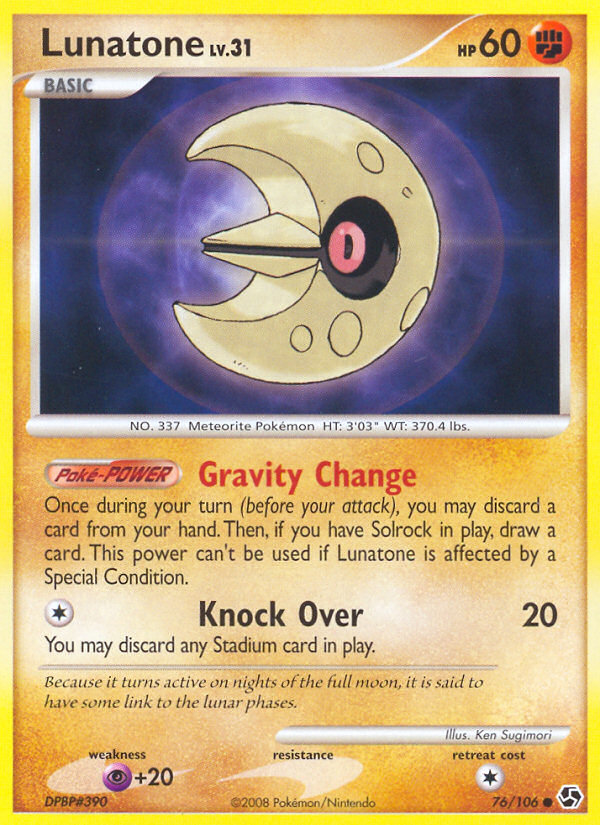
Image courtesy of TCGdex.net
Moon Lore and the Lunar Pokémon
Under a pale lunar glow, Lunatone drifts into view, its crescent silhouette catching starlight as if the night itself were a talisman. In the Pokémon trading card game universe, Lunatone embodies the night sky’s quiet wisdom and a cosmology rooted in ancient legends. The Great Encounters era—where this basic Fighting-type Pokémon first entered many players’ decks—took lunar symbolism and stitched it into gameplay. Ken Sugimori’s illustration captures that hushed, nocturnal energy: a stone-eyed orb tucking the moon’s secrets into its curve, inviting you to read the tides of battle as if they were centuries-old constellations. ⚡🔥
"The moon guides steady hands and patient minds—two traits Lunatone asks from any strategist who dares to play around its Gravity Change." 🎴
Moon Lore Meets Pokémon Mechanics
Lunatone’s lore-friendly design leans into the archetype of celestial balance. In the lore of the Pokémon TCG, the moon has long symbolized cycles, intuition, and the hidden tides of fate. This card’s flavor is reinforced by its in-hand power: Gravity Change. Once per turn, you may discard a card from your hand, and if Solrock is on the bench or in play, you draw a card—creating a subtle, lunar-tide tempo where you convert discard fodder into a new option. The caution that this Poke-Power can’t be used if Lunatone is suffering a Special Condition adds a quiet tension—moonlight is bright, but it can also be veiled by fog or shadow. Thematically, it mirrors ancient tales of celestial omens that bless or thwart a quest depending on the sky’s mood.
Pair Lunatone with Solrock to echo the sun-and-moon rhythm that folklore cherishes. In deck-building terms, Gravity Change becomes a careful resource—you sacrifice a card to gain a new one, and the presence of Solrock in play unlocks an extra card draw. It’s a small but satisfying nod to the old world’s belief that the heavens are an active, guiding force in every step of a journey. The card’s 60 HP and the vulnerability to Psychic attackers make it a delicate tempo piece—fragile enough to require careful positioning, but resilient enough to shape early-mid game skirmishes with the right support.
Strategic Spotlight: Knock Over and Stadium Disruptions
The other side of Lunatone’s toolkit is its attack, Knock Over, which costs a single Colorless energy and deals 20 damage. The real appeal lies in its optional effect: you may discard any Stadium card in play. Stadiums are the stage on which many games tilt—either enabling powerful draw engines, search tactics, or ruinous control effects. Lunatone’s ability to deliberately discard a Stadium can shut down an opponent’s combo line or nudge a match toward a more manageable tempo for you. In a world where tempo rules, “Discard a Stadium” can be as decisive as a late-game knockout, especially when you’re already leveraging Gravity Change to maintain pressure.
In practice, this means Lunatone shines in a deck that embraces resource management. You don’t just attack; you prune the battleground to your advantage. The Colorless cost keeps the door open wide—Lunatone can ride on a broad energy base, which is ideal for a stage that relies on strategic timing more than raw power. And with a Psychic-weakness of +20, Lunatone will encounter the kind of challenges that reward careful matchups, such as avoiding fast Psychic sweeps by leveraging your Stadium disruptions and Suolrock’s synergy. 🎮
Collectors’ Insight: Rarity, Variants, and Art
As a Common rarity in the Great Encounters set, Lunatone dp4-76 remains accessible to many collectors who want to complete a Moon- themed lineup without chasing high-price chase cards. The card exists in both normal and reverse-foil variants within that release, offering a tactile appeal for those who enjoy the texture-and-flair of reverse holos. Ken Sugimori’s art—authentic and evocative—continues to be a draw for fans who savor the era’s hand-drawn charm. While its official first edition count is not listed here, the absence of holo re-release in this specific card line keeps Lunatone grounded in a nostalgic, budget-friendly space. A common piece of a broader lunar constellation, it invites players and collectors alike to explore its moonlit mechanics and art. 💎
The card’s illustrator, Ken Sugimori, is a cornerstone of Pokémon’s visual identity. His rendition of Lunatone emphasizes curved geometry and serene facial features, turning a simple basic into a serene astral companion. Collectors who pair Lunatone with its sun-driven counterpart, Solrock, can curate a cohesive lunar-solar display that spans multiple sets, eras, and print styles. The artifact-like feel of this card—compact, unassuming, yet full of clever interactions—often appeals to players who enjoy deck-building that rewards patience, planning, and a touch of nostalgia. 🎨
Market Pulse: Value Trends and Practical Pricing
Market data for Lunatone dp4-76 shows a practical, budget-friendly footprint. CardMarket reports a range of prices with a low around 0.02 EUR and an average around 0.15 EUR; a “mid” around 0.28 EUR and occasional spikes toward 2.33 EUR for a fully realized normal print under certain conditions. On TCGPlayer, the normal (non-holo) version trades in the 0.11 USD to 0.28 USD neighborhood, with a market price around 0.35 USD, while reverse-holo variants can fetch a bit more, often hovering near 0.59–1.08 USD and up to 2.50 USD in some listings. For budget-focused collectors and casual players, Lunatone remains an approachable entry that can slot into lunar-themed decks without a heavy financial commitment. This stability—paired with its intriguing ability and its appealing art—helps it hold a quiet, steady demand among moon-lore enthusiasts. 🔎
Whether you’re compiling a “Moonlit Deck” for casual play, aiming to showcase a Ken Sugimori-era aesthetic, or simply collecting a piece of the ancient cosmos in card form, Lunatone offers a thoughtful blend of lore and gameplay. It reminds us that the Moon, in the Pokémon universe, is more than a backdrop—it’s a guiding force shaping strategy, aesthetics, and the stories players tell as they battle beneath a silvered sky. ⚡
Ready to sharpen your setup with a modern desk companion? Check out the Gaming Mouse Pad Neoprene 9x7 stitched edges—an ideal workspace accessory for long drafting sessions and weekend tournaments. Gaming Mouse Pad Neoprene 9x7 Stitched Edges ⚡
More from our network
- https://crypto-acolytes.xyz/blog/post/nft-stats-777-club-16-from-777-club-collection/
- https://crypto-acolytes.xyz/blog/post/master-minecraft-phantom-survival-essential-night-safety-tips/
- https://crypto-acolytes.xyz/blog/post/nft-stats-lil-chiller-633-from-lil-chillers-collection/
- https://wiki.digital-vault.xyz/wiki/post/pokemon-tcg-stats-ciphermaniacs-codebreaking-card-id-sv085-104/
- https://wiki.digital-vault.xyz/wiki/post/pokemon-tcg-stats-meditite-card-id-sm7-76/
Lunatone
Set: Great Encounters | Card ID: dp4-76
Card Overview
- Category: Pokemon
- HP: 60
- Type: Fighting
- Stage: Basic
- Dex ID: 337
- Rarity: Common
- Regulation Mark: —
- Retreat Cost: 1
- Legal (Standard): No
- Legal (Expanded): No
Description
Abilities
-
Gravity Change — Poke-POWER
Once during your turn (before your attack), you may discard a card from your hand. Then, if you have Solrock in play, draw a card. This power can't be used if Lunatone is affected by a Special Condition.
Attacks
| Name | Cost | Damage |
|---|---|---|
| Knock Over | Colorless | 20 |
Pricing (Cardmarket)
- Average: €0.15
- Low: €0.02
- Trend: €0.17
- 7-Day Avg: €0.16
- 30-Day Avg: €0.12
Support Our Decentralized Network
Donate 💠More from our network
- https://crypto-acolytes.xyz/blog/post/nft-stats-777-club-16-from-777-club-collection/
- https://crypto-acolytes.xyz/blog/post/master-minecraft-phantom-survival-essential-night-safety-tips/
- https://crypto-acolytes.xyz/blog/post/nft-stats-lil-chiller-633-from-lil-chillers-collection/
- https://wiki.digital-vault.xyz/wiki/post/pokemon-tcg-stats-ciphermaniacs-codebreaking-card-id-sv085-104/
- https://wiki.digital-vault.xyz/wiki/post/pokemon-tcg-stats-meditite-card-id-sm7-76/