
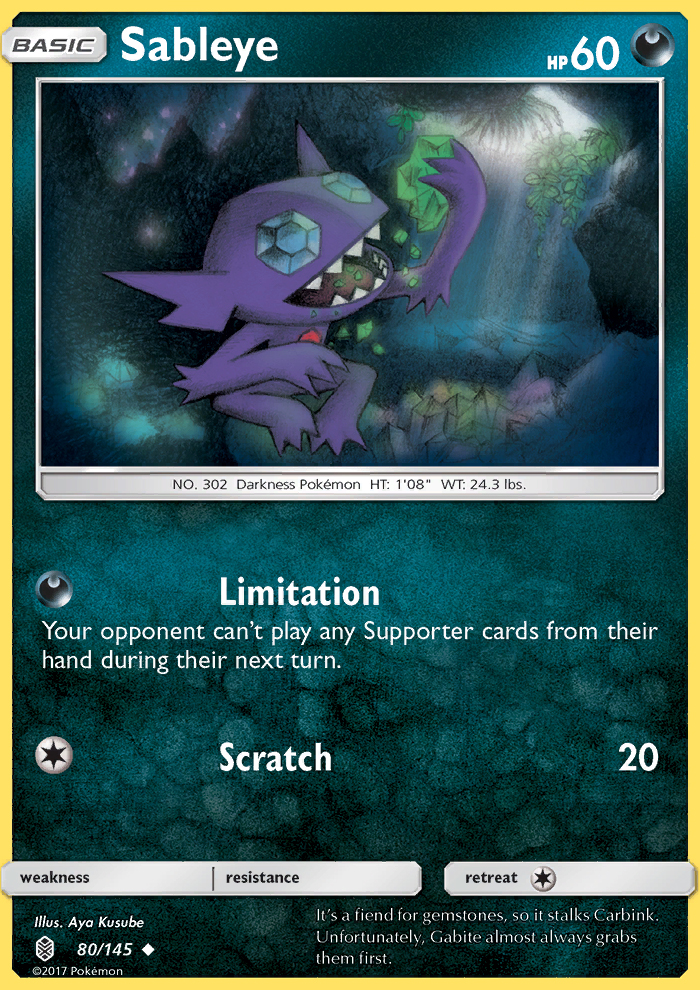
Image courtesy of TCGdex.net
Timing Sableye's Limitation: A Tempo-Tilt Guide for Pokémon TCG Players
In the Guardians Rising era, Sableye enters the fray as a lean, cunning disruptor. This Basic Darkness creature, boasting a modest 60 HP and two bite-sized attacks, invites you to win not by raw power but by tempo, timing, and misdirection. Illustrated by the talented Aya Kusube, this Uncommon gem embodies a sneaky, late-night pickpocket of the opponent’s momentum. Its first attack, Limitation, costs a single Darkness energy and quietly reshapes the pacing of a match by preventing your foe from playing any Supporter cards from their hand on their next turn. The second attack, Scratch, deals 20 damage for a Colorless cost. It’s not flashy, but for the right deck and the right moment, Sableye can pinch a win right when opponents think they’re guiding the tempo.
What Limitation actually changes on the table
The heart of Sableye’s power lies in the ripple effect of Limitation. In a game where Supporters drive most draws, searches, and set-up lines, turning off that engine for a full turn can be a game-changing pause. Your opponent can still use Items (like Quick Balls or Ultra Balls) and Basic Attacks, but they cannot play Supporters from their hand on their next turn. That creates an opening for you to establish your board, stack resources, or set up a stronger attacker while their options are narrowed.
With Sableye’s 60 HP, you’ll want to respect the math of tempo. A single hit from a larger foe or a smart combination of a few Benched Pokémon could knock it out if you don’t plan the timing carefully. That’s part of the thrill: you’re balancing risk versus reward, deciding whether to deploy Limitation early to blunt a critical draw engine or wait for a moment when your own setup and deck composition make the next turn’s lock feel decisive.
Crafting the timing: when to press the button
Timing is the name of the game. Here are practical guidelines to weave Limitation into your strategy without overreaching:
- Assess the opponent’s rhythm: If you expect your opponent to rely heavily on Supporters to chain draws, plays, and tutors, triggering Limitation when they’re about to draw into a key combo can stall their plan long enough for you to grab the initiative.
- Attach and attack on the turn you need to pressure: On a typical turn, you can attach one Darkness energy and use Limitation, provided you have the necessary resources. This makes Sableye a surprising early-game disruptor, especially if you’re patient about using Scratch to chip away at a troubled board.
- Protect your disruptive asset: Because Sableye is a compact Basic with limited HP, place it on a plan where you can pivot to a sturdier attacker or set up a second threat by the time Limitation’s effect resolves. Bench management matters: you don’t want to be forced to retreat into a vulnerable target just as your opponent’s Supporter stops coming.
- Pair with non-Supporter draw and search: Build a deck that relies on Items and evolving threats, not solely on Supports. That balance makes Limitation more reliable, letting you keep pressure while your higher-HP attackers or evolving threats come online.
Deck-building notes for a Sableye-centered strategy
Even though Sableye’s a compact unit, smart deck design can maximize its impact. Consider these considerations when constructing around Limitation:
- Energy flexibility: The first attack costs Darkness; ensure you have reliable access to Darkness energy so that Limitation can be deployed on important turns. A couple of extra Dark energies in the early game can keep you from stalling out due to a slow start.
- Supporter-disruption timing lines up with your win condition: If your deck aims to win via bench control and gradual tempo, Limitation can bridge the gap while you set up a larger threat. It’s less about outright damage and more about dictating the pace of the match.
- Bench pressure and retreat economy: With a retreat cost of 1, Sableye can be shuffled safely into a more robust finisher or tracked to the back of your bench while you pressure with other Pokémon. A careful retreat plan helps manage risk when Limitation buys you a turn of control.
Art, lore, and the feel of the card
Aya Kusube’s illustration invites you into Sableye’s world—the sly, gem-haunting trickster of the night. The Guardians Rising set, represented here as SM2, ties the character to a broader ecosystem where dark cunning meets island resilience. The artistry is not just eye candy; it’s a reminder that Pokémon TCG is a storytelling medium as much as a battlefield. The card’s Uncommon rarity sits nicely in the collector’s pocket and in casual play, a small but meaningful piece of a larger puzzle.
Collector’s snapshot: market value and collectibility
For collectors, this Sableye is a compelling case study in modern price dynamics. Non-holo versions tend to sit in the few-cent to few-dime range, while holo copies can fetch noticeably higher prices. Current price data shows:
- TCGPlayer (normal): low around 0.05 USD, mid around 0.20 USD, high around 1.49 USD
- TCGPlayer (market price): approximately 0.18 USD on average
- CardMarket (non-holo): average near 0.09 EUR, with holo variants up to around 0.27 EUR on average and occasional spikes higher for reverse holos
- Reverse holo values can climb to around 5.99 USD in transparent market conditions, reflecting collector demand
So, while the base card is accessible, the holo and reverse-holo iterations offer a meaningful target for players and collectors who love the vintage whisper of Guardians Rising. The artwork, the thematic fit with Sableye’s misdirection, and the practical pun of Limitation all contribute to why this little Dark-type can stay on a deck’s lips as a clever tempo tool.
Connecting to the broader Pokémon TCG landscape
The timing concept you practice with Sableye isn’t isolated to a single card. It echoes across the TCG community, where players seek to press their advantage at the exact moment opponents are most vulnerable. In the current climate, decks that blend disruption with tempo, while minimizing reliance on high-HP behemoths, tend to stay ahead. Sableye’s Limitation is a microcosm of that philosophy: a small, precise tool that can tilt key turns toward your side of the table, especially when you’re building toward a broader offensive plan that comes to life on later turns.
For fans who love the thrill of reading the board and timing their next strike, Sableye offers a nostalgic yet practical play pattern. The card’s quintessential charm lies in that moment when your opponent realizes their turn just got a little more complicated because a tiny, twinkling gem of a creature decided to interrupt their rhythm. ⚡🔥💎🎴🎨🎮
Interested in adding this strategic disruptor to your collection or your next deck build? Check the product link below and see how this little stalwart fits into your plan.
Non-slip Gaming Mouse Pad Neon Vibrant Polyester Surface
More from our network
- https://blog.crypto-articles.xyz/blog/post/exploring-gothitelle-evolution-line-design-in-pokemon-tcg/
- https://crypto-acolytes.xyz/blog/post/how-esports-scholarships-are-growing-at-universities/
- https://crypto-acolytes.xyz/blog/post/jars-of-dough-35-jars-of-dough-nft-stats/
- https://articles.zero-static.xyz/blog/post/minecraft-copper-grate-hardness-and-blast-resistance-explained/
- https://blog.crypto-articles.xyz/blog/post/explores-deoxys-lore-across-generations-in-pokemon-tcg/
Sableye
Set: Guardians Rising | Card ID: sm2-80
Card Overview
- Category: Pokemon
- HP: 60
- Type: Darkness
- Stage: Basic
- Dex ID: 302
- Rarity: Uncommon
- Regulation Mark: —
- Retreat Cost: 1
- Legal (Standard): No
- Legal (Expanded): Yes
Description
Attacks
| Name | Cost | Damage |
|---|---|---|
| Limitation | Darkness | |
| Scratch | Colorless | 20 |
Pricing (Cardmarket)
- Average: €0.09
- Low: €0.02
- Trend: €0.11
- 7-Day Avg: €0.05
- 30-Day Avg: €0.08
Support Our Decentralized Network
Donate 💠More from our network
- https://blog.crypto-articles.xyz/blog/post/exploring-gothitelle-evolution-line-design-in-pokemon-tcg/
- https://crypto-acolytes.xyz/blog/post/how-esports-scholarships-are-growing-at-universities/
- https://crypto-acolytes.xyz/blog/post/jars-of-dough-35-jars-of-dough-nft-stats/
- https://articles.zero-static.xyz/blog/post/minecraft-copper-grate-hardness-and-blast-resistance-explained/
- https://blog.crypto-articles.xyz/blog/post/explores-deoxys-lore-across-generations-in-pokemon-tcg/