
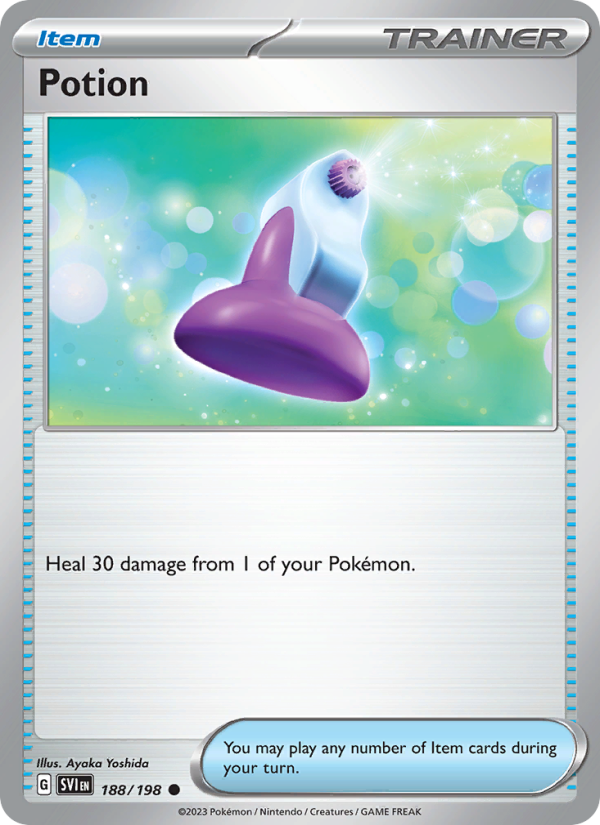
Image courtesy of TCGdex.net
Healing and High-Damage: Potions Role in Damage Maximization
In the Scarlet & Violet era of the Pokémon TCG, even a humble Item trainer card can swing the momentum of a match. Potion, a common trainer from SV01 illustrated by Ayaka Yoshida, embodies a deceptively simple concept with outsized tactical potential: heal 30 damage from one of your Pokémon. It’s easy to overlook in a fast-paced game, but when timed correctly, this single card can extend your offensive window, reduce opponent pressure, and pave the way for more aggressive plays across several turns. ⚡
First, let’s ground ourselves in the card’s basics. Potion belongs to the Trainer category as an Item, part of the Scarlet & Violet set. The card features a straightforward effect—heal 30 damage from one of your Pokémon—and its rarity is Common. Given its regulation mark G, Potion remains legal in both Standard and Expanded formats, making it a staple option for entry-level decks and budget-conscious players alike. The art by Ayaka Yoshida adds a touch of charm to an otherwise practical tool, reminding us that the TCG lives at the intersection of strategy and storytelling. 🎨
From a collector’s standpoint, Potion is also a reminder of why common cards still matter in a well-rounded deck. Its low entry price keeps new players in the game, while still existing printings under SV01’s umbrella provide enough supply for modern play. CardMarket data shows an average price around €0.05 with occasional dips to roughly €0.02, a signal that this card trades in the affordable corner of the market. For holo enthusiasts, the value can rise—holo versions fetch higher averages, reflecting demand for variety and shininess in playsets. This pragmatic pricing makes Potion a go-to pick for building resilient, cost-effective setups. 💎
Strategies for Maximizing Damage through Healing Synergy
So how do you turn a 30-point heal into real damage output? The key is healing as a strategic asset that sustains your frontline pressure over multiple turns. Here are several practical approaches you can try in real games and friendly matches:
- Extend the lifespan of your primary attacker. When your main attacker looks caved-in after a tough exchange, Potion can restore enough HP to prevent a knockout by your opponent’s next attack. By keeping that attacker active, you maintain the threat of continuing to push damage on subsequent turns, rather than sacrificing tempo to a KO. This is especially valuable against aggressive decks that rely on rapid knockouts to shut down your momentum.
- Set up two-turn or multi-turn KOs. Even if your current hand lacks the immediate power to KO, Potion buys you crucial turns to assemble the right board state. You can preserve a damaged Pokémon, pump it with additional damage later, and realize a larger KO on a following turn. The beauty is in the timing—heal first on your turn, then strike with a stronger or more efficient attack once you’ve gathered the right resources or evolved line.
- Preserve bench options and spread pressure safely. Healing helps you maintain the balance between attacking and retreating. If you’re playing a deck that uses retreat costs or switching effects to reconfigure your board, Potion gives you the stability needed to reposition without surrendering board presence. Keeping options open is often as valuable as dealing raw damage in a single swing.
- Complement with resilient evolutions and sturdy attackers. In practice, you’ll want attackers that can leverage extended play—Pokemon with strong, repeatable damage outputs that benefit from higher uptime. Potion acts as a reliable insurance policy so you aren’t forced to sacrifice your best threats too early in the game. This synergy creates a rhythm where you chip away at your opponent while maintaining pressure across two or more turns.
Timing is everything. The best Potion plays often come at moments when your opponent has just pried away a significant threat or when you anticipate a big hit that could KO your asset. Using Potion on the right turn reduces the risk of a quick sweep and keeps your offense humming. It’s a quiet kind of power—the kind that politicks the pace of a match without shouting for attention.
Furthermore, Potion’s role isn’t limited to raw HP restoration. It also cultivates a mental edge. Opponents learn to expect a healing swing on your next turn, which can affect their decision-making around their own tempo. This psychological dimension—knowing that your deck can stall or extend across turns—adds a layer of strategic depth to a seemingly simple card. 🎯
Art, Lore, and a Card That Feels Like a Friendly Hand
Ayaka Yoshida’s artwork on Potion brings a breezy, approachable vibe to a toolkit that every trainer should respect. The card’s art communicates accessibility and reliability—a visual cue that healing is within reach, even in the heat of battle. In Scarlet & Violet, where many players chase powerful archetypes and dramatic plays, Potion reminds us that progress often comes in small, steady increments. The accessibility of a common card with such practical utility reinforces the idea that every deck, even those built on a strict budget, can find meaningful leverage with the right timing and strategy. 🖼️
From a lore perspective, healing items are a timeless motif in the Pokémon world. They echo the in-world practice of caring for battle-weary Pokémon, translating that concept into a tangible in-game effect. For collectors and players who enjoy the tactile, narrative feel of the game, Potion embodies a warm bridge between tabletop tactics and the world-building that makes Pokémon so enduring. 🎴
Market Trends and Practical Takeaways for Collectors
If you’re monitoring the market, Potion remains a dependable, accessible option. The SV01 card pool is broad, and Potion’s Common rarity ensures it’s widely printed across several reprints, enhancing availability for players who need reliable, budget-friendly resources. In practice, you’ll often see this card included in budget decks that prioritize consistent healing to maintain offense. The pricing snapshot from CardMarket shows a healthy baseline around €0.05, with holo variants attracting a modest premium. For new collectors, Potion is a smart entry point into the Scarlet & Violet family without overextending your budget. 🔎
As new sets roll out, Potion’s standing shifts with the broader metagame, but its core utility remains stable. It’s worth keeping a handful on hand, especially if you’re building a deck that emphasizes grind-and-punish playstyles or if you enjoy experimenting with tempo-based strategies. The card’s regulation-friendly nature means you don’t have to chase rare prints to stay competitive, and its consistent availability makes it a reliable foundation for casual to mid-tier tournaments alike. ⚡
Deck-Building Notes and Quick Data
- Name: Potion
- Card type: Trainer – Item
- Set: Scarlet & Violet (SV01)
- Illustrator: Ayaka Yoshida
- Rarity: Common
- Effect: Heal 30 damage from 1 of your Pokémon
- Regulation: Standard and Expanded (Mark G)
- Variants: Normal and Reverse holo
More from our network
- https://crypto-acolytes.xyz/blog/post/nft-stats-lion-of-liquania-1174-from-lions-of-liquania-collection/
- https://transparent-paper.shop/blog/post/stable-diffusion-xl-prompt-expressionism-cybercathedral-circuit-maze-periwinkle-haze-snow-texture-moody-chiaroscuro/
- https://crypto-acolytes.xyz/blog/post/sheepmood-47-sheepmood-official-collection-nft-stats/
- https://blog.crypto-articles.xyz/blog/post/nft-data-heavy-liquid-graphic-786-from-heavy-liquid-graphic-collection-on-magiceden/
- https://blog.rusty-articles.xyz/blog/post/dorados-blue-white-beacon-at-34k-kelvin/
Potion
Set: Scarlet & Violet | Card ID: sv01-188
Card Overview
- Category: Trainer
- HP:
- Type:
- Stage:
- Dex ID:
- Rarity: Common
- Regulation Mark: G
- Retreat Cost:
- Legal (Standard): Yes
- Legal (Expanded): Yes
Description
Pricing (Cardmarket)
- Average: €0.05
- Low: €0.02
- Trend: €0.04
- 7-Day Avg: €0.03
- 30-Day Avg: €0.05
Support Our Decentralized Network
Donate 💠More from our network
- https://crypto-acolytes.xyz/blog/post/nft-stats-lion-of-liquania-1174-from-lions-of-liquania-collection/
- https://transparent-paper.shop/blog/post/stable-diffusion-xl-prompt-expressionism-cybercathedral-circuit-maze-periwinkle-haze-snow-texture-moody-chiaroscuro/
- https://crypto-acolytes.xyz/blog/post/sheepmood-47-sheepmood-official-collection-nft-stats/
- https://blog.crypto-articles.xyz/blog/post/nft-data-heavy-liquid-graphic-786-from-heavy-liquid-graphic-collection-on-magiceden/
- https://blog.rusty-articles.xyz/blog/post/dorados-blue-white-beacon-at-34k-kelvin/