
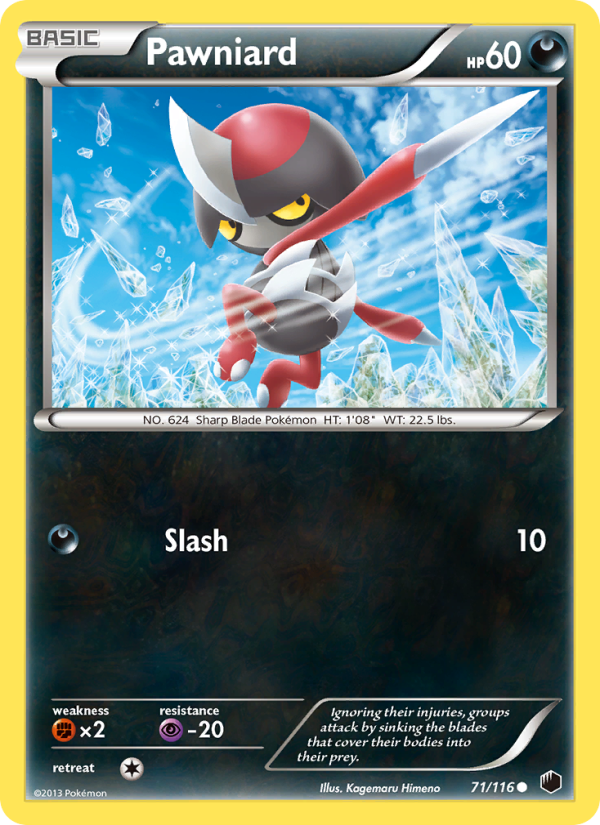
Image courtesy of TCGdex.net
Strategic sparks: turning Pawniard's modest swing into real damage
In the Plasma Freeze era, the little Pawniard brings a scrappy edge to a Darkness-focused lineup. With 60 HP, a single basic attack, and a clear path to its evolution, this Common Pokémon is a textbook lesson in how tempo and board state matter just as much as raw numbers. Illustrated by Kagemaru Himeno, Pawniard’s line teases bigger things to come—namely, Bisharp—so the true game is about maximizing value from a humble start. ⚡🔥
Card snapshot: what you’re playing with
- Name: Pawniard
- HP: 60
- Type: Darkness
- Stage: Basic
- Rarity: Common
- Attack: Slash — 10 damage
- Energy Cost: Darkness
- Weakness: Fighting ×2
- Resistance: Psychic -20
- Retreat Cost: 1
- Evolution: Evolves into Bisharp
- Set: Plasma Freeze (bw9)
- Legal (Format): Expanded
- Illustrator: Kagemaru Himeno
Pawniard is purpose-built for quick pressure, not a marathon slugfest. Its Attack, Slash, costs one Darkness energy and deals a modest 10 damage. That frugal cost is the card’s secret weapon: you can stack early advantage by accelerating Energy, searching for its evolution, and loading up Bisharp with the bigger, late-game damage that wins games. In other words, Pawniard is the spark, Bisharp is the flame. 🎴🎨
How to maximize damage: core ideas
To extract meaningful offense from this skeleton of a card, you need a plan that leverages tempo and evolution. Here are the pillars that consistently push Pawniard from a tease to a knockout threat:
- Evolution timing: Evolve to Bisharp as soon as you can safely do so. Bisharp typically wields more powerful attacks, and the moment you swing into that bigger threat, your deck’s damage curve takes a sharp bend upward. Plan your turn to evolve when you can keep energy on the board and maintain a threatening board presence.
- Energy acceleration: Use Darkness-energy acceleration to ensure you can attach a single energy to Pawniard on the first turn and still power Bisharp on the next. Cards that search for or accelerate Darkness energy help you bridge the tempo gap between Pawniard and Bisharp's stronger moves.
- Search and setup tools: Include trainers and supporters that fetch Pawniard, Bisharp, or additional Darkness energy. A quick fetch-and-attach sequence reduces the risk of getting stalled while you prepare your primary attacker.
- Board parity and protection: Don’t over-commit to a single target. If the active Pawniard threatens a big swing only after its evolution, you can weather a few exchanges by benching an extra Pawniard or two to maintain pressure and options when your opponent answers back.
- Damage modifiers and synergy: While this specific card’s core is a low-cost, early-pressure engine, your deck can incorporate other Darkness attackers or support cards that boost damage, increase attack speed, or help you retrieve the evolved Bisharp quickly. The goal is to turn one or two well-timed attacks into a knockout window for your Bisharp.
Two-turn plan: a plausible road to bigger numbers
Turn 1: Open with Pawniard on the bench or active. Attach a Darkness energy and use Slash for 10 damage. The goal is not to KO immediately but to place early pressure and set up your secondary attacker. While Pawniard chips away, your bench and hand work toward bringing Bisharp into play with an energy ready to go.
Turn 2: Evolve Pawniard into Bisharp (if you’ve drawn the evolution line and have a card in hand or in play that enables the evolution). With Bisharp out, you unleash its bigger attack—often delivering a much more consequential amount of damage and swinging the tempo firmly in your favor. The exact damage depends on your energy access and the supporting tools in your deck, but the leap from 10 to Bisharp’s primary attack is the core payoff of this strategy. 🔥
Two things to watch: stay mindful of your opponent’s removal and disruption, and ensure you have a backup plan if Bisharp’s arrival is delayed. A well-timed energy surge or a search effect can keep you on track, even if your initial plan stalls for a turn. The joy is watching a lowly Basic evolve into a board-swinging threat that your opponent must respect. 💎
Deck-building tips for a Pawniard-forward plan
- Balance your count: A focused Pawniard/Bisharp engine benefits from a lean, reliable support package. Favor cards that search, attach, and evolve, with a few utility trainers to narrows gaps when draws run dry.
- Preserve energy lines: Don’t over-commit to Pawniard’s early pressure if you can’t reliably evolve. Keep enough energy in the discard or in hand to accelerate Bisharp as soon as the moment arises.
- Weakness management: Remember Pawniard’s Fighting-type weakness. If you’re facing a deck rife with Fighting Pokémon, plan for a quick switch or cushion the losses with resilient bench options and removal support.
- Market-minded collector insights: Even though Pawniard is a Common card, the holo variants can carry a premium. For budget players, the non-holo versions provide value in play, while holo copies shine on the collector shelf. Current market trends show holo prices often hovering higher than standard cards, with low-end ranges in the tenths of a euro or dollar, and holo highs moving into the low single digits for well-kept copies. Always check the latest listings on CardMarket and TCGPlayer for up-to-date values. 🛍️
- Evolution lane: If Bisharp remains elusive, keep Pawniard ready for future turns and pivot to a versatile plan—this is where a flexible trainer suite shines, allowing you to adapt to your opponent’s strategy while you chase the big payoff.
Collector’s snapshot: rarity, value, and availability
The Pawniard card from Plasma Freeze sits at Common rarity, a category that typically emphasizes playability and splash value over high resale. In the current market, non-holo copies trend around a few tenths of a euro or dollar on average, with holo versions commanding higher curiosity and collector interest. CardMarket shows an average around €0.18 for basic copies, plus a holo-range that can approach higher euros. On TCGPlayer, normal printings hover near $0.09–$0.25, with reverse-holofoil exemplars climbing toward $0.40–$2 depending on condition and market demand. These figures fluctuate with set rotations and print runs, but the takeaway is clear: this paw is a budget-friendly play-and-collect option with the potential for hobby value, especially in holo form. 🔍
Aside from the immediate gameplay, Pawniard’s aesthetic—a compact silhouette of a blade-wielding Dark-type—fits nicely into a nostalgic PRISM of the Black & White era. The art, credited to Kagemaru Himeno, carries that signature sharpness and moody coloration that fans adore. It’s a reminder that even a seemingly modest card can carry a story, a moment in time when the game leaned into its darker, more strategic design language. 🎨
Art and vibe: the moment captured in Plasma Freeze
The artwork for Pawniard captures its predatory elegance—an agile assassin in miniature, ready to strike as soon as the energy aligns. Himeno’s piece echoes the set’s atmosphere: bold lines, a restrained palette, and a sense of imminent action. It’s the kind of card that looks great on a binder page and plays great on a tabletop, a reminder that strategy and style can go hand in hand. ⚡🎴
Product tie-in: upgrade your display while you game
While you fine-tune your Pawniard-Bisharp plan, you can also upgrade how you show off your collection. The Neon Card Holder MagSafe Phone Case is a stylish, practical companion for your phone stand, a perfect desk-side partner for note-taking, deck-building ideas, and rule-checks between rounds. It keeps your device safe while you curate your next big move in the TCG world. Neon Card Holder MagSafe Phone Case
More from our network
- https://blog.crypto-articles.xyz/blog/post/nft-data-fetix-2314-from-kode-fetix-collection-on-magiceden/
- https://crypto-acolytes.xyz/blog/post/nft-stats-nft-861-from-solana-terminals-collection/
- https://blog.crypto-articles.xyz/blog/post/nft-data-catwifmask-nft-145-from-catwifmask-nft-collection-on-magiceden/
- https://transparent-paper.shop/blog/post/aquila-blue-star-reveals-galactic-origins-through-motion-vectors/
- https://transparent-paper.shop/blog/post/stable-diffusion-xl-prompt-cyberpunk-neon-glow-fractal-labyrinth-quantum-aesthetic-matrix-inspired/
Pawniard
Set: Plasma Freeze | Card ID: bw9-71
Card Overview
- Category: Pokemon
- HP: 60
- Type: Darkness
- Stage: Basic
- Dex ID: 624
- Rarity: Common
- Regulation Mark: —
- Retreat Cost: 1
- Legal (Standard): No
- Legal (Expanded): Yes
Description
Attacks
| Name | Cost | Damage |
|---|---|---|
| Slash | Darkness | 10 |
Pricing (Cardmarket)
- Average: €0.18
- Low: €0.02
- Trend: €0.17
- 7-Day Avg: €0.17
- 30-Day Avg: €0.14
Support Our Decentralized Network
Donate 💠More from our network
- https://blog.crypto-articles.xyz/blog/post/nft-data-fetix-2314-from-kode-fetix-collection-on-magiceden/
- https://crypto-acolytes.xyz/blog/post/nft-stats-nft-861-from-solana-terminals-collection/
- https://blog.crypto-articles.xyz/blog/post/nft-data-catwifmask-nft-145-from-catwifmask-nft-collection-on-magiceden/
- https://transparent-paper.shop/blog/post/aquila-blue-star-reveals-galactic-origins-through-motion-vectors/
- https://transparent-paper.shop/blog/post/stable-diffusion-xl-prompt-cyberpunk-neon-glow-fractal-labyrinth-quantum-aesthetic-matrix-inspired/