
Image courtesy of TCGdex.net
Power Creep and Gastrodon East Sea: A Strategic Look at an Era-Spanning Benchmark
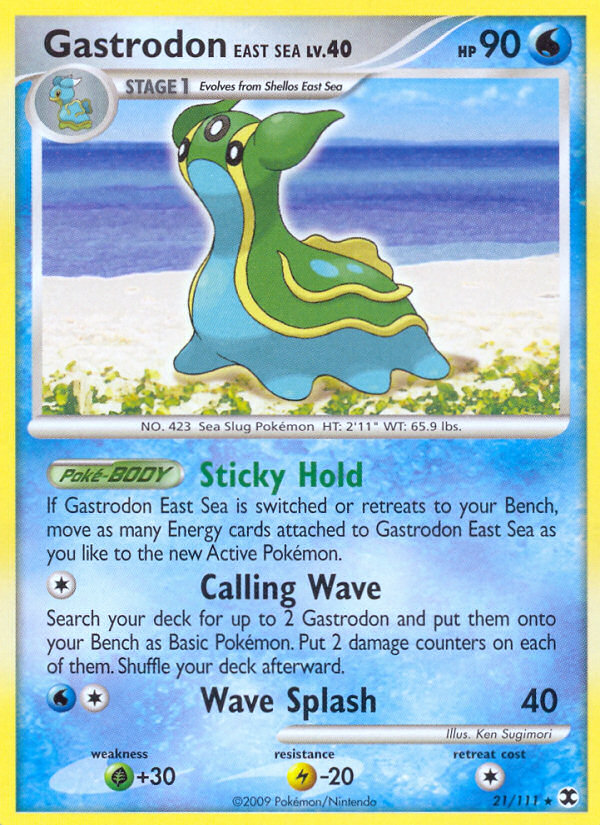
For many Pokémon TCG players, the phrase “power creep” is a nostalgic edit to a complex conversation: as new sets arrive with shinier moves, bigger HP, and more efficient energy acceleration, older cards can feel quaint or outclassed. Yet examining a card like Gastrodon East Sea—an early, thoughtfully designed trainer-friendly beast—provides a clear lens into how power creep evolved and how certain mechanics shaped deckbuilding across generations ⚡🔥. Released in Rising Rivals as a non- holo Rare, Gastrodon East Sea (pl2-21) wasn't just a single attacker; it was a strategic engine for bench development and energy management that could tilt the tempo of a match with the right play order.
Gastrodon East Sea is a Water-type Stage 1 Pokémon that evolves from Shellos East Sea. Its 90 HP places it in the middle of the curve for its era, sturdy enough to survive a few hits while you set up a more dominant board. What makes this card particularly noteworthy is its unique Poke-BODY called Sticky Hold. If Gastrodon East Sea is switched or retreats to your Bench, you may move as many Energy attached to Gastrodon East Sea as you like to the new Active Pokémon. It’s a subtle, but potentially explosive, energy-management tool that encourages exact timing and careful bench choreography. In a format where energy attachment and retreat costs often dictated tempo, Sticky Hold offered a flexible way to reallocate resources on the fly, keeping pressure on opponents while you assembled your biggest threats. 🧠
Two attacks support that strategic flexibility. Calling Wave is a powerful bench-accelerator-style move: for Colorless, you can search your deck for up to two Gastrodon and place them onto your Bench as Basic Pokémon, then place two damage counters on each of them and shuffle your deck. This is not just a flood; it’s a controlled spread that compounds your board presence across multiple turns, enabling layered threats and forcing your opponent to answer multiple lines of attack. The second attack, Wave Splash, costs Water + Colorless and deals 40 damage. While not explosive by modern standards, Wave Splash provides a reliable finisher or a consistent nudge to finish off weakened opposing Pokémon after your switching tricks. Taken together, these moves illustrate how early generation cards could leverage tempo without demanding heavy investment in draw-support or item-heavy setups. 🎴
Card at a glance
- Set: Rising Rivals (pl2)
- Rarity: Rare
- Stage: Stage 1 (evolves from Shellos East Sea)
- HP: 90
- Type: Water
- Attacks:
- Calling Wave — Colorless: Search your deck for up to 2 Gastrodon and put them onto your Bench as Basic Pokémon. Put 2 damage counters on each of them. Shuffle your deck.
- Wave Splash — Water + Colorless: 40 damage
- Weakness: Grass (+30)
- Resistance: Lightning (-20)
- Retreat: 1
- Illustrator: Ken Sugimori
In the broader arc of Pokémon TCG design, Gastrodon East Sea embodies a transitional moment: it bridges established bench-play concepts with the burgeoning idea that energy movement could be as influential as raw damage. Sticky Hold foreshadows the later emphasis on energy acceleration and efficient resource management, which would become central as newer formats introduced more complex trainers, supporters, and energy strategies. While the card itself isn’t standard-legal in today’s competitive scene (the card’s own metadata shows it was not legal in standard or expanded even when it was printed), its mechanics still resonate with players who study how early power creep shaped what later sets would aim to achieve: tempo control, flexible energy usage, and multi-pronged threats. 🎮
Power creep dynamics: what this card reveals about evolving design
Power creep in the Pokémon TCG isn’t just about bigger numbers. It’s about how ease of reach to multiple threats, precise energy management, and board presence evolve over time. Gastrodon East Sea’s Calling Wave bypasses heavy draw requirements by directly populating the bench with Gastrodon clones, pressuring the opponent to clear multiple threats at once. When paired with Sticky Hold, the player can reposition energy to enable a fresh Active Pokémon to hit the battlefield with momentum—an elegant workaround to early-game stall tactics that rely on keeping active Pokémon locked in place. This pattern—rapid bench development paired with flexible energy placement—became a throughline that later sets would adopt in more streamlined forms. The upshot is a card that feels gentle on the surface but demonstrates how one well-timed ability could ripple through deck design for years. 🪙
Collector’s snapshot: rarity, print run, and pricing hints
From a collector’s lens, Gastrodon East Sea sits as a Rare card in a popular. The card’s market presence today shows a split between non-holo copies and the more sought-after reverse holos. Card prices reflect general accessibility, with Cardmarket listing an average around €1.31 for standard copies and a range that can dip well below €1 while peaking near €2 for well-preserved or lightly-played examples. TCGPlayer data paints a similar picture in USD terms: normal copies commonly hover under $2, with reverse holofoils climbing toward $4–$5 in steady markets, depending on condition and seller. These numbers offer a valuable benchmark for collectors spotting rising interest in older sets and variants—especially those who value the historical lane of energy-centric design in the game’s evolution. The data underscores how power creep can elevate the value of strategic, mechanically rich cards when new formats or casual play rotate into emphasis. 💎
Practical takeaways for decks and casual play
- Tempo over brute force: Gastrodon East Sea demonstrates that controlling the pace of a game—by swelling the bench and redistributing energy—can outpace straightforward damage outputs in the right hands.
- Energy economy matters: Sticky Hold makes energy management a core lever. In practice, you’d time retreats to optimize energy transfers to your next attacker, turning a single card’s ability into a systems-level advantage.
- Format realities: While not legal in standard or expanded now, the card remains a fertile case study for how older sets influenced later rotations and deck-building heuristics. It’s a reminder that some of the most enduring ideas in TCG design began with niche, clever interactions.
- Collector value today: With non-holo copies widely available and reverse holos holding a premium, investing in this card is as much about history as it is about potential future appreciation—especially if nostalgia drives a broader interest in Rising Rivals. ⚡
- Art and lore: The painterly work of Ken Sugimori captures Gastrodon East Sea with a classic, water-tinged charm, reinforcing the creature’s lore as a coastal, East Sea variant that fans remember fondly. 🎨
More from our network
Gastrodon East Sea
Set: Rising Rivals | Card ID: pl2-21
Card Overview
- Category: Pokemon
- HP: 90
- Type: Water
- Stage: Stage1
- Evolves From: Shellos East Sea
- Dex ID: 423
- Rarity: Rare
- Regulation Mark: —
- Retreat Cost: 1
- Legal (Standard): No
- Legal (Expanded): No
Description
Abilities
-
Sticky Hold — Poke-BODY
If Gastrodon East Sea is switched or retreats to your Bench, move as many Energy cards attached to Gastrodon East Sea as you like to the new Active Pokémon.
Attacks
| Name | Cost | Damage |
|---|---|---|
| Calling Wave | Colorless | |
| Wave Splash | Water, Colorless | 40 |
Pricing (Cardmarket)
- Average: €1.31
- Low: €0.1
- Trend: €1.17
- 7-Day Avg: €1.18
- 30-Day Avg: €0.86
Support Our Decentralized Network
Donate 💠More from our network
- https://blog.crypto-articles.xyz/blog/post/nft-data-318-from-decent-ducks-collection-on-magiceden/
- https://transparent-paper.shop/blog/post/stable-diffusion-xl-prompt-cyberpunk-ottoman-tile-pattern-iridescent-metallic-airbrush-gradient-epic-sci-fi-poster-neon-noir/
- https://wiki.digital-vault.xyz/wiki/post/pokemon-tcg-stats-magnemite-card-id-hgss4-68/
- https://crypto-acolytes.xyz/blog/post/nft-stats-memeverse-327-from-memeverse-collection/
- https://blog.crypto-articles.xyz/blog/post/nft-data-haxz-1590-from-haxz-collection-on-magiceden/