
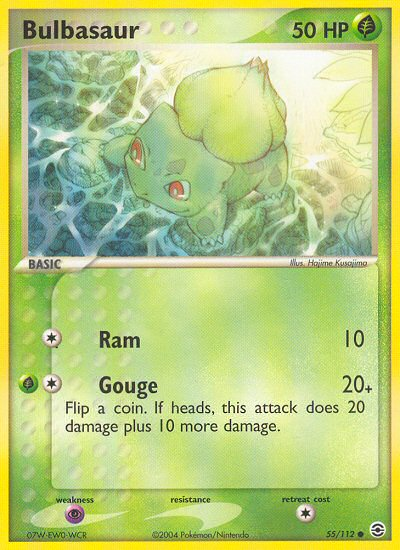
Image courtesy of TCGdex.net
Power Creep Analytics: Bulbasaur in the Modern TCG Meta
Power creep isn’t a dirty word in Pokémon TCG circles—it’s the market’s quiet, electric heartbeat. Each new expansion introduces stronger strategies, quicker damage, and smarter synergy that push older cards to the edge of relevance. Yet even a humble Basic like Bulbasaur—this fabled print from the FireRed & LeafGreen era—offers a surprisingly rich lens for examining how analytics interpret power growth over time. Let’s break down what power creep looks like through Bulbasaur’s numbers, its attacks, and the nostalgia wrapped around a Common Grass type that fans still treasure for its iconic art and enduring charm ⚡🔥.
Card snapshot: what the data tells us about this Bulbasaur
- Name: Bulbasaur
- Set: FireRed & LeafGreen (ex6) — print line with a 112-card official count
- Rarity: Common
- Type & Stage: Grass / Basic
- HP: 50
- Illustrator: Hajime Kusajima
- Attacks:
- Ram — Cost: Colorless; Damage: 10
- Gouge — Cost: Colorless + Grass; Damage: 20+, with a coin flip: if heads, this attack does 20 damage plus 10 more damage
- Weakness: Psychic x2
- Illustrative notes: The holo variant is part of the pull for collectors, with the classic Kusajima art style that fans still commemorate.
- Pricing snapshot: CardMarket shows a historically wide range (low around €0.25, average near €2.22, with holo values climbing higher), while TCGPlayer lists a spectrum from about $0.49 up to $33.19 for notable copies—reflecting holo-primed nostalgia more than raw power.
In the card’s own era, Bulbasaur’s kit was simple and elegant: a tiny baseline that could grow into a rounded deck with careful evolution. The basic 50 HP stands in stark contrast to the HP budgets of modern basics, which routinely eclipse 60, 70, or higher just to stand up to the heavier hitters that define today’s meta. The attacks—one cheap, one conditional—reward players who lean into coin-flip luck rather than reliable, consistent damage. It’s a classic, almost “starter-pack” design that feels quaint next to the relentless power creep of newer sets. Yet that quaintness is precisely what makes Bulbasaur so valuable for analytics: it’s a yardstick for power progression rather than a benchmark for competitive viability 🎮🎴.
Power creep through the analytics lens
When analysts model power creep, they typically measure a few core axes: raw damage output against energy costs, survivability (HP), consistency (reliability of effects), and ecosystem impact (how the card scales with evolutions and trainer-support). Bulbasaur illustrates each axis in a clean, approachable way:
- Damage per energy: Ram delivers 10 damage for a single Colorless energy, a respectable baseline in its day for a Basic. Gouge increases the curve to 30 damage on a heads scenario (20 base plus 10 more), but only with two energies and a coin flip, introducing a reliability risk that modern decks typically minimize with stable effects. In a modern context, a 50 HP starter that demands coin-flip risk to achieve mid-range damage is a hard sell against consistently performing 2-energy attacks that reliably exceed 30 damage.
- HP and survivability: With 50 HP, Bulbasaur sits far below today’s front-line basics, which often sport tougher survivability to weather early exchange. HP is a durable proxy for “time-to-trade” in the meta—older basics die more quickly to newer, beefier attackers, illustrating power creep in practice.
- Consistency vs. luck: The coin flip on Gouge is a microcosm of a broader tension in the TCG: risk-reward vs. reliability. Modern sets emphasize dependable outcomes, with effects that don’t hinge on RNG. Bulbasaur’s Gouge embodies an era where a lucky flip could swing a game, but a string of tails isolates a deck in a hurry.
- Evolution and synergy: Though Bulbasaur evolves into a line that includes Ivysaur and Venusaur in the broader FireRed & LeafGreen family, the raw strength of the chain is less about one card and more about the synergy in the entire line. In modern power creep terms, the value of a basic appreciates when its evolution line brings robust synergy with energy acceleration, trainer-cards, and your deck’s overall tempo. Bulbasaur’s basic-to-evolution dynamic is a reminder that growth curves are as important as single-turn output.
From a collector’s perspective, power creep also influences print runs and holo rarity. The existence of a holo Bulbasaur ex6-55 print can drive demand beyond what its raw stats would justify, because collectors chase “the feel” of older sets and the signature Kusajima artwork. This blend of nostalgia and power creep is why so many players invest in both competitive decks and well-preserved holo prints—the market rewards the aesthetic and historical significance as much as it rewards raw play value 💎🎨.
What this means for players and collectors today
For players, Bulbasaur remains a fascinating study in how old foundations compare to modern power curves. It’s a reminder that the most impactful cards aren’t always the strongest in a vacuum; they win through synergy, timing, and the broader engine of a deck. In a world where modern basics often feature higher HP, more reliable damage, and better synergy with Trainers and support Pokémon, Bulbasaur’s strength lies in its potential to anchor nostalgic, theme-based builds—if you enjoy the art, the vibe, and a trip down memory lane while you play, you’ll find a corner of the meta where it feels right. And for collectors, the holo and non-holo variants provide a tangible link to the era’s design philosophy, a snapshot of how power creep shaped set architecture and market dynamics over time ⚡🔥.
In short, Bulbasaur offers a compact, data-driven portrait of power creep in action: an era’s baseline that reveals how much the game has evolved. By weighing HP, attack reliability, and evolution potential, we can better understand why modern sets push for higher floors and steeper ceilings—and why fans keep returning to these early prints for warmth, artistry, and a dash of gambling-on-a-coin flip magic 🎴💎.
Neon Gaming Mouse Pad - Custom 9x7 Neoprene with Stitched EdgesMore from our network
- https://crypto-acolytes.xyz/blog/post/nft-stats-hero-1218-from-soul-gate-heroes-collection/
- https://transparent-paper.shop/blog/post/stable-diffusion-xl-prompt-retro-futurism-neon-noir-fractal-art-fur-texture-cyberpunk-arcade-aesthetic/
- https://blog.digital-vault.xyz/blog/post/master-photoshop-action-bundles-for-creators/
- https://articles.digital-vault.xyz/blog/post/inferno-of-the-star-mounts-a-nod-to-early-mtg-history/
- https://crypto-acolytes.xyz/blog/post/debros-695-debros-nft-stats/
Bulbasaur
Set: FireRed & LeafGreen | Card ID: ex6-55
Card Overview
- Category: Pokemon
- HP: 50
- Type: Grass
- Stage: Basic
- Dex ID: 1
- Rarity: Common
- Regulation Mark: —
- Retreat Cost:
- Legal (Standard): No
- Legal (Expanded): No
Description
Attacks
| Name | Cost | Damage |
|---|---|---|
| Ram | Colorless | 10 |
| Gouge | Colorless, Grass | 20+ |
Pricing (Cardmarket)
- Average: €2.22
- Low: €0.25
- Trend: €2.98
- 7-Day Avg: €2.89
- 30-Day Avg: €2.28
Support Our Decentralized Network
Donate 💠More from our network
- https://crypto-acolytes.xyz/blog/post/nft-stats-hero-1218-from-soul-gate-heroes-collection/
- https://transparent-paper.shop/blog/post/stable-diffusion-xl-prompt-retro-futurism-neon-noir-fractal-art-fur-texture-cyberpunk-arcade-aesthetic/
- https://blog.digital-vault.xyz/blog/post/master-photoshop-action-bundles-for-creators/
- https://articles.digital-vault.xyz/blog/post/inferno-of-the-star-mounts-a-nod-to-early-mtg-history/
- https://crypto-acolytes.xyz/blog/post/debros-695-debros-nft-stats/