
Image courtesy of TCGdex.net
Energy Retrieval and the Pulse of Power Creep in Pokémon TCG
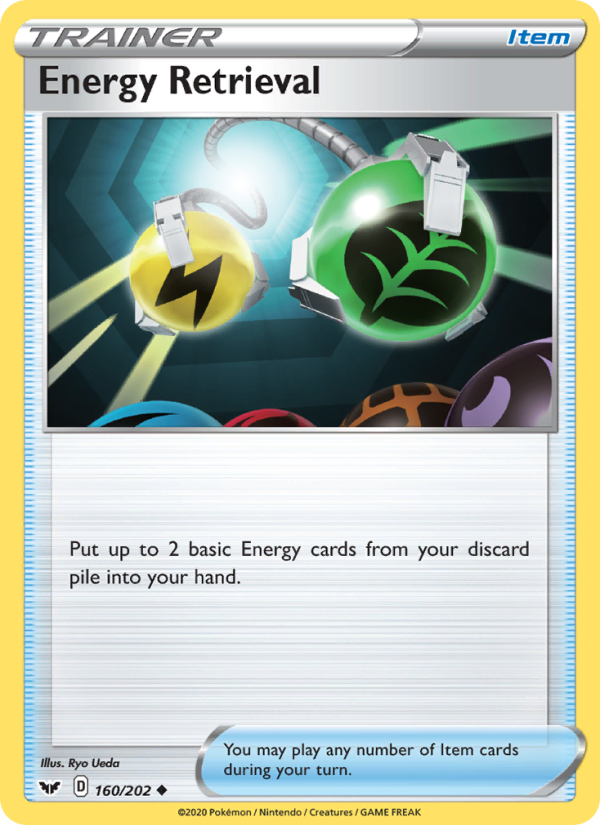
As the Pokémon TCG grows, so too does the conversation around power creep—the way new cards raise the ceiling of what’s possible, sometimes leaving foundational staples feeling dated. The trainer card Energy Retrieval from the Sword & Shield era offers a perfect case study. This Uncommon Item, illustrated by Ryo Ueda, belongs to swsh1 and carries a deceptively simple effect: “Put up to 2 basic Energy cards from your discard pile into your hand.” In a single line, it hints at wider dynamics: how efficiently a deck can recycle energy, how tempo shifts when you reclaim resources, and how the meta evolves as newer, shinier tools arrive on the field ⚡. The analytic lens reveals not only the card’s strength, but how power creep reshapes deck-building decisions across formats.
What Energy Retrieval does in practice
- Type and classification: Trainer — Item. It sits in the same family as other energy-acceleration tools, but its limited scope makes it a niche engine rather than a universal fix.
- Set and identity: Sword & Shield (swsh1), card swsh1-160. The illustration by Ryo Ueda anchors it to the early Sword & Shield aesthetics—clean lines, relatable trainer vibes, and a sense of practical, on-the-ground utility.
- Rarity and legal status: Uncommon. Legend has it that the card is Expanded-legal while not standard-legal in the current era, reflecting how card ecosystems evolve and curate space for older tools alongside new engines.
- Effect in plain terms: “Put up to 2 basic Energy cards from your discard pile into your hand.” This can momentarily refill energy resources after a discard-heavy turn or two, letting a player keep pressure on the board without fishing through the deck for new energy copies.
- Art and craft: The art direction and typography are clean, with no artificial embellishment—the card leans into practical nostalgia rather than spectacle.
“In the tempo wars of the metagame, efficiency is king’s land. Energy Retrieval is a clean, low-variance way to claw back two energies from the discard, but it doesn’t force the pace the way newer tools can.”
Analytics behind power creep: measuring value over time
Power creep isn’t just about raw damage or HP tallies. In Pokémon TCG, it’s about how a card’s efficiency, tempo, and card economy interact with evolving deck archetypes. Energy Retrieval provides a compact case study in three dimensions:
- Efficiency per play: The card’s cost is a single Trainer card with an effect that recovers up to two basic Energy cards. In early Sword & Shield-era terms, that’s a solid one-card engine to accelerate energy access without drawing extra resources or setting up complicated chains.
- Tempo impact: Returning two energy cards to hand after a discard-heavy turn can reduce the friction between energy attachment and utilization. But the tempo payoff hinges on how quickly a deck can leverage those retrieved energies—whether they translate into immediate attach-turn momentum or simply refill the energy count for later turns.
- Economy and format life span: The Expanded format keeps older tools viable longer, while Standard rotation pushes players toward newer accelerants. Energy Retrieval’s Expanded relevance demonstrates how power creep can be uneven across formats: a card that feels middling in Standard may still define niche, reliable play in Expanded, preserving its value for a subset of players.
From a market perspective, the card’s value aligns with its utility and format accessibility. CardMarket shows an average price around 0.19 EUR with occasional volatility, while TCGPlayer’s normal listings sit in the cents to dollar range depending on condition and listing dynamics. This affordability is typical for niche energy tools and helps explain why Energy Retrieval remains a staple for budget or legacy decks that prize consistency over flashy upgrades. The data snapshot reinforces a broader truth: power creep often nudges older staples toward selective use, rather than outright replacement, unless a newer tool delivers a clear, scalable advantage across a wide swath of decks.
Strategic takeaways for players and collectors
- Deck-building discipline: Use Energy Retrieval to stabilize mid-game energy counts, especially in builds that rely on discarding energy via attack costs or discard-generating effects. It’s a deliberate, patient engine rather than an explosive early-game spike.
- Format awareness: In Expanded, Energy Retrieval can see renewed synergy with other discard-and-recover strategies. In Standard, newer energy-recursion options may outpace it, but disciplined use still earns value on the table.
- Collector nuance: The Energy Retrieval card’s rarity and illustration by Ryo Ueda make it a tasteful collectible for Sword & Shield-era fans. Even if it isn’t the flashy centerpiece of a deck, it stands as a tangible snapshot of how energy management evolved through the early days of the era ⚡🎨.
- Investment perspective: For price-conscious collectors, the card presents a stable, low-risk addition. The combination of modest market prices and Expanded utility means it’s accessible for budget builds and for players testing discard-based strategies across years of play.
Connecting to the broader network and a featured product
While we analyze the mathematics of energy recycling, you can stay sharp while you game with gear that keeps your desk calibrated and ready for long night sessions. For fans who enjoy a clean, reliable surface, consider this neon-toned mouse pad—9x7 inches, neoprene, stitched edges. It pairs nicely with late-night deck-building sessions and on-stream strategizing, giving you the precision you crave as you optimize your list and test new sequences. Explore the product linked below to boost your setup while you hunt for that perfect Energy Retrieval loop.
Neon Gaming Mouse Pad 9x7in Neoprene with Stitched Edges
More from our network
- https://articles.digital-vault.xyz/blog/post/how-mods-kept-the-witcher-3-wild-hunt-alive-for-years-on-pc/
- https://blog.digital-vault.xyz/blog/post/how-to-use-product-hunt-for-maximum-impact/
- https://blog.rusty-articles.xyz/blog/post/pokemon-sword-and-shield-pros-and-cons-of-a-movie-adaptation/
- https://crypto-acolytes.xyz/blog/post/bbc-1514-battle-bros-club-nft-stats/
- https://blog.digital-vault.xyz/blog/post/statistical-insights-into-limits-of-solidarity-card-synergy-networks/
Energy Retrieval
Set: Sword & Shield | Card ID: swsh1-160
Card Overview
- Category: Trainer
- HP:
- Type:
- Stage:
- Dex ID:
- Rarity: Uncommon
- Regulation Mark: D
- Retreat Cost:
- Legal (Standard): No
- Legal (Expanded): Yes
Description
Pricing (Cardmarket)
- Average: €0.19
- Low: €0.02
- Trend: €0.1
- 7-Day Avg: €0.11
- 30-Day Avg: €0.16
Support Our Decentralized Network
Donate 💠More from our network
- https://articles.digital-vault.xyz/blog/post/how-mods-kept-the-witcher-3-wild-hunt-alive-for-years-on-pc/
- https://blog.digital-vault.xyz/blog/post/how-to-use-product-hunt-for-maximum-impact/
- https://blog.rusty-articles.xyz/blog/post/pokemon-sword-and-shield-pros-and-cons-of-a-movie-adaptation/
- https://crypto-acolytes.xyz/blog/post/bbc-1514-battle-bros-club-nft-stats/
- https://blog.digital-vault.xyz/blog/post/statistical-insights-into-limits-of-solidarity-card-synergy-networks/