
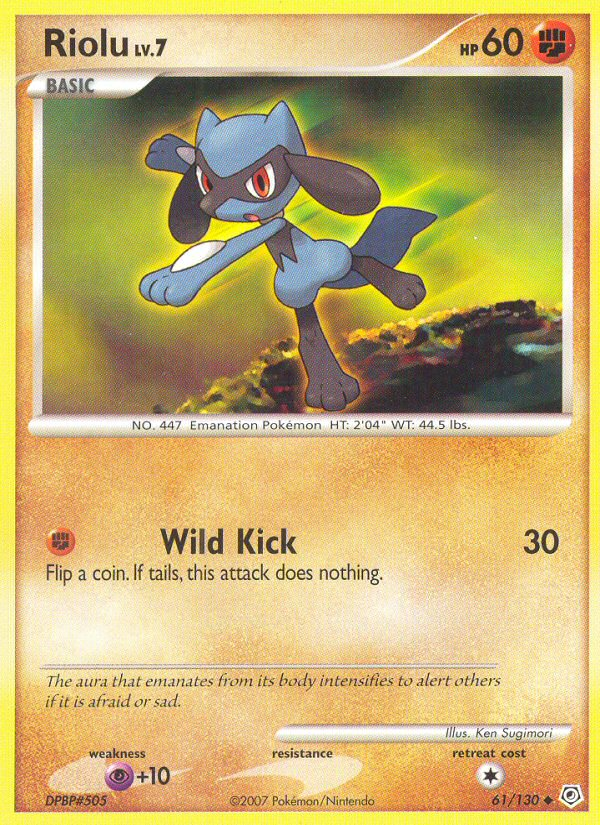
Image courtesy of TCGdex.net
Riolu price spikes aren’t just about a single card spiking up in value; they’re a case study in how supply, demand, and collector psychology collide in the Pokémon TCG market. The dp1-61 Riolu from the Diamond & Pearl era embodies several drivers that can push prices upward—sometimes overnight. With its 60 HP and basic Fighting-type frame, it’s a reminder that even a small, uncommons-level card can become a beacon for price action when the right conditions align. ⚡🔥
Understanding the mechanics behind sudden price spikes
Prices in the Pokémon TCG market move in waves. A spike often starts with scarcity—whether from limited print runs, a reprint delay, or the appearance of a coveted variant. Riolu’s dp1-61 isn’t a flashy holo or a chase-tournament staple, yet it sits at a crossroads that can trigger demand-driven spikes: a beloved character (Riolu’s eventual evolution into Lucario), the art by Ken Sugimori, and a Diamond & Pearl era that carries nostalgic weight for many players and collectors. When a card’s availability tightens, even a modestly printed piece can surge as collectors chase the “right” version, be it a basic, reverse holo, or a variant stamped with special imagery like countdown calendars. The market loves a narrative, and Riolu’s story—being a sturdy, entry-level companion with a clear evolution path—plays into that narrative. 🎴
Variant reality: why minor cards gain major attention
Riolu’s card family spans multiple variants, including standard print, reverse holo, and special variants with stamps. The dp1-61 listing notes the basic and reverse variants, plus a stamp variant in some printings. For collectors, reverse-holo versions and stamped variants often carry outsized premiums relative to the standard non-holo print. In fact, price data from the TCGPlayer side shows a stark contrast: non-holo Riolu dp1-61 sits in the neighborhood of a few tenths of a dollar on average, while reverse-holo prints can reach higher valuations—even into the range of single to double digits for the right listing. This split creates a pull among buyers who want the aesthetic glow of a holo or the scarcity of a stamped variant, pushing up demand and, in turn, prices when stock is limited. 🔥💎
What the numbers say about Riolu dp1-61 today
Data paints a clear picture: standard, non-holo Riolu dp1-61 typically trades around capacity-aware values in the low dollars or less, with Cardmarket reports showing average prices hovering around 0.67 EUR and low points near 0.02 EUR. The volatility comes from micro-shifts in supply and local market conditions. When you look at TCGPlayer figures, the standard version often sits with a mid price around 0.71 USD and a high around 2.69 USD in some listings, revealing how quickly a card can move in value, depending on condition, copy, and proximity to demand spikes. Reverse-holo copies, on the other hand, demonstrate even greater variance. With average mid-prices near 5–6 USD and highs stretching toward the 10–11 USD zone for coveted listings, the reverse holo variant clearly underlines how cosmetic appeal and rarity combine to drive price up during a spike. Market activity tends to be episodic—moments of swift demand followed by stabilization as stock catches up. 🛠️📈
Strategic insights for players and serious collectors
For players who’ve kept Riolu in their binder as a confident early-game attacker, dp1-61 offers a straightforward, budget-friendly option. The card’s attack, Wild Kick, costs a single Fighting energy and deals 30 damage, but with a coin flip risk— tails means no damage. That risk-reward dynamic is a practical microcosm of the evolving meta: sometimes a simple, reliable card beats a flashy card in casual play; other times, a collector’s variant is a better long-term investment. The presence of Psychic-type weakness for Riolu adds a familiar strategic wrinkle, reminding players to consider opponent typings and resistances as the game state shifts. And yet, it’s not just about a number on a price tag—the Riolu art by Ken Sugimori adds a layer of fan attachment. The character’s journey, from a basic Riolu to the legendary Lucario, resonates with fans who love both competitive play and lore. 🎨🎮
Collectors should be mindful of variant-specific trajectories. While a standard Riolu dp1-61 can be a sound starter-grade piece, the real upside often sits with reverse holo and stamped editions, which tend to respond more dramatically to shifts in supply and nostalgia. Keeping an eye on listings and price trackers helps, but so does understanding the set’s history. Diamond & Pearl is a beloved era for many collectors, and Riolu’s placement within dp1—the Diamond & Pearl logo and the dp1 set symbol—serves as a nostalgic anchor that can catalyze price movement when new collectors discover the old favorites. ⚡
How to approach purchasing and long-term value
Before pulling the trigger, assess condition, variant, and legitimacy. A well-graded reverse holo dp1-61 can outperform a pristine standard print in some markets, but always verify the card’s edition, stamp status, and alignment with the official set symbol. For investment-minded buyers, tracking the hiccups in print runs and the timing of reprints is crucial. If a reprint reintroduces stock into the market, prices for the most coveted variants often pause, then resume with renewed energy as supply tightens again. For players, a solid, affordable Riolu can fit into a deck-building strategy that values endurance and early aggression, especially when paired with Lucario’s evolving toolkit in later sets.。
Art, lore, and the tangible value of quarterbacking nostalgia
Ken Sugimori’s art on Riolu is more than a pretty face on a card; it’s a cultural artifact within the Pokémon TCG community. The DP era art, the clean silhouette of a Fighting-type with its compact HP of 60, and the unassuming stance all contribute to a card that’s as much about storytelling as it is about statistics. In a market hungry for both competitive value and collector’s pride, such artwork helps explain why some Riolu prints spike despite modest gameplay impact. The combination of art, character arc, and set history creates a compelling narrative that fans love to invest in—one that’s reinforced by data showing how variants can skew perceived scarcity and, therefore, price. 🎴💎
CTA
Interested in keeping a unique piece of this story in your collection or binder? Explore the latest offering and add a rugged companion to your gear lineup:
Rugged Phone Case – Impact Resistant Dual Layer TPU/PCMore from our network
- https://transparent-paper.shop/blog/post/top-10-digital-paper-packs-for-scrapbooking-success/
- https://wiki.digital-vault.xyz/wiki/post/pokemon-tcg-stats-azumarill-card-id-a2a-015/
- https://blog.digital-vault.xyz/blog/post/monks-fist-through-the-ages-mtg-keyword-evolution/
- https://blog.crypto-articles.xyz/blog/post/maximizing-prize-trades-with-rotom-in-pokemon-tcg/
- https://blog.rusty-articles.xyz/blog/post/central-milky-way-beacon-hot-blue-white-star-at-8000-light-years/
Riolu
Set: Diamond & Pearl | Card ID: dp1-61
Card Overview
- Category: Pokemon
- HP: 60
- Type: Fighting
- Stage: Basic
- Dex ID: 447
- Rarity: Uncommon
- Regulation Mark: —
- Retreat Cost: 1
- Legal (Standard): No
- Legal (Expanded): No
Description
Attacks
| Name | Cost | Damage |
|---|---|---|
| Wild Kick | Fighting | 30 |
Pricing (Cardmarket)
- Average: €0.67
- Low: €0.02
- Trend: €1
- 7-Day Avg: €0.83
- 30-Day Avg: €0.55
Support Our Decentralized Network
Donate 💠More from our network
- https://transparent-paper.shop/blog/post/top-10-digital-paper-packs-for-scrapbooking-success/
- https://wiki.digital-vault.xyz/wiki/post/pokemon-tcg-stats-azumarill-card-id-a2a-015/
- https://blog.digital-vault.xyz/blog/post/monks-fist-through-the-ages-mtg-keyword-evolution/
- https://blog.crypto-articles.xyz/blog/post/maximizing-prize-trades-with-rotom-in-pokemon-tcg/
- https://blog.rusty-articles.xyz/blog/post/central-milky-way-beacon-hot-blue-white-star-at-8000-light-years/