
Image courtesy of TCGdex.net
Seedot and Special Energies: A Practical Look at Their Interaction in the Pokémon TCG
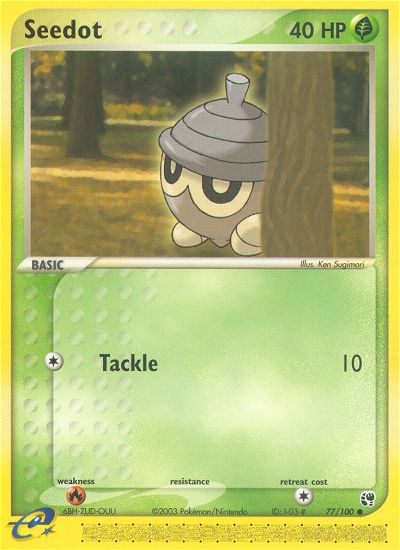
Seedot, a humble Grass-type Basic Pokémon with 40 HP, represents the quiet power of early game setups. Hailing from the Sandstorm expansion (ex2), this little orb of foliage carries the artistry of Ken Sugimori and a steady path toward evolution—first to Nuzleaf, then to Shiftry. In the grand tapestry of the Pokémon TCG, Seedot’s low-cost Tackle attack (Colorless, for 10 damage) is the kind of move that rewards smart energy management and anticipates bigger plays in the later turns. For collectors and players alike, Seedot embodies the balance between accessibility (Common rarity) and strategic potential that can make a deck feel cohesive even on a tight budget. ⚡🎴
At its core, Seedot’s Tackle costs a single Colorless energy. That simple requirement is what makes Special Energies so interesting in practice. Colorless costs mean that any energy attached to Seedot—whether a basic Energy or a Special Energy card that provides Colorless energy—can satisfy the attack’s cost. This is where the conversation between Seedot and special energies becomes a fun, mechanic-first puzzle. If you’ve ever held a Double Colorless Energy (DCE) or a Scramble Energy, you know that those cards can change the timing of when Seedot can strike. A DCE attached to Seedot on the first turn can power Tackle immediately, delivering 10 damage and advancing Seedot toward its evolutions. The elegance lies in how you sequence your attachments, because Seedot’s 40 HP also nudges you to think carefully about risk: a single Fire-type hit could leave Seedot trembling on the bench, but that same vulnerability can spur you to lean into your evolution plan. Fire weakness ×2 means opponents with a single-fire blow can KO Seedot quickly, which in turn makes your decision to accelerate or pivot all the more consequential. 🔥
From a collector’s lens, Seedot’s Sandstorm basic silhouette is a reminder of the era’s design language. The card’s common rarity makes it an approachable target for build-around decks, especially those emphasizing evolutionary lines: Seedot → Nuzleaf → Shiftry. The evolution path adds depth without requiring rare staples, which is appealing for players who want a tangible growth arc in their deck. The fact that Ken Sugimori’s artistry accompanies Seedot provides an extra layer of reverence for fans who appreciate the lore and visuals of classic sets. Each time you attach a Special Energy to Seedot and see the card come to life on the table, you feel the rhythm of a classic era in the TCG’s ongoing story. 💎🎨
How Special Energies Change the Equation
Special Energies, broadly speaking, are more than mere power sources—they’re tools that shape tempo and risk. When you attach a Special Energy to Seedot, you’re not just paying for a single colorless cost; you’re choosing a subtle upgrade to the turn’s calculus. For example, a Special Energy that incidentally provides extra effects (draw, damage mitigation, or card filtering) can influence how you evaluate taking another turn with Seedot’s evolution line. However, the core cost of Tackle remains a single Colorless unit, so the energy you attach must ultimately satisfy that requirement. If you’re running Double Colorless Energy, you can deliver Tackle’s 10 damage with a single attachment, which is a powerful tempo swing for a Basic Seedot. If you’re using a different Special Energy that counts as Colorless energy or grants a multi-energy payoff, Seedot may reach a more ambitious attack threshold sooner—though you’ll still need to respect rules about attaching only one energy per turn. ⚡🎮
It’s also worth noting that Special Energies can impact Seedot’s vulnerability window. Because Seedot’s HP is modest, a well-timed special-energy-augmented attack from a Fire or Fighting-type deck might threaten Seedot faster than a standard basic-energy approach. This reality nudges players toward a defensive philosophy: use Seedot to initiate your evolution plan, but avoid giving your opponent easy KO opportunities by leaving Seedot on the bench too long or by mismanaging attached energies. The strategy becomes a dance of setting up Nuzleaf’s potential while preserving Seedot’s life for the crucial next steps. 🔥🎴
Strategy: Building Around Seedot and Special Energies
For players looking to leverage Seedot’s ecosystem, the practical steps center on tempo, evolution, and bench management. Start by recognizing Seedot’s role as a development platform. With a plan to evolve into Nuzleaf, Seedot can be a springboard for a midgame pivot that brings stronger Grass-type pressure and disruption. The presence of Special Energies broadens the deck’s flexibility, letting you tailor energy flow to your local meta. If you can attach a Special Energy that supplies Colorless energy on Turn 1, you unlock Tackle’s damage output earlier than you might expect. If your deck uses multiple Special Energies that exploit grass synergy, Seedot can stabilize early board presence while you sculpt your evolution curve. 💨💎
From a deck-building perspective, consider pairing Seedot with mentors or draw engines that sustain you through the first few turns. The Sandstorm era mindset often rewards a patient game where you guard Seedot just long enough to reach Nuzleaf, where the real offense begins. As you navigate your matches, keep in mind Seedot’s weakness to Fire: if your opponent’s plan hinges on quick KO on Seedot, you’ll want a plan B—perhaps a quick retreat or a pivot to a sturdy Grass-type that can absorb the exchange. A well-timed evolution turn can flip the board, letting Shiftry unleash more dynamic attacks and more resilient HP values in later stages. 🎮🎨
Collector tip: Seedot’s common status keeps it accessible for pocket-friendly builds, but the sandstorm-era artwork, Ken Sugimori’s signature line, and the potential of evolving lines make it a satisfying centerpiece for a nostalgic deck. The card’s market presence—modest yet steady in value, with a typical price range that reflects its common rarity—means you can enjoy both competitive play and collection without a steep financial commitment. If you’re curious about current pricing trends, note that card-market figures around its region show gentle growth tied to playable formats and nostalgia-driven interest. ⚡💎
Slim Lexan Phone Case for iPhone 16 — Ultra-thin Glossy FinishMore from our network
- https://crypto-acolytes.xyz/blog/post/dr3-parallax-refines-hipparcos-era-distance-for-a-hot-blue-star/
- https://blog.zero-static.xyz/blog/post/humor-keeps-mtg-community-alive-with-lathliss-dragon-queen/
- https://crypto-articles.xyz/tmp8xbbm8d_/how-to-study-neuroscience-on-your-own-a-step-by-step-guide.html
- https://crypto-articles.xyz/tmp_fxdg25i/glossy-or-matte-polycarbonate-phone-case-with-card-holder.html
- https://blog.crypto-articles.xyz/blog/post/nft-data-483-from-colors-nfts-collection-on-magiceden/
Seedot
Set: Sandstorm | Card ID: ex2-77
Card Overview
- Category: Pokemon
- HP: 40
- Type: Grass
- Stage: Basic
- Dex ID: 273
- Rarity: Common
- Regulation Mark: —
- Retreat Cost:
- Legal (Standard): No
- Legal (Expanded): No
Description
Attacks
| Name | Cost | Damage |
|---|---|---|
| Tackle | Colorless | 10 |
Pricing (Cardmarket)
- Average: €0.25
- Low: €0.02
- Trend: €0.45
- 7-Day Avg: €0.35
- 30-Day Avg: €0.28
Support Our Decentralized Network
Donate 💠More from our network
- https://crypto-acolytes.xyz/blog/post/dr3-parallax-refines-hipparcos-era-distance-for-a-hot-blue-star/
- https://blog.zero-static.xyz/blog/post/humor-keeps-mtg-community-alive-with-lathliss-dragon-queen/
- https://crypto-articles.xyz/tmp8xbbm8d_/how-to-study-neuroscience-on-your-own-a-step-by-step-guide.html
- https://crypto-articles.xyz/tmp_fxdg25i/glossy-or-matte-polycarbonate-phone-case-with-card-holder.html
- https://blog.crypto-articles.xyz/blog/post/nft-data-483-from-colors-nfts-collection-on-magiceden/