
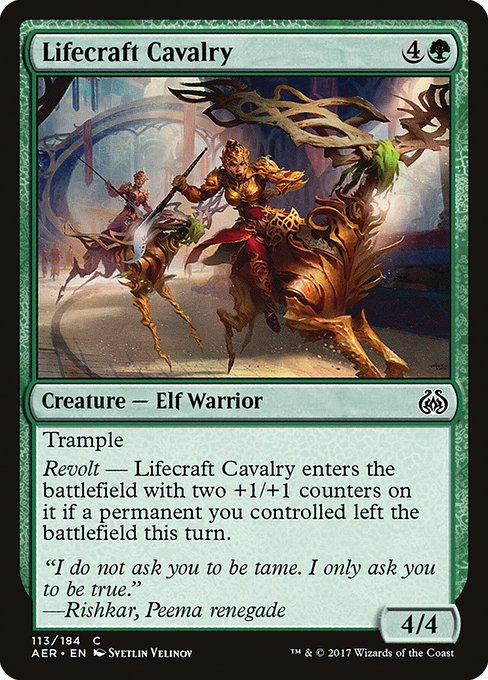
Image courtesy of Scryfall.com
Probability in Motion: Lifecraft Cavalry and Revolt on the Battlefield
Green mana has always loved big bodies, stomping through battles with a smile and a lot of leaves in the wind. Lifecraft Cavalry arrives in Aether Revolt with a flourish: a solid 5-mana investment for a 4/4 creature that brings trample to the party and one of the game’s more deliciously conditional lines of growth. Its Revolt ability—“This creature enters with two +1/+1 counters on it if a permanent left the battlefield under your control this turn”—turns a routine 4/4 into a surprising 6/6 trampler when you’ve sacrificed something in the same turn. It’s a mechanic that invites careful planning and a little bit of chaos theory 🧙♂️🔥. Today we dive into the simulation world of probability-based triggers and how Lifecraft Cavalry behaves when Revolt actually fires in the heat of combat, with a nod to the card’s lore, design, and practical playability. 💎⚔️
Understanding the core stats and the Revolt trigger
- Mana cost: {4}{G} — a fair price for a plus-sized 5-mana green creature once you factor in the potential upside.
- Power/Toughness: 4/4, with potential growth to 6/6 via Revolt on entry.
- Keywords: Trample and Revolt. The combination is a drumbeat for aggressive, battlefield-swinging plays that reward tempo and careful sacrifice timing.
- Rarity & Set: Common from Aether Revolt (Aer). The design philosophy here is to reward players who lean into the set’s artifact and revolt themes without breaking the bank on a rare mythic punch.
- Lore & flavor: The card’s flavor text, “I do not ask you to be tame. I only ask you to be true,” hints at a broader theme in Rishkar’s world—where growth and revolt push back against stifling order. The art by Svetlin Velinov captures a sturdy elf warrior as part of a mechanized, industrious march forward.
From a gameplay perspective, Lifecraft Cavalry incentivizes a strategy where you couple board-state manipulation with efficient threats. On the surface it’s a solid beater, but the true power lies in how you engineer the moment Revolt triggers. If a creature or artifact departs under your control this turn, Lifecraft Cavalry effectively enters as a 6/6 trampler, a significant swing that often translates into decisive pressure. This is not just about numbers; it’s about how you sequence sacrifice effects, removal, or even artifact-oriented synergies to maximize value. 🧙♂️🎲
Simulating the probability: what makes Revolt tick?
When you scan the battlefield, Revolt asks a simple, stubborn question: did a permanent leave the battlefield under your control this turn? If yes, Lifecraft Cavalry enters with two +1/+1 counters; if no, it comes in as a plain 4/4. In a vacuum, that’s a binary outcome, but the real fun is in the probability of that event happening during a given turn. That’s where probability-based simulations come into play. 🧭
Imagine a typical midrange green build where several permanents might die over the course of a turn due to combat, removal, or a synergy line with sacrifice outlets. Suppose you have a handful of potential sources of death: a small Elf, an artifact, or a fight that wipes a creature you control. If each has an independent chance p of leaving the battlefield this turn, the probability that at least one leaves is 1 minus the probability that none leave, i.e., 1 − (1−p1)(1−p2)…(1−pn). When you run a quick mental or actual simulation, you’ll often land in a sweet spot where Revolt triggers in roughly the 30–60% range for many typical board configurations. Of course, the exact number depends on the matchup, removal density, and your own sacrifice engines. 🔥
In a few concrete scenarios, the math becomes even more enticing. If you control three permanents with a 25% solo chance of leaving (combat damage, removal, or a sacrifice outlet), the chance that at least one leaves is about 52% on any given turn. If you stack even more potential “left the battlefield” events, that probability climbs quickly, nudging Lifecraft Cavalry into that comfortable Revolt territory more often than not. These simulations aren’t predictions carved in stone; they’re a guide to how you can tilt the odds in your favor with smart play and deck-building. 🎯
Strategic takeaways and practical play
- Deck-building. Center Revolt-enabled lines around sacrifice outlets or removal that you’re comfortable using on your own board. Cards that exile, sac, or bounce provide predictable Revolt triggers that feel good when Lifecraft Cavalry drops as a 6/6 trampler. 🔧
- Ramp and acceleration. Pair Lifecraft Cavalry with early ramp or mana acceleration to reach the 5-mana cost on schedule, maximizing the odds that you can deploy a threat Your opponent also has to deal with. The longer you stall, the more the probability window opens and closes with each turn. 🪄
- Combat math. A 6/6 trampler is a credible late-game pressure option. If your opponent overextends, resist the temptation to trade early; instead, leverage the extra power to force unfavorable blocks and keep Revolt live. ⚔️
- Flavor and collectible appeal. The card’s artwork and narrative tie into a broader mechanical ecosystem that fans of Aether Revolt appreciate—where invention, loyalty, and a little risk-taking collide. The common rarity makes it accessible for budget decks while still delivering memorable moments in games. 🎨
Where it fits in the broader MTG tapestry
Lifecraft Cavalry sits at an interesting crossroad in green's long-standing toolkit. It’s not the brute-force megabeater that some multicolor cities crave, but its Revolt mechanic invites you to orchestrate a micro-game within every combat step. The “two +1/+1 counters” are not merely a stat bump; they symbolize a tactical moment where sacrifice, timing, and tempo converge to tilt a game toward your favor. And in a world where nostalgic references to Rishkar’s renegade lines are never far away, the card feels both timely and timeless. 🧙♂️💎
For collectors and players who love the tactile joys of MTG’s evolving design space, Lifecraft Cavalry offers a clear example of how a simple mechanic can compound with a strong body to create meaningful decisions. Its place in Aer’s mechanical ecosystem—paired with revolt-friendly themes and elf-centric flavor—remains a bright spot for fans who enjoyed the visual storytelling and the thrill of the big swing. 🎲
Foot-shaped Memory Foam Mouse Pad with Wrist RestMore from our network
Lifecraft Cavalry
Trample
Revolt — This creature enters with two +1/+1 counters on it if a permanent left the battlefield under your control this turn.
ID: b2a92a03-4e1d-4b79-ad75-a29db2ea5495
Oracle ID: 13db0230-b57e-47fd-9025-580d06cc88ee
Multiverse IDs: 423780
TCGPlayer ID: 126501
Cardmarket ID: 294902
Colors: G
Color Identity: G
Keywords: Revolt, Trample
Rarity: Common
Released: 2017-01-20
Artist: Svetlin Velinov
Frame: 2015
Border: black
EDHRec Rank: 26430
Penny Rank: 14346
Set: Aether Revolt (aer)
Collector #: 113
Legalities
- Standard — not_legal
- Future — not_legal
- Historic — legal
- Timeless — legal
- Gladiator — legal
- Pioneer — legal
- Modern — legal
- Legacy — legal
- Pauper — legal
- Vintage — legal
- Penny — legal
- Commander — legal
- Oathbreaker — legal
- Standardbrawl — not_legal
- Brawl — legal
- Alchemy — not_legal
- Paupercommander — legal
- Duel — legal
- Oldschool — not_legal
- Premodern — not_legal
- Predh — not_legal
Prices
- USD: 0.07
- USD_FOIL: 0.20
- EUR: 0.07
- EUR_FOIL: 0.15
- TIX: 0.03
More from our network
- https://crypto-acolytes.xyz/blog/post/nft-stats-solgod-1113-from-solgods-collection/
- https://crypto-acolytes.xyz/blog/post/nft-stats-doodle-bonk-1923-from-doodle-bonk-collection/
- https://crypto-acolytes.xyz/blog/post/nft-stats-mebananasfnt61-from-monkeyseatbananasnft-collection/
- https://wiki.digital-vault.xyz/wiki/post/pokemon-tcg-stats-redeemable-ticket-card-id-sv09-156/
- https://blog.rusty-articles.xyz/blog/post/how-modern-pokemon-cards-reward-aggression-in-staryu-decks/