
Image courtesy of TCGdex.net
Talonflame V in the Fire-Swift Meta: A Look at its Place Across Generations
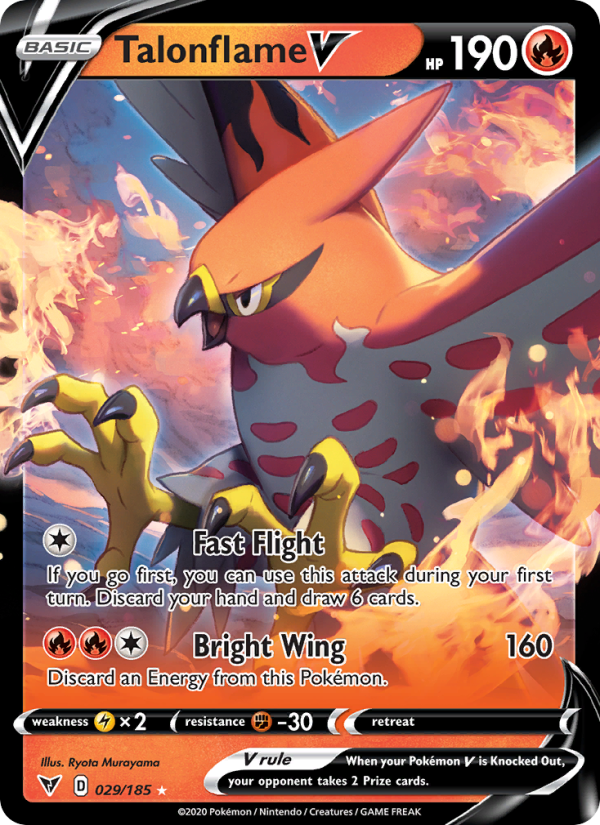
Fire has always been a theatrical type in the Pokémon TCG, and Talonflame V brings that signature blaze into a modern, high-pressure format. This Basic Pokémon from the Vivid Voltage set (swsh4-29) stands out with a hefty 190 HP and two potent attacks that reward quick setup and decisive finishes. Illustrated by Ryota Murayama, this holo foil carries the visual punch fans crave, pairing a dramatic burst of flame with the swift, aerial grace of a Talonflame in full pursuit. For collectors, the holo rarity adds a shimmer that resonates with fans who remember the early days of flame-based strategies while appreciating contemporary power creep.
To understand how this Talonflame stacks up against older versions, it helps to consider both mechanical evolution and gameplay tempo. Historically, many Talonflame lines relied on straightforward aggression—fast, efficient fire damage backed by versatile energy acceleration. Talonflame V preserves the pressure, but it also introduces a first-turn draw engine that can reshape opening hands. If you go first, you can use Fast Flight to discard your hand and draw six cards on your opening turn. That’s a bold, tempo-setting advantage: it can smooth out a rough draw and push you toward a strong setup for Bright Wing or a future explosive turn. ⚡🔥
Attacks that define the tempo
- Fast Flight — Colorless, and the kicker here is the opening-turn leverage. If you’re going first, you may discard your hand and draw six cards, potentially setting up multiple lines of attack or a surprise combination of hand cards that change the board state by turn two. This is a hallmark of the Vivid Voltage era: give the player a risk-reward burst of consistency at the cost of immediate energy commitment.
- Bright Wing — Fire, Fire, Colorless; 160 damage. The energy demand is substantial, but the payoff is big, especially when you consider that you must discard an Energy from Talonflame to fire it off. That energy cost invites careful planning: you might want to attach Energy repeatedly in a way that keeps Talonflame ahead on board presence while you cycle more Energy into play for later turns. The 160 damage is enough to threaten most non-EX Pokémon in a single hit when your board is well-set, and it helps you close games once you’ve established early control with Fast Flight’s tempo.
In the broader context of the set and the era, this design mirrors a shift toward risk-managed acceleration: you sacrifice a card or two of energy economy to maximize board impact, then rely on the rapid tempo to keep opponents on their heels. The trade-off—discard an Energy when you use Bright Wing—nudges players toward energy management strategies, including energy attachment tricks and potential reusability through trainer effects that stabilize energy flow. It’s a different flavor from older Talonflame iterations that prioritized direct attack pressure without an explicit burn-and-draw engine on the first turn.
Where it fits in the lineup
As a Basic V, Talonflame V does not require an earlier Talonflame to come into play, offering a clean, opening-play option that can surge onto the field on turn one if you’re going first. This makes it a versatile centerpiece for aggressive Fire decks that want to threaten big numbers early and keep the pressure on. The card’s 190 HP helps it survive against many standard hits in the format, though its Lightning weakness (×2) means you’ll want to pair it with resist-and-retreat strategies that minimize exposure to Electric-type threats—especially in metagames where Lightning-types are popular. Its Fighting resistance (−30) is a nice offset against some meta threats, softening those colliding blows just enough to stay in the game longer.
The set’s visual language—Murayama’s dynamic illustration—and the holo foil reinforce the collectible appeal, making this a go-to for players who value both playability and display value. For builders, it’s a card that rewards thoughtful sequencing and deck thinning, since the first-turn draw can be a swing factor when you’re deciding which Energy to attach and when to chase your Bright Wing payoff.
Strategy and deck-building note
- Opening tempo matters: If you go first, Fast Flight can set your hand well, enabling you to sculpt a turn-two or turn-three plan that leverages Bright Wing’s heavy hit while maintaining pressure with subsequent draws.
- Energy management: Since Bright Wing requires two Fire Energy plus a Colorless, you’ll want reliable Fire Energy acceleration in the deck. Cards from similar rotations that support energy acceleration or quick Energy recycling can turn Talonflame V into a calculator that consistently outputs 160 damage when needed.
- Risk vs. reward: The energy discard component of Bright Wing is a deliberate cost. If you’re able to recover or replenish that energy quickly through deck utilities, you maximize Talonflame V’s staying power on the bench and field.
- Matchup awareness: Against faster, single-prize decks, Talonflame V’s early draw and high HP can help you take two hits while you set up your next big swing. Against multi-attack or energy-dense decks, you may need to time your Bright Wing carefully and pivot to secondary attackers or a retreat plan to preserve momentum.
Market pulse and collectibility
From a collector’s standpoint, the holo variant’s value has been influenced by the broader Vivid Voltage print run and the ongoing interest in fire-type staples. CardMarket shows an average near €0.95 with a low around €0.35 and a trend that hints at modest growth in balanced market conditions. On the U.S. side, TCGPlayer data for holofoil Talonflame V demonstrates a wider spread: low prices near the $0.40–$0.75 range, with mid values hovering around the $1 mark, and occasional spikes well above $20 when premium copies surface or when market scarcity aligns with demand. Direct market insights peg holofoil copies as high as roughly $25.75, underscoring how condition, print variant, and parser-driven demand can drive unusual price swings. Taken together, this card is both playable and collectible—an appealing combination for players who want a reliable attacker and collectors who savor holo artistry and a robust card lineage. 🔥💎
The artistry of Ryota Murayama, paired with a formidable 190 HP and two potent attacks, makes Talonflame V a standout in the Vivid Voltage era. It embodies the ongoing evolution of the Fire archetype: capable of exploding onto the scene with first-turn draw power, then delivering a heavy-hitting finish that keeps the pressure on through the midgame. For players, this means a deck that rewards careful planning, a willingness to risk a quick discard for a sharper draw, and an eye toward energy economy that can extend the life of your board presence. For collectors, the holo variation remains a visually striking piece with a playable pedigree and a place in the broader Talonflame family tree. 🎴⚡
Curious minds can explore more about this card and related releases through the product link below, where you’ll find the latest listing and market snapshots. And if you’re upgrading your desk setup while curating your collection, check out a touch of flair that doesn’t break the mood: the Neon Aesthetic Mouse Pad. It’s a small elegance to accompany the big-glow moments of your Talonflame V sessions.
More from our network
Talonflame V
Set: Vivid Voltage | Card ID: swsh4-29
Card Overview
- Category: Pokemon
- HP: 190
- Type: Fire
- Stage: Basic
- Dex ID: 663
- Rarity: Holo Rare V
- Regulation Mark: D
- Retreat Cost: 0
- Legal (Standard): No
- Legal (Expanded): Yes
Description
Attacks
| Name | Cost | Damage |
|---|---|---|
| Fast Flight | Colorless | |
| Bright Wing | Fire, Fire, Colorless | 160 |
Pricing (Cardmarket)
- Average: €0.95
- Low: €0.35
- Trend: €0.89
- 7-Day Avg: €0.88
- 30-Day Avg: €0.92
Support Our Decentralized Network
Donate 💠More from our network
- https://rusty-articles.xyz/tmpglew8q67/f45c42cb.html
- https://blog.digital-vault.xyz/blog/post/discrepant-distances-reveal-a-turquoise-sagittarius-hot-giant/
- https://crypto-acolytes.xyz/blog/post/nft-stats-samuzinft96-from-smauzinft-collection/
- https://crypto-acolytes.xyz/blog/post/nft-stats-rage-guy-159-from-rage-guys-collection/
- https://articles.digital-vault.xyz/blog/post/monster-hunter-world-console-vs-pc-which-runs-best/