
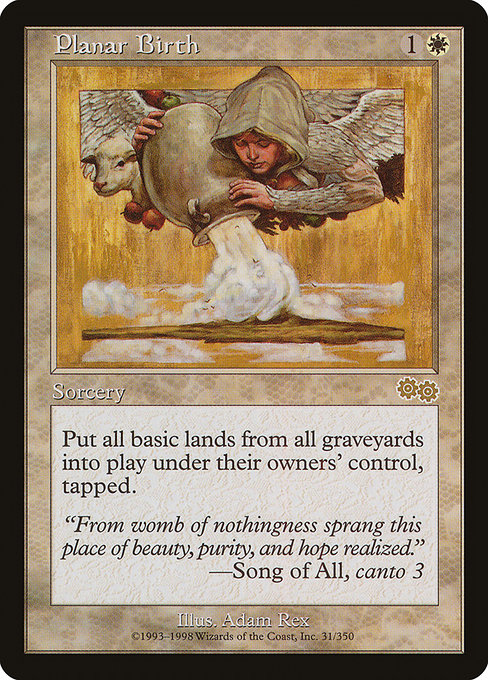
Image courtesy of Scryfall.com
Planar Birth and the language of card advantage
White has always been fond of reclaiming what was once yours—think of it as the polite version of a blowout, where the terrain itself becomes a resource. Planar Birth (from Urza’s Saga) is a quintessential fluctuation in the spectrum of card advantage: it doesn’t draw you more cards, but it tilts the resource balance by returning all basic lands from every graveyard to the battlefield tapped under their owners’ control. It’s a spell that asks you to measure tempo, risk, and the gravity of gravesides 🧙♂️🔥. If you consider card advantage as more than “cards in hand,” Planar Birth is a masterclass in how lands—your most fundamental resource—can become engines of inevitability over time.
“From womb of nothingness sprang this place of beauty, purity, and hope realized.” — Song of All, canto 3
At its core, this rare sorcery costs only {1}{W} to cast, but its true power lies in what it returns: basic lands only, from all graveyards, to the battlefield tapped. That limitation—basics only—gives Planar Birth a very particular flavor: it punishes too-heavy land specialization in graveyards you didn’t expect, and it rewards players who maintain a strong basics presence in both graveyards or who can populate those graveyards efficiently. The result is a swingy, dramatic shift in board state that can swing the game toward you if timed correctly, or slam the brakes on an opponent who was trying to race away on a deluge of colorless momentum ⚔️🎲.
How the theory plays out on the battlefield
Advanced card-advantage theory asks: what happens when you multiply resources that already exist rather than merely adding new ones? Planar Birth multiplies land sources—pulling back a whole set of basic lands that may have been languishing in graveyards. If you’ve already played fetch lands or ways to draw into basics, the spell can suddenly flood your side with fresh, untapped mana sources on the very next turns. The subtlety is that they come in tapped, so you’re not getting immediate acceleration on the turn you cast it. The payoff comes in the turns that follow, when your board presence compounds and your mana base becomes a stubborn fortress 🔥💎.
In practice, the decision to cast Planar Birth hinges on the density of basics in the graveyards and the tempo of the game. If your opponent is grinding you with removal or forcing you into a grindy late game, Planar Birth can be a lifeline or a trap—depending on whether you control the board when the lands re-enter. The spell acts like a reset button that also leans into your terrain advantage: more bases to tap for more diverse mana needs. For some white-heavy shells, it’s a way to rebound from a board wipe with a robust, land-rich board state that punishes an opponent who assumed the game was about to due to a single removal spell. And yes, it also plays well with a few protective layers—notably protection for your lands or ways to recourse if Basic lands become temporarily unavailable in the graveyards you care about.
Practical guidance: when to deploy Planar Birth
- When you know there are multiple basics in play across both graveyards. If both players have a healthy supply of basics sent to the graveyard, Planar Birth can flood the board with civilization-level mana sources, shifting the scale in your favor.
- In long, attrition-heavy games where you’re trying to outlast the opposition. The returned basics give you staying power, especially in formats that reward sustained land drops and recursion—think of it as a white answer to years of mana denial.
- When you can weather the tempo hit. Because the lands come into play tapped, you’re choosing to trade immediate tempo for long-term value. If your plan includes heavy land-based shoring or a late-game engine, Planar Birth acts as fuel for the engine you’re building.
- In decks that leverage fundamentals more than flashy plays. If your strategy is built around reliable, consistent land drops and a robust board, Planar Birth reinforces that aesthetic while still offering potential blowout value if timed with other white tools.
One of the enduring satisfactions of Planar Birth is the way it reframes a graveyard—the place where bodies go after the spell resolves—into a staging ground for the next act. It’s not about stealing a single card; it’s about reimagining the battlefield as a reservoir of basic mana. And yes, if your opponent is packing heavy graveyard interactions or mass land destruction, Planar Birth becomes a conditional upheaval: you’re inviting a dramatic pivot in the game’s momentum 🔥⚔️.
Flavor, art, and the collectible arc
Adam Rex’s illustration for Planar Birth captures that sense of planetary renewal—an idea that lands, once thought buried, rise again in a new, ordered canopy. The flavor text references a dreamlike plane where purity and hope are realized, aligning with the card’s function as a return mechanism for basic lands. In the Urza’s Saga era—late 1990sMTG design was teeming with big, game-defining effects—Planar Birth stands out for its elegance: a single spell that invites you to rethink what “advantage” means in a land-centric shell. The card’s rarity is rare, and its status as a non-foil, black-bordered original print makes it a cherished piece for collectors who chase the turn-of-the-century mana-scale that defined so many modern decks in retrospect.
From a value perspective, Planar Birth sits in the modest-but-tangible space for vintage and legacy players who still cherish the Urza’s Saga era. Its price point—roughly a few dollars in USD and euros—reflects its status as a strategic gem rather than a must-have staple for every deck. The fact that it’s a non-foil print with a striking yet understated art style only adds to the nostalgia and the tactile appeal of laying down a rare white spell that alters the field by turning graves into gardens of green and white mana 💎.
Gaming Mouse Pad 9x7 Custom Neoprene with Stitched EdgesAs we dissect Planar Birth through the lens of advanced card-advantage theory, we’re reminded that MTG’s most lasting innovations often come from the simplest ideas: a single spell that redefines what a resource is and how it travels from the void into the heart of our battlefield. White’s patient, garden-like tempo proves again that strategy can be both elegant and explosive—especially when the plan is as timeless as a planewalker's dream.
More from our network
- https://wiki.digital-vault.xyz/wiki/post/pokemon-tcg-stats-cherrim-card-id-dp7-14/
- https://articles.zero-static.xyz/blog/post/making-necrotic-hex-work-midrange-deck-optimizations/
- https://wiki.digital-vault.xyz/wiki/post/pokemon-tcg-stats-musharna-card-id-sv105b-117/
- https://wiki.digital-vault.xyz/wiki/post/pokemon-tcg-stats-mysterious-fossil-card-id-ex16-85/
- https://wiki.digital-vault.xyz/wiki/post/pokemon-tcg-stats-miltank-card-id-sv04-147/
Planar Birth
Return all basic land cards from all graveyards to the battlefield tapped under their owners' control.
ID: c7cacdff-aa83-4644-b2f0-ce8c89dddfbf
Oracle ID: 7a9d13b3-3823-463a-acd9-8b7a9d5e121f
Multiverse IDs: 5766
TCGPlayer ID: 6982
Cardmarket ID: 10238
Colors: W
Color Identity: W
Keywords:
Rarity: Rare
Released: 1998-10-12
Artist: Adam Rex
Frame: 1997
Border: black
EDHRec Rank: 17099
Set: Urza's Saga (usg)
Collector #: 31
Legalities
- Standard — not_legal
- Future — not_legal
- Historic — not_legal
- Timeless — not_legal
- Gladiator — not_legal
- Pioneer — not_legal
- Modern — not_legal
- Legacy — legal
- Pauper — not_legal
- Vintage — legal
- Penny — not_legal
- Commander — legal
- Oathbreaker — legal
- Standardbrawl — not_legal
- Brawl — not_legal
- Alchemy — not_legal
- Paupercommander — not_legal
- Duel — legal
- Oldschool — not_legal
- Premodern — legal
- Predh — legal
Prices
- USD: 3.19
- EUR: 2.53
- TIX: 1.72
More from our network
- https://blog.rusty-articles.xyz/blog/post/the-last-of-us-part-i-roadmap-post-launch-analysis-and-insights/
- https://blog.rusty-articles.xyz/blog/post/parody-cards-and-mtg-culture-insights-from-sarkhans-whelp/
- https://wiki.digital-vault.xyz/wiki/post/pokemon-tcg-stats-marill-card-id-sv05-064/
- https://crypto-acolytes.xyz/blog/post/speed-demystified-how-quickness-shapes-fighting-games/
- https://crypto-acolytes.xyz/blog/post/nft-stats-catwifmask-nft-358-from-catwifmask-nft-collection/