
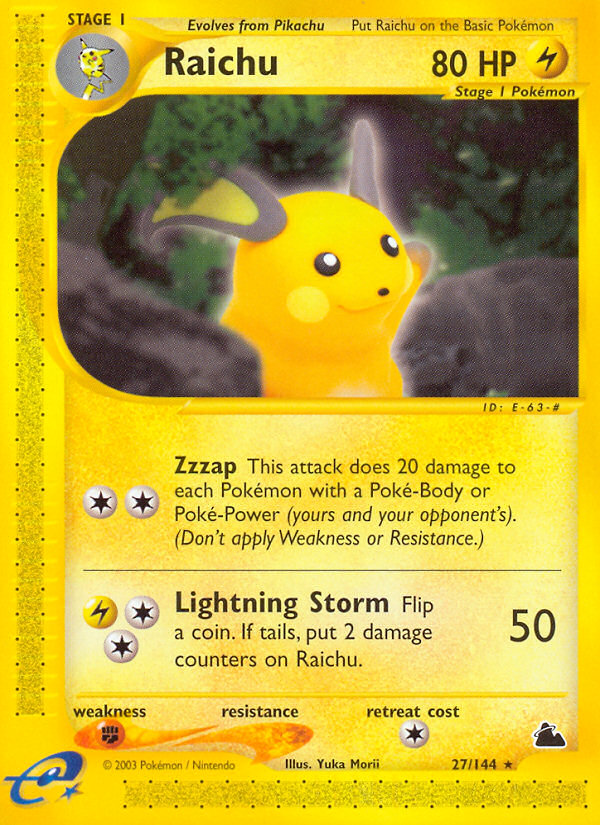
Image courtesy of TCGdex.net
Unlocking Rarity: The Raichu from Skyridge
Pokémon TCG collectors often chase the aura of a card’s rarity—the story behind why a card is scarce, coveted, and just a little magical to hold in your hands. The Raichu from the Skyridge set sits squarely in that category. Not a holo or first-edition jewel, but a rare print with lasting appeal, thanks to its era-defining mechanics, striking art, and the nostalgia of Pikachu’s larger evolution into a confident, electric stadium favorite. ⚡🔥
Skyridge, released in the early 2000s, is renowned for its art-forward presentation, vibrant card borders, and a connection to the Team Rocket era’s evolving gameplay ideas. Raichu appears as a Stage 1 evolution from Pikachu, carrying the electric legacy forward with a compact 80 HP and a silhouette that instantly sparks recognition among trainers who grew up battling with these energies and strategies. The card number is eCard 27, and the card’s illustration—authored by Yuka Morii—captures Raichu’s electric swagger with a playful, dynamic flair that fans still celebrate. The rarity is clearly labeled as Rare, a classification that helped cement its desirability during a crowded print run. 🎴
What makes this Raichu so rare on paper?
- Rarity and print style: In Skyridge, not every card earned a holo foil, and Raichu is one of the non-holo rares. The set featured two recognized variants for many cards: standard non-holo and reverse-holo options, with no first-edition rainbow shining on every page. For Raichu, the non-holo version (and its reverse) stood as the accessible face of rarity in a set known for its art-forward presentation.
- Unique mechanics for its era: The Zzzap attack cares about more than raw numbers. It delivers 20 damage to each Pokémon with a Poké-Body or Poké-Power on both sides of the field. In an era when players leaned on Poké-Body and Poké-Power to power resources, Zzzap created a moment of mutual destruction—where timing and board state could swing the game just as much as damage output. This interaction is a nostalgic hallmark that elevates the card’s story beyond stat sheets. 🔌
- Powerful secondary attack with risk: The second attack, Lightning Storm, costs Lightning + Colorless + Colorless and deals 50 damage. However, a tails result on a coin flip adds two damage counters to Raichu itself. That built-in self-risk mirrors the high-stakes decisions players face with rare cards—take the big hit, or hold back—adding layers to its collectible narrative. ⚡
- Set context and print runs: Skyridge’s official card count sits around 144 (within a broader storytelling ecosystem of 182 cards across various printings). This environment, paired with the era’s design language and the set symbol, creates a distinctive identity that modern reprints can’t replicate. The rarity designation matters, but the set’s uniqueness—plus the illustrator’s signature—colors collectors’ perceptions of value. 🏷️
- Market memory and limited availability: Modern price dashboards show a healthy gap between the non-holo Raichu’s base value and the reverse holo’s premium. For example, CardMarket’s EUR averages hover around the 180 EUR mark, with wide swings between the low and mid ranges, while TCGPlayer’s USD readings for the non-holo Raichu sit around the high-$90s to $100s in recent data, and the reverse holo perspectives can exceed that. Those differences aren’t just numbers—they reflect how kids who opened packs back in the day, and modern collectors who chase the set’s aesthetic, vote with their wallets. 💎
The illustration by Yuka Morii adds a layer of desirability that’s hard to quantify with raw stats. Morii’s work on Skyridge captures Raichu’s nimble energy with a clarity and color that still reads well in full-art reprint conversations. The Raichu here stands as a little electric ambassador—not the flashiest holo, perhaps, but a card with enduring charm and a story to tell about a time when Pokémon battles leaned on Poké-Power orchestration as much as on simple damage counters. 🎨
Design, deck-building, and the nostalgia factor
In practice, this Raichu is more than a line on a rarity chart. It’s a teaching tool for understanding how early-2000s mechanics shaped the TCG metagame. Zzzap’s global damage ripple invites players to scrutinize each opponent’s Pokémon with Poké-Bodies or Poké-Powers, understanding that edges can swing when those effects hit multiple targets at once. The Lightning-type identity ties Raichu into a broader family of electric counterparts—pushing fans to recall Pikachu’s long evolution path and the electric draw of Thunderbolt lines that define many classic decks. The card’s HP of 80 keeps it within standard early-Stage 1 expectations, making it manageable in play, while its vulnerability to Fighting-types adds a strategic layer for matchups that’s still a talking point in collector circles. 🧠🎮
“Zzzap turns every round into a micro-puzzle: who benefits from the flip, and can you weather the storm without overexposing Raichu to big counterweights?”
Identifying a true Skyridge Raichu
- Set name: Skyridge
- Card number: eCard 27
- Rarity: Rare
- Type: Lightning
- Stage: Stage 1 (evolves from Pikachu)
- Attacks: Zzzap and Lightning Storm
- Illustrator: Yuka Morii
- Variants: normal and reverse (non-holo)
- Weakness: Fighting ×2
For modern collectors, the thrill lies not only in the card’s power but in its history. The Skyridge Raichu embodies a transitional moment in the Pokémon TCG, where art and function danced with evolving rulesets. It’s a reminder that rare cards aren’t just about who can play them today; they’re about the memories of where you were when you first opened the pack, the local tournaments you attended, and the conversations that followed with friends about the odd interactions Zzzap created on a crowded table. ⚡💬
Market pulse and investment sense
Market data paints a picture of steady appreciation tempered by the realities of supply and demand. The non-holo Raichu from Skyridge sits in a comfortable price range for dedicated collectors, with notable volume for reverse-holo equivalents. For investors, the card’s rarity in a beloved set, paired with the enduring cultural footprint of Raichu in the franchise, makes it a compelling hold for nostalgic value and long-term growth. Keep an eye on the swap activity around the eCard 27 slot—sometimes even small shifts in set-wide interest can nudge the price trajectory more than a single listing threshold. 📈
Customizable Desk Mouse Pad — One-Sided Print, 3mm Thick Rubber BaseWhether you’re chasing pure nostalgia, historical value, or the joy of flipping through a card that captures a moment in time, Raichu from Skyridge offers a compelling blend of story, art, and playability. Its rarity isn’t just about scarcity; it’s about the aura of a time when the Pokémon universe expanded in bold new directions, and a young trainer could imagine a fully charged electric future in every match. 💎🎴
More from our network
- https://area-53.zero-static.xyz/27612fc7.html
- https://wiki.digital-vault.xyz/wiki/post/pokemon-tcg-stats-pinsir-card-id-a3b-093/
- https://crypto-acolytes.xyz/blog/post/nft-stats-george-plays-clash-royale-877-from-gpcr-nft-collection-collection/
- https://crypto-acolytes.xyz/blog/post/nft-stats-gorbagio-635-from-gorbagio-collection/
- https://wiki.digital-vault.xyz/wiki/post/pokemon-tcg-stats-primordial-altar-card-id-swsh12-161/
Raichu
Set: Skyridge | Card ID: ecard3-27
Card Overview
- Category: Pokemon
- HP: 80
- Type: Lightning
- Stage: Stage1
- Evolves From: Pikachu
- Dex ID: 26
- Rarity: Rare
- Regulation Mark: —
- Retreat Cost:
- Legal (Standard): No
- Legal (Expanded): No
Description
Attacks
| Name | Cost | Damage |
|---|---|---|
| Zzzap | Colorless, Colorless | |
| Lightning Storm | Lightning, Colorless, Colorless | 50 |
Pricing (Cardmarket)
- Average: €180.01
- Low: €24.99
- Trend: €146.27
- 7-Day Avg: €165.4
- 30-Day Avg: €122.55
Support Our Decentralized Network
Donate 💠More from our network
- https://area-53.zero-static.xyz/27612fc7.html
- https://wiki.digital-vault.xyz/wiki/post/pokemon-tcg-stats-pinsir-card-id-a3b-093/
- https://crypto-acolytes.xyz/blog/post/nft-stats-george-plays-clash-royale-877-from-gpcr-nft-collection-collection/
- https://crypto-acolytes.xyz/blog/post/nft-stats-gorbagio-635-from-gorbagio-collection/
- https://wiki.digital-vault.xyz/wiki/post/pokemon-tcg-stats-primordial-altar-card-id-swsh12-161/