
Image courtesy of TCGdex.net
Forecasting Marowak’s TCG Future with Machine Learning
In the ever-evolving world of Pokémon TCG, data nerds and nostalgia seekers alike love to imagine what the future might hold for classic cards. This piece dives into how modern machine learning models could project Marowak’s value and role in decks many years after its Base Set 2 debut. ⚡ From a card’s simple line stats to the swirl of market data, we can map a thoughtful forecast that blends playability, collectability, and a dash of historical sentiment.
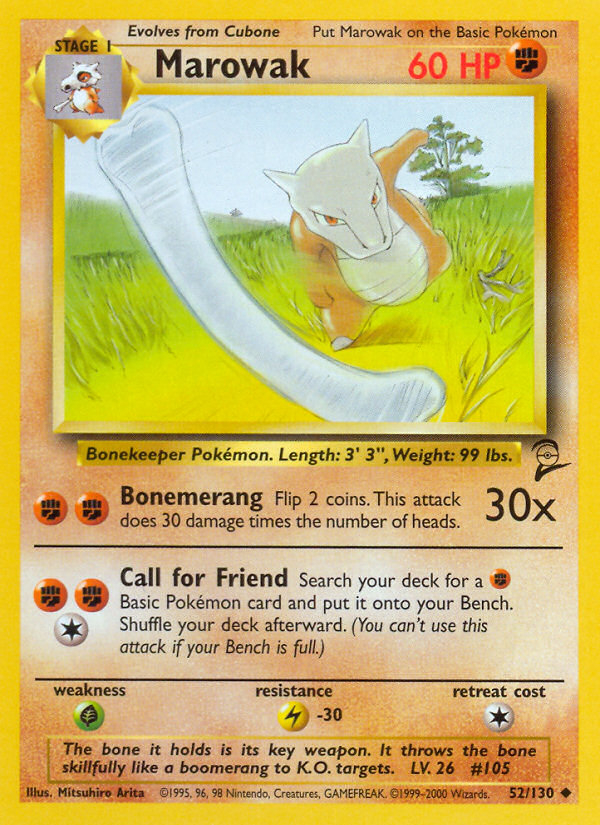
Our subject is Marowak, a Fighting-type Stage 1 evolved from Cubone, with a modest 60 HP and two distinct attacks. The first, Bonemerang, costs two Fighting energy and delivers 30 damage multiplied by the number of heads from flipping two coins. The second, Call for Friend, accelerates deck thinning by letting you search for a Fighting Basic Pokémon to the Bench, provided you have room. This combination—simple, probabilistic damage and a bench-front-loaded fetch—offers both a playable tempo and a nostalgic, archetypal feel that resonates with older-format players. The art, crisply rendered by Mitsuhiro Arita on Base Set 2, reinforces the card’s enduring appeal for collectors who prize not just power but provenance. 🔥
When we talk about predicting a Pokémon card’s future with ML, we’re really forecasting two intertwined trajectories: gameplay viability and market value. The model ingests features like rarity (Marowak is Uncommon), HP, evolution path, stage, and the specific attack costs and effects. It also leverages external signals—set reprints, rotations, and broader market conditions. For Marowak, the Base Set 2 era gives a compact, well-defined feature set: an Uncommon Fighting-type, a stage-1 evolution from Cubone, a humble HP of 60, and two attacks with distinctly different risk/reward profiles. The model can learn how these elements historically correlate with reprint cycles, price movements, and demand shifts across collector communities. 💎
From a gameplay perspective, Bonemerang’s two-coin mechanic is a probabilistic engine. The two coins yield four equally likely outcomes: HH, HT, TH, TT. The damage results—60, 30, 30, or 0 respectively—translate into an expected value of 30 damage per activation. ML dashboards often translate this into an efficiency score relative to metagame pace and opponent strategies in vintage or casual formats. Call for Friend adds a practical recursive element: fetch a Fighting Basic Pokémon to the Bench, which can fuel flexible turn pipelines but is constrained by bench space. In model terms, these mechanics become feature-engine correlated signals: damage potential, risk of overextension, and the tempo of your board state. The model may project that in formats where bench space is abundant and search is powerful, Marowak’s utility slightly edges upward, even if its raw DPS isn’t sky-high. ⚡
Market data embedded in the card’s history helps the model triangulate value trajectories. In recent snapshots, the Marowak card shows an average price in the vicinity of €1.49 on CardMarket, with a low around €0.10 and a high near €8.90. On TCGPlayer, the USD range spans from roughly $0.20 to $8.90, with a mid-price near $1.10 and a market price around $1.80. These figures hint at a nostalgia-driven baseline: affordable for casual collectors, with occasional spikes tied to reprint chatter, graded submissions, and the broader revival of old-set love. A well-tuned ML model would treat Uncommon status as a factor reducing supply pressure relative to Commons or Rares, but not eliminating demand, especially when the artwork and historical significance come into play. The model’s trend feature (reflecting recent movement) might indicate only a mild uptrend unless a new print or special edition emerges. 📈
In practice, the future-facing models for Marowak would likely explore several scenarios. A gentle, sustained growth trajectory could occur if reprint rumors circulate, if graded examples appreciate due to newer grading systems, or if the Base Set 2 niche experiences a resurgence in fan-driven set collections. A sharper uptick might happen if a modern reprint or homage product highlights the Base Set 2 era, or if a themed reprint introduces Marowak into a popular modern framework. Conversely, scarcity of reprints and the sheer volume of new sets could dampen fever for this particular card, especially if the market leans toward newer, shinier cards with higher play viability. No matter the path, the probabilistic backbone of Bonemerang—two coins, variable damage—keeps the card honest as a collectible rather than an overwhelming power spike. 🔮
“Historical price signals plus card design philosophy often weave a more resilient forecast for vintage Uncommons. Marowak sits at a confluence of nostalgia, art value, and modest in-game utility, which classic models tend to reward with a steady, if unflashy, uplift.”
From a collector’s lens, the Base Set 2 line’s stability adds credibility to a predictive narrative. Mitsuhiro Arita’s illustration remains a strong driver for high-grade submissions and signaled interest in near-mint samples. For ML, the deck-building angles—such as pairing Marowak with a Cubone lineage, sustaining basic Fighting choices, and leveraging the Call for Friend mechanic—offer a blueprint for modeling deck synergy over time. The rarity curve, combined with illustrator recognition and historical print runs, contributes to a nuanced forecast that blends market dynamics with tactile collector sentiment. In other words, the models aren’t just guessing a price—they’re inferring a story about why a card like Marowak endures in the appendices of TCG history. 🔥
For players, the evolving narrative also speaks to how Marowak could see future play sessions in specialized formats or themed collections. The card’s two-attack setup, its vulnerabilities to Grass and resilience via Lightning resistance, and its evolution path from Cubone create a compact toolkit for a creative Fighting-type deck. A ML-driven forecast would emphasize how those mechanics interact with broader meta shifts and with the ebb and flow of nostalgia-driven demand. And while the numbers provide direction, the human element—art, memory, and the joy of opening a booster—continues to steer the heart of the market. 🎴
As you scan the horizon for long-term value, keep an eye on the small but steady signals: the card’s Uncommon status, the enduring appeal of Mitsuhiro Arita’s art, and the compact, reliable utility of Marowak’s Bonemerang. The future is not only about who swings hardest in the current meta; it’s also about who preserves the stories that keep a card memorable across generations. ⚡
Interested in a stylish way to complement your Pokémon hobby? Check out the featured product below, a durable phone case that pairs modern protection with a classic vibe—perfect for fans who want a daily reminder of where their cards came from.
Beige Circle Dot Abstract Pattern Tough Phone Case Case Mate
More from our network
- https://blog.crypto-articles.xyz/blog/post/nft-data-814-from-pumppets-collection-on-magiceden/
- https://crypto-acolytes.xyz/blog/post/demonfella-ii-61-demonfella-ii-nft-stats/
- https://crypto-acolytes.xyz/blog/post/nft-stats-nft-336-from-whail-collection/
- https://blog.zero-static.xyz/blog/post/colos-yearling-inspired-custom-mtg-card-design-guide/
- https://wiki.digital-vault.xyz/wiki/post/pokemon-tcg-stats-baxcalibur-card-id-sv02-060/
Marowak
Set: Base Set 2 | Card ID: base4-52
Card Overview
- Category: Pokemon
- HP: 60
- Type: Fighting
- Stage: Stage1
- Evolves From: Cubone
- Dex ID: 105
- Rarity: Uncommon
- Regulation Mark: —
- Retreat Cost:
- Legal (Standard): No
- Legal (Expanded): No
Description
Attacks
| Name | Cost | Damage |
|---|---|---|
| Bonemerang | Fighting, Fighting | 30 |
| Call for Friend | Fighting, Fighting, Colorless |
Pricing (Cardmarket)
- Average: €1.49
- Low: €0.1
- Trend: €1.64
- 7-Day Avg: €1.06
- 30-Day Avg: €1.38
Support Our Decentralized Network
Donate 💠More from our network
- https://blog.crypto-articles.xyz/blog/post/nft-data-814-from-pumppets-collection-on-magiceden/
- https://crypto-acolytes.xyz/blog/post/demonfella-ii-61-demonfella-ii-nft-stats/
- https://crypto-acolytes.xyz/blog/post/nft-stats-nft-336-from-whail-collection/
- https://blog.zero-static.xyz/blog/post/colos-yearling-inspired-custom-mtg-card-design-guide/
- https://wiki.digital-vault.xyz/wiki/post/pokemon-tcg-stats-baxcalibur-card-id-sv02-060/