
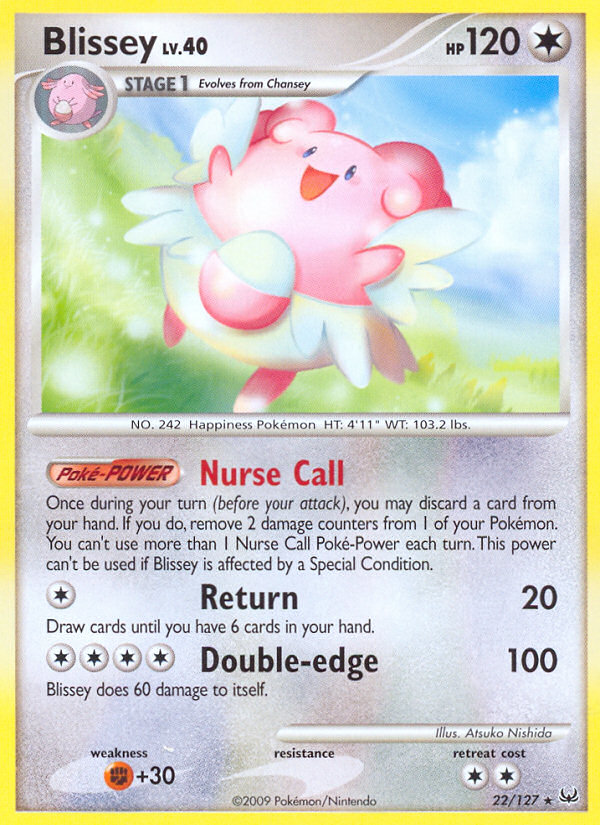
Image courtesy of TCGdex.net
What makes Blissey cards valuable in the Pokémon TCG
For many collectors and players, Blissey from the Platinum era sits at a delightful crossroads of utility, art, and nostalgia. This Stage 1 Colorless-type Pokémon evolves from Chansey and features a sturdy 120 HP, a rarity flagged as Rare, and an illustration by the beloved Atsuko Nishida. While the card’s age means it isn’t commonly tournament-legal in today’s formats, its enduring charm and historic power profile keep it perennially desirable in both collections and casual decks. The Platinum set (pl1) is famous for bridging generations, and Blissey stands out as a healer with a memorable mechanic that emphasizes hand advantage and battlefield resilience.
Two mechanics anchor Blissey’s value: the Nurse Call Poké-Power and the Return/Double-edge combination. Nurse Call reads: “Once during your turn (before your attack), you may discard a card from your hand. If you do, remove 2 damage counters from 1 of your Pokémon. You can't use more than 1 Nurse Call Poké-Power each turn. This power can't be used if Blissey is affected by a Special Condition.” This kind of utility was ahead of its time—a built-in engine for healing while you methodically draw into better options. When paired with Return, which lets you draw cards until you have six in hand, Blissey becomes a patient value engine: trade a little HP for a wealth of cards and a steadier flow of resources over several turns. The sheer flexibility of “hand-refresh” plus “heal a little” makes Blissey a favorite for mid-game tempo plays in its era, and a nostalgic reminder of how early 2000s TCG design rewarded tactical patience.
Blissey’s attack suite reinforces its role as a definitive tanker. Return, a single-colorless energy attack, draws your hand to six cards, ensuring your next turns aren’t stranded in a clutch of useless draws. The more ambitious Double-edge costs four Colorless energy and delivers a hefty 100 damage, but at the cost of your Blissey taking 60 damage in return. That self-damage mechanic mirrors Blissey’s lore: a potent healer who must guard against overexertion. In practice, the risk-reward dynamic teaches players to pace Blissey’s evolution with backing Pokémon and to time heals with nurse counters rather than going all-in on pure aggression. The card’s weakness, Fighting, with a +30 modifier, adds a cautionary note against certain archetypes that dominated the era’s metagame.
Aesthetically, this Blissey is a prize piece for art lovers. Atsuko Nishida’s illustration captures Blissey’s warm, nurturing nature—soft lines, cheerful eyes, and a sense of gentle power that aligns with the Pokémon’s in-game role as a caregiver. The Platinum set itself has a distinct early-2000s vibe, and Blissey’s design sits comfortably among other beloved Generation II staples. For many collectors, the card’s rare status is bolstered by the fact that it’s a non-holo common-to-rare lineage printed during a transitional period in the TCG’s evolution. If you’re hunting for a display-worthy piece, Nishida’s art paired with Blissey’s healer persona makes a compelling case for a dedicated slot in any gallery of classic cards.
“Platinum-era Blissey proves that healers can be as strategic as attackers—it's all about controlling the pace of the game and keeping your options open.” ⚡
From a market perspective, Blissey from Platinum shows a nuanced value profile. The card’s base non-holo print sits at modest levels in modern markets, while authentic reverse-holo variants tend to command noticeably higher attention. Data from CardMarket (updated late 2025) shows an average around EUR 0.81 for non-holo copies, with occasional fluctuation that reflects broader interest in older sets. If you’re chasing a holo or reverse-holo presentation, prices rise—reverse-holo copies have shown averages around EUR 3.31 to EUR 7.00 in peak listings, with market values often nudging upward when nostalgia or set completeness are the focus. Meanwhile, TCGPlayer’s non-holo range sits roughly between USD 1.49 and USD 3.82 depending on condition and specific print, with reverse-holo options typically averaging higher at around USD 3.31–7.00 in peak markets. Those figures underscore a simple truth: condition, variant (non-holo versus reverse holo), and set provenance all tilt value in meaningful ways. In a hobby where “rare” often translates to “scarcity,” Blissey’s Platinum card remains a durable anchor for both wallets and display cases. 🔎💎
For collectors, awareness of print variations matters. The Platinum card bl1-22 shows detailed evolution metadata: the card is a Stage 1, evolves from Chansey, and sits in the Platinum set with a specific official count (127 cards officially, 133 total across all printings). Its illustrator is confirmed as Atsuko Nishida, preserving the integrity of the artwork credit that many collectors prize as part of a card’s identity. The card’s legality note—stamped as not currently standard-legal or expanded-legal—doesn’t dampen its appeal; it adds to the aura of a rare, time-capsule piece that players and collectors alike chase for the complete collection and for the stories that surround early-2000s play styles.
For players looking to build a Blissey-centered strategy today, it’s essential to recognize how these cards age in the meta. The combination of Nurse Call and Return emphasizes a tempo approach that rewards patient play and careful hand management. The 120 HP pool provides a solid frontline for mid-game healing, and the 2 Retreat Cost keeps Blissey at a comfortable but not overwhelming mobility level. Its Fighting-type weakness remains a caveat against some popular attackers from the era’s best decks, but that risk is a familiar companion to any classic healer archetype. In short, the value of this Blissey isn’t just about its numerical attack power; it’s about the web of strategic choices it invites—heal, draw, and trade carefully to outlast opponents who push for quick, heavy damage. 🎴🎨
If you’re curious where to start price-conscious collecting, keep an eye on those reverse-holo listings and condition reports. The data hints that while non-holo copies are approachable, the reverse-holo variants carry a premium, particularly as collectors seek a complete Platinum-era display. Pairing Blissey with its Chansey predecessor in a binder set can create a compelling narrative arc—one about care, resilience, and the evolution of a beloved healer through the generations. And if you’re a player who appreciates a strategic puzzle, Blissey remains a memorable reminder of how healing and hand-management once coalesced into a distinctive, game-changing engine. 🔥💎
Product spotlight
Curious how Blissey’s value translates into modern collectibles and accessories? This article sits alongside curated gear and gear-inspired finds, including a practical, modern accessory at the bottom of the page. The product below demonstrates how tech meets collection culture—an everyday item that supports a Pokémon lifestyle while you curate or play.
Phone Case with Card Holder MagSafeMore from our network
- https://area-53.zero-static.xyz/6227b3fd.html
- https://transparent-paper.shop/blog/post/stable-diffusion-xl-prompt-dark-fantasy-gothic-cyberpunk-matrix-green-aluminum-metallic-vinyl-gloss-texture-high-contrast-lighting-epic-poster-art/
- https://crypto-acolytes.xyz/blog/post/solidskulls-1335-solidskulls-nft-stats/
- https://crypto-acolytes.xyz/blog/post/nft-stats-gorbagio-1938-from-gorbagio-collection/
- https://crypto-acolytes.xyz/blog/post/nft-stats-rock1275-from-sol-rocks-collection/
Blissey
Set: Platinum | Card ID: pl1-22
Card Overview
- Category: Pokemon
- HP: 120
- Type: Colorless
- Stage: Stage1
- Evolves From: Chansey
- Dex ID: 242
- Rarity: Rare
- Regulation Mark: —
- Retreat Cost: 2
- Legal (Standard): No
- Legal (Expanded): No
Description
Abilities
-
Nurse Call — Poke-POWER
Once during your turn (before your attack), you may discard a card from your hand. If you do, remove 2 damage counters from 1 of your Pokémon. You can't use more than 1 Nurse Call Poké-Power each turn. This power can't be used if Blissey is affected by a Special Condition.
Attacks
| Name | Cost | Damage |
|---|---|---|
| Return | Colorless | 20 |
| Double-edge | Colorless, Colorless, Colorless, Colorless | 100 |
Pricing (Cardmarket)
- Average: €0.81
- Low: €0.1
- Trend: €1.17
- 7-Day Avg: €0.82
- 30-Day Avg: €1.06
Support Our Decentralized Network
Donate 💠More from our network
- https://area-53.zero-static.xyz/6227b3fd.html
- https://transparent-paper.shop/blog/post/stable-diffusion-xl-prompt-dark-fantasy-gothic-cyberpunk-matrix-green-aluminum-metallic-vinyl-gloss-texture-high-contrast-lighting-epic-poster-art/
- https://crypto-acolytes.xyz/blog/post/solidskulls-1335-solidskulls-nft-stats/
- https://crypto-acolytes.xyz/blog/post/nft-stats-gorbagio-1938-from-gorbagio-collection/
- https://crypto-acolytes.xyz/blog/post/nft-stats-rock1275-from-sol-rocks-collection/