
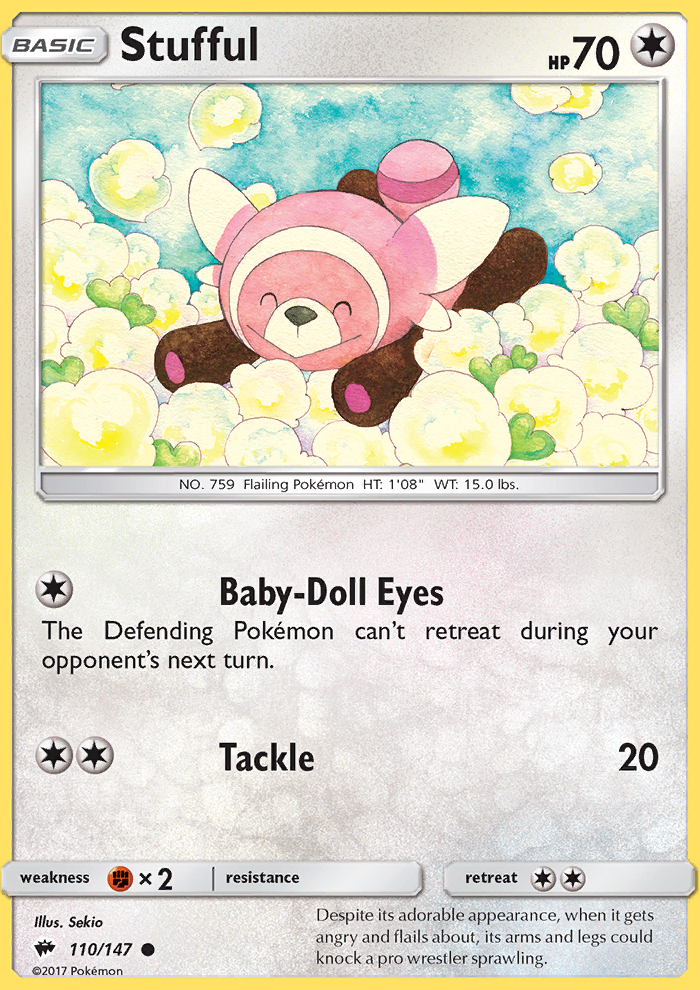
Image courtesy of TCGdex.net
What makes Japanese printings visually distinct, especially with Stufful from Burning Shadows
For long-time Pokémon TCG fans, the question “why do Japanese printings look different across printings?” is part of the charm of collecting. The Stufful from the Burning Shadows set (SM3) offers a perfect microcosm of the phenomenon. This unassuming Colorless Basic with 70 HP may look the same at a glance, but its visuals shift subtly—and sometimes decisively—between normal, holo, and reverse-holo printings, with additional nuance when Japanese printers step into the lineup.
In the Burning Shadows era, Stufful’s card imagery remained faithful to Sekio’s playful, teddy-bear energy. Yet the foil treatment, border polish, and even the text box sheen can change how the card feels in your hand. The modern Pokémon TCG uses a variety of print runs within a single set: standard (normal) cards, holofoil variants, and reverse-holo variants. The Stufful you see as SM3-110 in non-holo form emphasizes a clean, print-accurate portrayal of the art, while the holo version adds a shimmering, reflective layer that can catch the light and make the little cub pop against the dark, textured backdrop of the Burning Shadows palette. The reverse-holo versions flip that idea: the foil effect appears in the card’s background around the art and name, giving the same image a distinctly different “feel” on the table. This isn’t just cosmetic; collectors often find the holo and reverse-holo versions to be more visually striking, which can impact display decisions and perceived value in hand-collection setups. ⚡
A note on the Stufful card in this particular print run
Stufful in Burning Shadows is a Basic Colorless-type Pokémon with 70 HP. Its two attacks—Baby-Doll Eyes (which prevents the Defending Pokémon from retreating on your opponent’s next turn) and Tackle for 20 damage—form a simple, friendly toolkit that fits the set’s mid-range power curve. The card’s illustrator, Sekio, brings a soft, endearing aesthetic that aligns with Stufful’s personality: a little tough on the outside, a big-hearted backup friend on the inside. The card’s weakness to Fighting ×2 and its Retreat Cost of 2 shape how players consider it in decks that lean on speed and disruption, versus those that rely on sturdy front-line pressure. The fact that the set code is SM3 reinforces the Burning Shadows era’s distinct visual language, even as the English and Japanese releases share core artwork and mechanics. 🔥
From a printing-variation standpoint, this Stufful exists in several flavors within the same print run: normal (the unadorned card), holo (the world around the art gleams with foil), and reverse holo (foil on the card’s non-art areas, often including the card name). Each version requires different production steps and foil patterns, which is where the visual divergence begins. While the art by Sekio remains constant, the foil’s texture, the way light plays across the surface, and the subtle border shimmer can drastically alter how a card looks under glass or in a binder sleeve. These differences are more than cosmetic—they’re part of what collectors chase: a tactile memory of where and when a card was printed. 💎
Why the differences matter to gameplay and display
Beyond aesthetics, print variations can influence how a card sits in a collection or on a battlefield. The holo and reverse-holo variants can make a Stufful stand out in a sea of green and red borders, which is helpful for quick identification during a casual game night. In terms of strategy, the Stufful’s Baby-Doll Eyes and Tackle remain the same across printings, but how you present the card matters when you’re building displayable decks or shelf displays. The visual flavor—foil sheen on a basic Pokémon—also hints at the era’s broader design philosophy: even humble commons carry a certain sparkle, inviting players to appreciate the card as both a tool for play and a collectible piece of art. 🎨
For collectors who like to assess value at a glance, the price anchors for Stufful pull from two markets. CardMarket’s data shows the non-holo average around a few cents to a few tenths of a euro, while the holo versions trend higher, reflecting both foil rarity and collector demand. The reverse holo tends to sit somewhere between the two—foil on the non-art areas catching the eye and sometimes driving a premium in the right lot. Keeping an eye on these numbers helps explain why a single card can look dramatically different in your binder depending on which printing you favor. 📈
Display, care, and authenticity tips
When you pull a Stufful from Burning Shadows, consider how you’ll display it. A standard non-holo card sits nicely in a traditional sleeve and standard binder page. A holo or reverse-holo, on the other hand, rewards a slightly more protective approach—foil is more susceptible to micro-scratches if the sleeve isn’t snug, so a top-loader or semi-rigid sleeve is a good idea. For authenticity, verify the set symbol and the card number (SM3-110 for this specific Stufful) and note that the Japanese printings may differ slightly in foil pattern or text alignment compared to English versions. The best way to learn is to compare side-by-side with a trusted reference, like the high-resolution scans hosted by TCGdex and related databases. This Stufful illustrates how even a common card can reveal a story about printing techniques, regional variation, and collector psychology. 🔎
Neon MagSafe Phone Case with Card HolderMore from our network
- https://blog.rusty-articles.xyz/blog/post/blizzard-teams-unionize-across-hearthstone-and-warcraft-rumble/
- https://articles.zero-static.xyz/blog/post/street-fighter-ii-photo-mode-showcase-retro-screenshots/
- https://blog.rusty-articles.xyz/blog/post/their-number-is-legion-mtg-forums-react-to-the-card/
- https://blog.crypto-articles.xyz/blog/post/nft-data-bpw-647-from-bonk-puppets-collection-on-magiceden/
- https://crypto-acolytes.xyz/blog/post/nft-stats-children-of-cope-137-from-children-of-cope-collection/
Stufful
Set: Burning Shadows | Card ID: sm3-110
Card Overview
- Category: Pokemon
- HP: 70
- Type: Colorless
- Stage: Basic
- Dex ID: 759
- Rarity: Common
- Regulation Mark: —
- Retreat Cost: 2
- Legal (Standard): No
- Legal (Expanded): Yes
Description
Attacks
| Name | Cost | Damage |
|---|---|---|
| Baby-Doll Eyes | Colorless | |
| Tackle | Colorless, Colorless | 20 |
Pricing (Cardmarket)
- Average: €0.06
- Low: €0.02
- Trend: €0.05
- 7-Day Avg: €0.07
- 30-Day Avg: €0.07
Support Our Decentralized Network
Donate 💠More from our network
- https://blog.rusty-articles.xyz/blog/post/blizzard-teams-unionize-across-hearthstone-and-warcraft-rumble/
- https://articles.zero-static.xyz/blog/post/street-fighter-ii-photo-mode-showcase-retro-screenshots/
- https://blog.rusty-articles.xyz/blog/post/their-number-is-legion-mtg-forums-react-to-the-card/
- https://blog.crypto-articles.xyz/blog/post/nft-data-bpw-647-from-bonk-puppets-collection-on-magiceden/
- https://crypto-acolytes.xyz/blog/post/nft-stats-children-of-cope-137-from-children-of-cope-collection/