
Image courtesy of TCGdex.net
Tempo in Pokémon TCG: How Machamp Helps You Control the Battle Pace
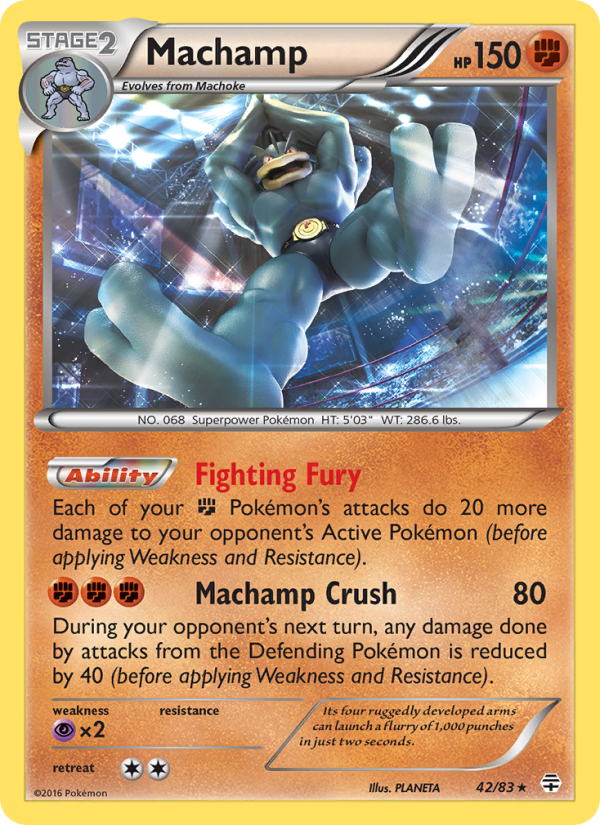
In the Pokémon Trading Card Game, tempo is a shopper’s guide to momentum. It isn’t just about who hits harder on a single turn; it’s about who structures the game so that every incoming attack lands with maximum pressure while your opponent scrambles to stabilize. In Generations, the rare fighting powerhouse Machamp stands as a textbook example of tempo manipulation. With 150 HP and a dual-pronged toolkit, this Stage 2 brawler, illustrated by PLANETA, teaches players to think three turns ahead—how many Energy you’ve committed, which Pokémon remain primed on the bench, and how you’ll weather the swing-back from a determined opponent. ⚡🎴
At the heart of Machamp’s tempo play are two core elements: a constant damage boost for all Fighting attacks and a strategic defensive bend on the opponent’s retaliation. The ability, Fighting Fury, makes every Fighting Pokémon in play deliver 20 more damage to the opponent’s Active Pokémon. That incremental boost compounds quickly as you chain attacks with other Fighting Pokémon, turning ordinary blows into a crescendo of offense. In practical terms, this means you’re buying tempo not with big one-turn nukes, but with reliable, scalable pressure that compounds as the game unfolds. When your board fills with Fighting energy and a growing bench, your damage ceiling rises with each turn—an edge that pushes your opponent into tighter decision-making. 🔥
Machamp’s attack, Machamp Crush, is equally tempo-conscious. For three Fighting Energy, you deal 80 damage and, crucially, you impose a powerful proactive tempo swing: during your opponent’s next turn, any damage dealt by the Defending Pokémon’s attacks is reduced by 40 before weakness and resistance. That means you’re not just trading blows—you’re dictating when and how risk transfers to your opponent. In practice, you can absorb retaliation and survive longer on the board while steadily pressuring the Defending Pokémon. The combination of +20 damage from Fighting Fury and the next-turn damage reduction created by Machamp Crush makes this card a tempo engine: it accelerates your aggression while dulling your opponent’s immediate response. 🪙💥
Card Snapshot: How the numbers and timing matter
- Name: Machamp
- Stage: Stage 2 (Evolves from Machoke)
- HP: 150
- Type: Fighting
- Rarity: Rare
- Set: Generations (g1)
- Illustrator: PLANETA
- Weakness: Psychic ×2
- Retreat Cost: 2
- Attacks: Machamp Crush — 80 damage; three Fighting Energies; effect: during your opponent’s next turn, any damage done by attacks from the Defending Pokémon is reduced by 40 (before applying Weakness and Resistance).
- Ability: Fighting Fury — “Each of your Fighting Pokémon's attacks do 20 more damage to your opponent's Active Pokémon (before applying Weakness and Resistance).”
The Generations artwork, a vivid reminder of early-XY-era reprints, captures Machamp’s stoic presence on the battlefield. PLANETA’s illustration brings a sense of weight and grit to a card that’s all about control and tempo. For collectors, the holo variant in this set is a desirable piece, not only for the art but for the nostalgia it evokes—a reminder of the era when big Fighting types could swing games with calculated, multistep sequences. 🎨💎
Strategic play: building tempo with Machamp in mind
To leverage Machamp’s tempo engine, you want to optimize the timing of your evolutions and the energy you commit. Because Machamp Crush requires three Fighting Energies, you’ll often want a plan to accelerate energy onto your board while protecting your development on the bench. A steady tempo deck might prioritize Machoke’s evolution window so Machamp hits around the mid-game, when the opponent’s options become most constrained. The +20 damage aura from Fighting Fury synergizes especially well with other Fighting Pokémon on the bench or in play, allowing a broader board-wide pressure without tipping your hand too early.
Retreat cost 2 invites mindful bench management. You don’t want to pay to retreat Machamp at the wrong moment, only to see your attacker get knocked out and your tempo engine stall. Instead, you’ll aim to maintain a resilient front line, where Machamp’s presence signals consistent threat, while other Fighting Pokémon add speed and finisher potential. In practice, you’ll be balancing energy ramp, threat application, and defensive resilience—turning Machamp’s two-layer toolkit into a reliable battlefield rhythm. ⚡🎯
In terms of matchups, the Psychic weakness is a genuine consideration. In formats where Psychic types are prevalent, Machamp’s staying power is tested, requiring careful target selection and energy allocation to avoid unfavorable exchanges. The reliance on three Fighting Energies also means you’ll want to plan your energy draw and board setup to avoid getting stalled by early KO trades. A well-timed Machamp Crush can buy crucial turns, letting you drag out the game at your pace while your opponent scrambles to disrupt your flow. 🔎🔥
Collector insights: rarity, art, and value trends
As a Rare card printed in Generations, Machamp carries a certain collectible weight. The Generations set revisited familiar faces, and Machamp’s holo variant remains a sought-after piece for players who appreciate the synergy of tempo and power. Pricing has shown a typical spectrum for holo Fighting rares: Cardmarket data points to an average around the 2 EUR mark for non-holo copies, with holo variants often trending higher (roughly in the 5–6 EUR ballpark on average, depending on condition and market). For TCGeography, the holo variant has been observed with mid prices around the low-to-mid range of USD or EUR, with peaks that spike based on demand and packaging in collections. The key takeaway for collectors is that clean, well-centered holo copies—especially with the PLANETA art—hold enduring appeal beyond raw play value. 🧩💎
From a player’s perspective, Machamp’s unique tempo toolkit means it remains relevant in discussions about deck pacing and multi-Pokémon pressure lines. The card’s specialty is not simply dealing big numbers; it’s about shaping the pace of the game so that your opponent’s options narrow while your own board grows more threatening each turn. In a modern collector’s sense, that narrative—combining art, rarity, and a memorable play pattern—adds to the card’s allure, whether you’re chasing a competitive build or a cherished display piece. 🎴⚡
Slim Glossy Phone Case for iPhone 16 — Lexan PolycarbonateMore from our network
- https://blog.crypto-articles.xyz/blog/post/nft-data-fantasy-mermaid-girl-7-from-tasshub-vip-access-collection-on-magiceden/
- https://crypto-articles.xyz/tmpq9ktwc6d/8b943f66.html
- https://blog.zero-static.xyz/blog/post/howling-fury-reprints-tracking-mtg-price-cycles-and-collector-demand/
- https://wiki.digital-vault.xyz/wiki/post/pokemon-tcg-stats-brocks-grit-card-id-sm9-172/
- https://wiki.digital-vault.xyz/wiki/post/pokemon-tcg-stats-nuzleaf-card-id-swsh7-96/
Machamp
Set: Generations | Card ID: g1-42
Card Overview
- Category: Pokemon
- HP: 150
- Type: Fighting
- Stage: Stage2
- Evolves From: Machoke
- Dex ID: 68
- Rarity: Rare
- Regulation Mark: —
- Retreat Cost: 2
- Legal (Standard): No
- Legal (Expanded): Yes
Description
Abilities
-
Fighting Fury — Ability
Each of your Fighting Pokémon's attacks do 20 more damage to your opponent's Active Pokémon (before applying Weakness and Resistance).
Attacks
| Name | Cost | Damage |
|---|---|---|
| Machamp Crush | Fighting, Fighting, Fighting | 80 |
Pricing (Cardmarket)
- Average: €1.99
- Low: €0.79
- Trend: €2.64
- 7-Day Avg: €2.82
- 30-Day Avg: €2.45
Support Our Decentralized Network
Donate 💠More from our network
- https://blog.crypto-articles.xyz/blog/post/nft-data-fantasy-mermaid-girl-7-from-tasshub-vip-access-collection-on-magiceden/
- https://crypto-articles.xyz/tmpq9ktwc6d/8b943f66.html
- https://blog.zero-static.xyz/blog/post/howling-fury-reprints-tracking-mtg-price-cycles-and-collector-demand/
- https://wiki.digital-vault.xyz/wiki/post/pokemon-tcg-stats-brocks-grit-card-id-sm9-172/
- https://wiki.digital-vault.xyz/wiki/post/pokemon-tcg-stats-nuzleaf-card-id-swsh7-96/