
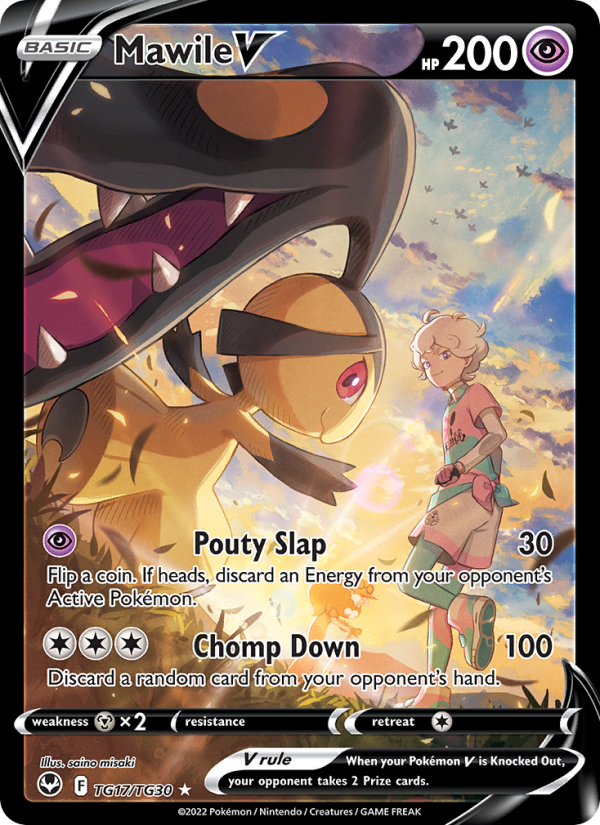
Image courtesy of TCGdex.net
PSA vs BGS: Why Mawile V Grading Values Don’t Always Align
For modern Pokémon TCG collectors, a Mawile V from Silver Tempest is more than a pretty holo-foil. It’s a data point in a larger conversation about grading, pricing, and the ways two of the most trusted grading services evaluate the same card. PSA and Beckett Grading Services (BGS) both aim to separate the rare specimens from the ordinary, but they do so using different scales, different emphases, and different ways of communicating a card’s condition. That divergence is precisely what makes Mawile V an instructive case study for players and collectors alike ⚡.
PSA uses a straightforward 1–10 scale for the overall grade, with the final number chosen after assessing four major criteria—centering, edges, corners, and surface. Each factor contributes to the final score, but the interpretation is consolidated into a single grade that most of the market instantly recognizes. In contrast, BGS layers the evaluation: four independent subgrades (Centering, Edges, Corners, Surface), each rated 1–10, and then an overall grade (still 1–10) is assigned based on those subgrades. That means BGS slabs carry visible subscore detail—the kind of nuance that helps collectors diagnose exactly where a card shines or falters. The result? A BGS 9.5 with 9/9.5 subgrades may look different on the slab than a PSA 9 or PSA 10, and that difference matters when the market prices the two slabs side by side.
In practical terms, those structural differences show up in how a Mawile V is valued. This card—Silver Tempest’s Mawile V (swsh12-TG17)—is a holo-rare V Basic Psychic with a hefty 200 HP, featuring a pair of attacks: Pouty Slap for 30, and Chomp Down for 100 that disrupts your opponent by discarding a random card from their hand. It’s legal in Expanded, not Standard, and carries the Regulation Mark “F.” The holo foil surface, the card’s centering, and the integrity of the holographic sheen all feed into both grading outcomes and market pricing. For a card with a dynamic foil, subtle foil blemishes or edge nicks can push a grade differently on PSA versus BGS, even when the naked eye sees a card that’s quite sharp in person. The art direction and the Silver Tempest era’s card-stock choices add another layer: a modern holo card can be especially finicky about surface and gloss variance, which BGS tends to quantify with their Surface subgrade while PSA weighs the overall impression more holistically.
How each service weighs the Mawile V’s strengths
- PSA: Emphasizes a clean, market-ready appearance in a single grade. If the centering is excellent, edges and corners are sharp, and the surface shows minimal or no flaws, PSA 10 is within reach. If any of those areas dip even slightly, the grade may settle at 9 or lower, which can still fetch solid value depending on demand and the card’s visibility in the market.
- BGS: Breaks the card down into four aspects and then prints an overall grade. A Mawile V that is nearly flawless might earn subgrades like Centering 9.5, Edges 9.5, Corners 9.5, Surface 9.5, culminating in a strong composite like BGS 9.5 with high subgrades. A single flaw in Surface or Centering can pull the overall grade down, even if the card is otherwise pristine. On the other hand, a BGS 10 with uniformly high subgrades can command premium in specific collector circles.
Market observers note that PSA 10s of modern staples often carry broad appeal and liquidity, while BGS slabs with high subgrades are particularly prized by users who value the transparency of the subgrade data. In some cases, a BGS 9.5 can outsell a PSA 9 because buyers prize the granular detail; in others, a pristine PSA 10 edges ahead due to broad market familiarity. The Mawile V card illustrates this dynamic: while the card’s own value is anchored in its rarity and playability within decks, grading value can swing with the slab’s story as much as with the card itself 🚀.
What makes Mawile V a telling case study
The Mawile V from Silver Tempest embodies several live-market realities. It’s a modern V-card with a high HP total that appeals to both collectors and deck builders, and it’s printed in a holo form that can be unforgiving to surface wear. The card’s legality status—Expanded only—also informs collector demand, as some players chase cards that remain widely usable in competitive formats. For graders, the holo surface presents challenges not just in color consistency but in surface texture and potential micro-scratches that are invisible to casual observers but measurable by professional graders. The card’s value therefore becomes a negotiation between the card’s inherent desirability and the slab’s storytelling—how the grade communicates both the card’s physical condition and its marketability.
Illustrator credits, a factor some fans track, aren’t included in the data provided here. For this Mawile V print, the exact illustrator can vary by release press and printing batch. That gap doesn’t change a card’s gameplay or condition, but it does influence collector conversations and value perception among those who prize artistic attribution as part of their collection. The important takeaway is that precise grading results interact with broader market cues—pop reports, supply, and demand curves for modern holo V cards in Expanded—in shaping value.
Maximizing value as a Mawile V collector or dealer
- Handle with care: holo surfaces are sensitive to fingerprints and micro-scratches. Store in protective sleeves and within a rigid top loader to preserve surface integrity.
- Centering matters: the closer a Mawile V sits to perfect centering, the more likely it is to achieve a top-tier PSA or BGS grade. For PSA, expect a 10 only with near-perfect centering and surface; for BGS, a few hairline factors could still yield a gem with favorable subgrades.
- Assess the edges and corners under good lighting: even minor edge whitening or corner concerns can tip a subgrade. In BGS, that could meaningfully affect the overall grade due to the four-subgrade model.
- Consider market readiness: because expanded legality matters, buyers evaluating PSA vs BGS can differ in their preferred grading partner. If you’re aiming for broad resale, PSA 10 often delivers the quickest liquidity; if you’re targeting niche markets, a high BGS subgrade set may fetch a premium.
- Document and authenticate: keep purchase receipts and any grading submission details. This helps buyers trust the condition narrative when slabs change hands.
For the curious, the Mawile V’s numeric profile—200 HP, Psychic type, Basic stage, the health of its holo surface, and its two attacks—serves as a crisp reminder that modern cards can offer big upside with careful grading. The Pouty Slap and Chomp Down moves are fun to reference in deck-building conversations, but in grading terms, it’s the card’s physical fidelity and presentation that drive value when PSA and BGS offer different readings of the same print. And as collectors know, those readings can be as dynamic as a Nuzleaf’s decision in a late-game moment 💎.
Want to explore Mawile V further or secure this exact print in a graded slab? The product below offers a contemporary way to display your passion for Pokémon TCG lore and strategy—and it pairs nicely with the idea of premium presentation and care for your collection.
Phone Stand Desk Decor Travel Smartphone Display StandMore from our network
- https://crypto-acolytes.xyz/blog/post/nft-stats-gib-3220-from-gib-collection/
- https://wiki.digital-vault.xyz/wiki/post/pokemon-tcg-stats-warp-point-card-id-ex14-84/
- https://crypto-acolytes.xyz/blog/post/nft-stats-non-fungible-token-975-from-non-fungible-tokens-collection/
- https://blog.crypto-articles.xyz/blog/post/nft-data-hero-994-from-soul-gate-heroes-collection-on-magiceden/
- https://crypto-articles.xyz/blog/post/pfp-391-pumpfun-pepe-nft-stats/
Mawile V
Set: Silver Tempest | Card ID: swsh12-TG17
Card Overview
- Category: Pokemon
- HP: 200
- Type: Psychic
- Stage: Basic
- Dex ID: 303
- Rarity: Holo Rare V
- Regulation Mark: F
- Retreat Cost: 1
- Legal (Standard): No
- Legal (Expanded): Yes
Description
Attacks
| Name | Cost | Damage |
|---|---|---|
| Pouty Slap | Psychic | 30 |
| Chomp Down | Colorless, Colorless, Colorless | 100 |
Pricing (Cardmarket)
- Average: €0.7
- Low: €0.08
- Trend: €0.76
- 7-Day Avg: €0.69
- 30-Day Avg: €0.65
Support Our Decentralized Network
Donate 💠More from our network
- https://crypto-acolytes.xyz/blog/post/nft-stats-gib-3220-from-gib-collection/
- https://wiki.digital-vault.xyz/wiki/post/pokemon-tcg-stats-warp-point-card-id-ex14-84/
- https://crypto-acolytes.xyz/blog/post/nft-stats-non-fungible-token-975-from-non-fungible-tokens-collection/
- https://blog.crypto-articles.xyz/blog/post/nft-data-hero-994-from-soul-gate-heroes-collection-on-magiceden/
- https://crypto-acolytes.xyz/blog/post/pfp-391-pumpfun-pepe-nft-stats/