
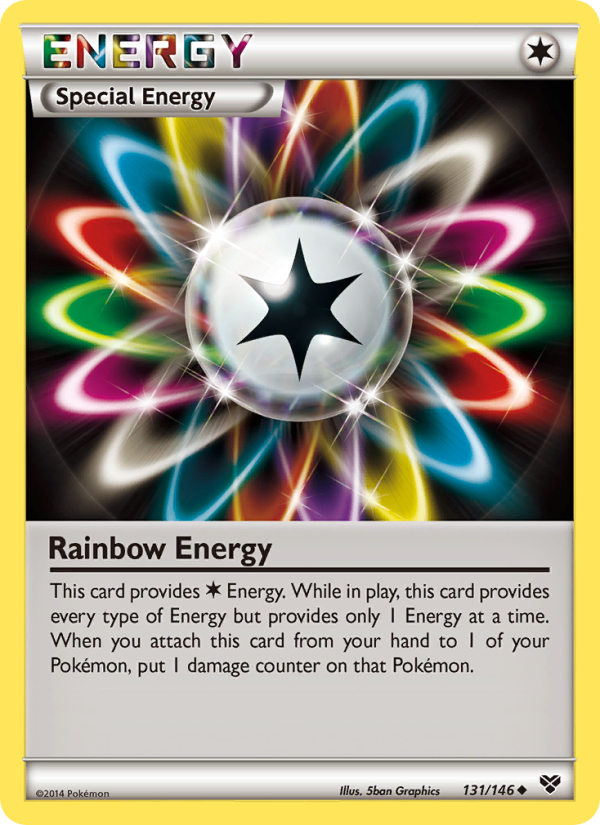
Image courtesy of TCGdex.net
Why Rainbow Energy Reprints Change Its Market Value ⚡
Rainbow Energy sits at a fascinating crossroads in the Pokémon TCG economy. It is not a straightforward attacker or a powerhouse trainer card; instead, it is a strategic tool—a Special Energy that can power every type of Energy while staying singular in its energy production. In gameplay, this means you can attach Rainbow Energy from your hand and bend the energy universe to your deck’s needs, but you pay a price: the card grants only 1 Energy at a time and places a damage counter on the attached Pokémon when you do. In collectible terms, these dual natures—versatility in play and a distinct drawback—combine with reprints to shape how much collectors and players are willing to pay over time. This article dives into how reprints have historically influenced Rainbow Energy’s price and what you can expect in the current market. Rainbow Energy belongs to the XY era, identified as XY1 with a holo variant among its print lines. The card’s rarity is Uncommon, and its artwork is credited to 5ban Graphics. This card’s evolution status is straightforward: it doesn’t evolve from or into other Pokémon; its power comes from its energy utility and the strategic niches it fills in decks that rely on Colorless energy flexibility. For players, this means Rainbow Energy can slot into a wide array of decks that value energy type flexibility, particularly in Expanded format where older Energy cards remain usable alongside modern staples. For collectors, the holo and reverse-holo variants offer a visual appeal that often commands a premium relative to the standard print, and reprints can ripple through both variants differently. The core driver behind reprint-driven price shifts is supply. When a card reappears in new sets, printed copies flood the market—sometimes temporarily—while demand from players and collectors may rise or stay steady depending on how the card remains relevant in current decks. Rainbow Energy’s price profile illustrates this dynamic clearly. On CardMarket, Rainbow Energy tends to hover around a modest range with an average in the neighborhood of 0.25 EUR for standard copies, accompanied by a low watermark near 0.03 EUR and a positive trend around 0.49. The holo variant, when available, tends to sit higher, with average holo pricing around 1.66 EUR and a broader spread (low ~0.45 EUR to a higher end around 1.24 EUR in the trend). This suggests that reprints can compress the floor for ordinary copies while keeping the premium for holo copies alive due to collector demand and display value. Meanwhile, on TCGPlayer, Rainbow Energy shows a similar story from a different market perspective. The standard (non-reverse) Rainbow Energy lists a low around 0.2 USD, a mid around 0.41 USD, and a high around 3 USD, with market pricing near 0.39 USD. The reverse-holofoil version pushes higher, with a mid price around 0.88 USD and a market price around 1.24 USD, reflecting both rarity and the allure of foil finishes among collectors. These figures reveal a consistent pattern: reprints can depress or stabilize the base price for common versions, while foil variants maintain or widen their premium, particularly in markets where nostalgia and display value drive collector interest. What does this mean for you as a player or a collector? First, reprints tend to lower entry barriers for new players, expanding access to Rainbow Energy as a deck-building tool. For price-sensitive buyers, this is good news—more copies in circulation typically means you can acquire Rainbow Energy for a reasonable price, especially the plain non-holo print. For collectors chasing condition and finish, holo and reverse-holo Rainbow Energy remains a buoyant niche, with prices historically sitting above standard versions and often riding the wave of reprint cycles rather than being crushed by them. The key is timing: shortly after a reprint wave, prices may dip, but as demand catches up—particularly for sealed sets or near-mint holo copies—value can stabilize or recover. From a gameplay perspective, Rainbow Energy remains a tactical option in formats where its energy flexibility matters. The card’s effect—providing Colorless Energy while enabling color-specific energy generation—continues to invite clever deck-building. In Expanded, where many retro cards stay legal, Rainbow Energy serves as a bridge that enables colorless or multi-type strategies without sacrificing a single energy source. Its drawback—involving a damage counter upon attachment—adds a risk-reward layer that advanced players exploit in carefully calibrated matchups. The evolving meta and the presence of reprints influence how often players consider Rainbow Energy in budget decks or when chasing competitive edge. Art and lore fans will appreciate the XY-era flavor. The XY set’s art direction, highlighted by 5ban Graphics, captures the playful yet strategic spirit of Rainbow Energy. While reprints keep the card accessible to new collectors, the holo and reverse-holo variants continue to be prized for their vivid foil finishes and the nostalgic callback to early XY play patterns. The interplay between rarity, condition, and the physical foil finish helps explain why holographic copies often command a price premium even as reprints broaden the card’s availability. If you’re thinking about collecting Rainbow Energy or building around it in a current Expanded roster, consider how reprints could affect your long-term plan. A prudent approach is to track both the base price and the foil premiums across multiple marketplaces to assess volatility. The data points from CardMarket and TCGPlayer illustrate a market that values accessibility on the one hand and collectability on the other—so a reprint cycle might reduce the price floor for non-foil copies while keeping foil variants appealing to collectors. Product tie-in note: while you’re exploring price dynamics and deck-building options, you can also check out the featured product linked below. It’s a stylish reminder that a thriving Pokémon lifestyle connects collectors and players with other passions—whether that’s keeping a phone safe with a sleek case like the iPhone 16 Phone Case - Slim Lexan Glossy Finish, which sits neatly alongside your TCG adventures. iPhone 16 Phone Case - Slim Lexan Glossy FinishMore from our network
- https://crypto-acolytes.xyz/blog/post/nft-stats-chill-capy-947-from-thug-capy-gang-collection/
- https://blog.crypto-articles.xyz/blog/post/nft-data-pump-punks-838-from-pump-punks-collection-on-magiceden/
- https://crypto-acolytes.xyz/blog/post/nft-stats-imperia-928-from-imperia-rome-citizens-collection/
- https://donation.digital-vault.xyz/donation/post/support-open-economics-built-on-cooperation-for-a-fairer-world/
- https://blog.rusty-articles.xyz/blog/post/how-to-use-red-banner-on-minecraft-servers/
Rainbow Energy
Set: XY | Card ID: xy1-131
Card Overview
- Category: Energy
- HP:
- Type:
- Stage:
- Dex ID:
- Rarity: Uncommon
- Regulation Mark: —
- Retreat Cost:
- Legal (Standard): No
- Legal (Expanded): Yes
Description
Pricing (Cardmarket)
- Average: €0.25
- Low: €0.03
- Trend: €0.49
- 7-Day Avg: €0.44
- 30-Day Avg: €0.44
Support Our Decentralized Network
Donate 💠More from our network
- https://crypto-acolytes.xyz/blog/post/nft-stats-chill-capy-947-from-thug-capy-gang-collection/
- https://blog.crypto-articles.xyz/blog/post/nft-data-pump-punks-838-from-pump-punks-collection-on-magiceden/
- https://crypto-acolytes.xyz/blog/post/nft-stats-imperia-928-from-imperia-rome-citizens-collection/
- https://donation.digital-vault.xyz/donation/post/support-open-economics-built-on-cooperation-for-a-fairer-world/
- https://blog.rusty-articles.xyz/blog/post/how-to-use-red-banner-on-minecraft-servers/